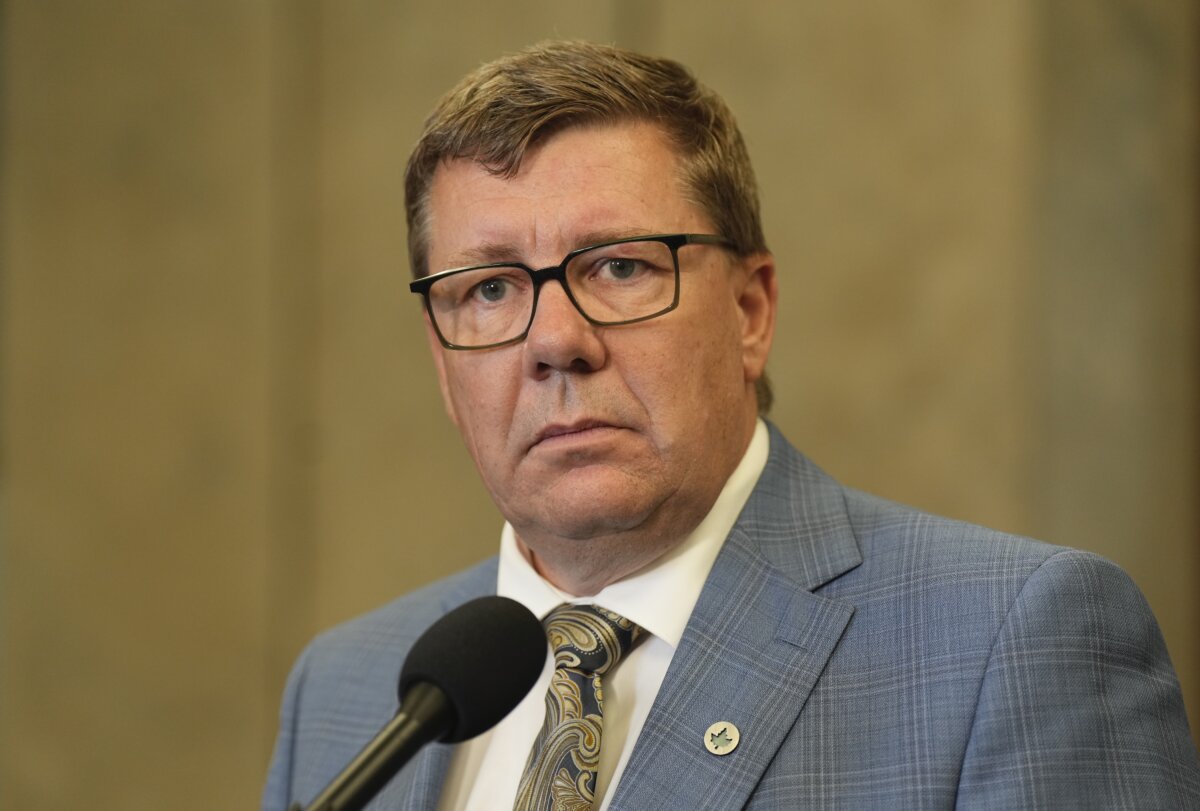

Saskatchewan Premier Scott Moe says his province is troubled by the new tariffs that India plans to impose on Canadian yellow peas.
Moe said the province took “immediate action” by urging Ottawa to quickly work toward the removal of India’s planned 30 percent duty on yellow peas, noting that the impact will be exacerbated by the 100 percent duty China imposed on Canadian peas in March.
“Saskatchewan is deeply concerned to learn that India will be imposing a 30 percent duty on yellow pea imports,” Moe wrote in an Oct. 30 letter posted on X. “India is an incredibly important market for Saskatchewan, with $480 million of pea exports being shipped into India in 2024.”
The tariffs, announced Oct. 29, are set to go into effect on yellow pea imports into India on Nov. 1. India’s government says the tariffs are being imposed because yellow peas exports, including from Canada, are undercutting the domestic price of yellow peas in India and causing a decline in the production of chickpeas.
Moe’s letter, addressed to Minister of Agriculture Heath MacDonald and Minister of International Trade Maninder Sidhu, asks Ottawa to resolve the issue and restore “certainty” for Saskatchewan and Canada’s producers and exporters.
“Together, the Indian and Chinese markets comprise 71 per cent of our pea exports in 2024. As such, it also remains an urgent priority for Canada to resolve trade issues with China, including reopening that market to Canadian peas,” Moe wrote. “The trade uncertainty with the United States, tariffs imposed by China on agricultural products, and now duties imposed by India are devastating the agriculture industry.”
The letter notes that China imported 920,000 metric tonnes of peas last year compared to the 2.1 million tonnes imported by India. Canada has supplied more than 95 percent of China’s peas in recent years and continues to be the leading supplier of peas to India. The letter adds that Saskatchewan produced 1.5 million metric tonnes of peas in 2024, comprising roughly 50 percent of all peas produced in Canada.
“These trade disruptions impact the entire supply chain and are having immediate consequences for producers, businesses, and jobs,” Moe wrote. “We need to get back to tariff free trade.”
Foreign Affairs Minister Anita Anand’s trip to India earlier this month led to a commitment from both nations to rebuild full diplomatic ties and begin discussions to grow bilateral free trade and investment, which had been put on hold by Ottawa in 2023.
The relationship between the two countries had been strained since former Prime Minister Justin Trudeau accused India in September 2023 of being involved in the murder of pro-Khalistan activist Hardeep Singh Nijjar in B.C. that summer, a claim New Delhi denies.
Anand said on Oct. 20 that Canada is also building a “strategic partnership” with China. The remark, which came after a visit to meet with government officials in China, Singapore, and India, drew criticism from Conservative MP Michael Chong, who serves as his party’s foreign affairs critic.
Anand said she and Chinese Foreign Affairs Minister Wang Yi agreed during their Oct. 17 meeting in Beijing “to find areas where we can further co-operate.” She said they discussed various matter such as energy, environment, aviation, and health care.
 Friends Read Free
Copy
Facebook
Tweet
Friends Read Free
Copy
Facebook
Tweet