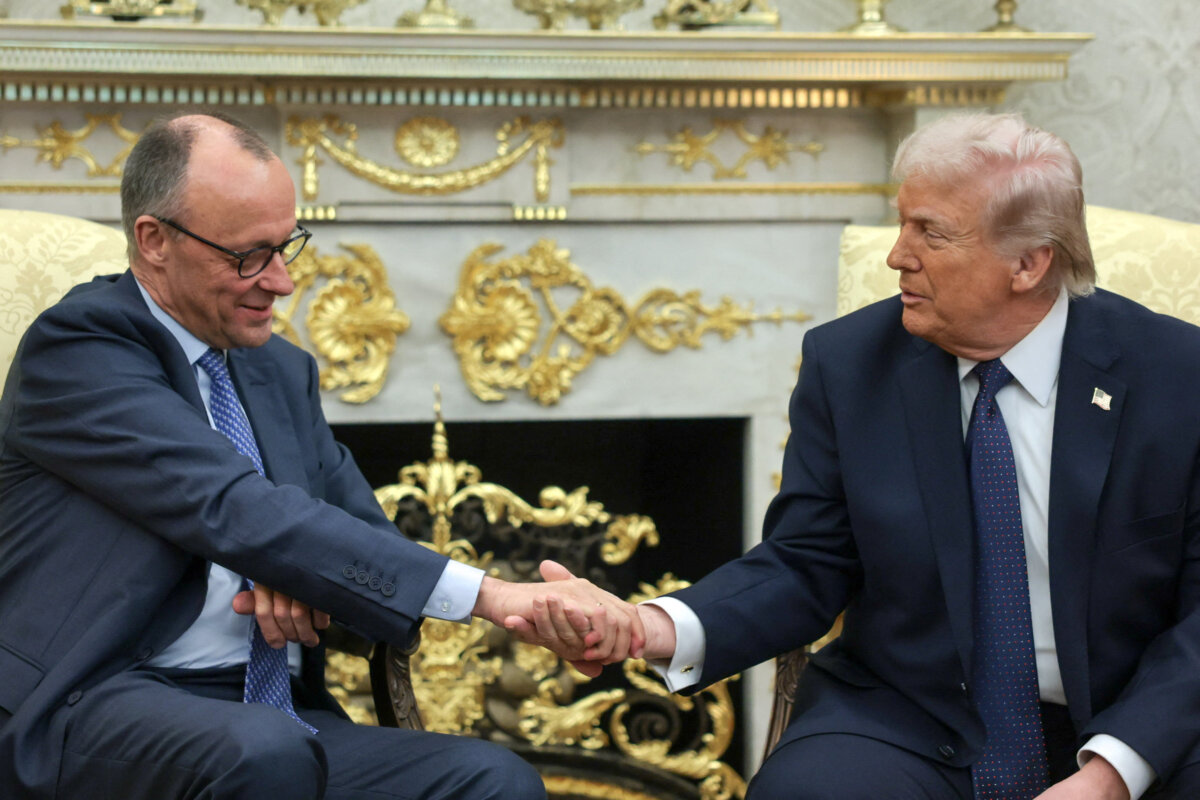
German Chancellor Friedrich Merz met with President Donald Trump at the White House on Tuesday, with the U.S. president saying Berlin is aligned with Washington on the Iran War.
“We are on the same page in terms of getting this terrible regime in Tehran away,” the German leader said during the meeting on March 3.
Major attacks by the United States and Israel were launched on Iran on Feb. 28 after U.S.–Iran nuclear talks ended without a breakthrough. Trump signaled that the U.S.–Israel military assault on Iranian targets could continue for weeks.
Merz, who has emerged as one of Europe’s more hawkish voices on Iran, also thanked the United States for what he described as the close cooperation between the two allies during a period of heightened global tensions.
“Tough times call for strong partnerships,” he said in a March 3 post on X following the talks.
The German chancellor added that Iran’s regional activities pose a direct threat to Western nations and their allies.
“Iran spreads terror, which endangers our partners and us,” Merz said. “We share the interest that all of this comes to an end.”
The meeting comes as the conflict between Iran and the U.S.–Israel alliance continues to escalate after joint military operations targeted Iranian facilities and military infrastructure.
Europe is mixed in its support.
Trump has criticized British Prime Minister Keir Starmer and warned that the historic U.S.–UK Special Relationship is under strain.
“He has not been helpful. I never thought I‘d see that. I never thought I’d see that from the UK,” Trump told British newspaper The Sun on March 3.
Trump said he never expected to see the once “most solid of all” alliances in such difficulty. The Special Relationship between the UK and the United States dates back to the end of World War II and the early Cold War period.
During Tuesday’s Oval Office meeting, Trump also expressed frustration with Spain’s basing decision and Madrid’s reluctance to increase Spain’s defense spending commitment to NATO.
Spanish Foreign Minister José Manuel Albares told Telecinco on March 2 that U.S. forces could not use Spanish bases to support ongoing operations against Iran.
“Spanish bases are not being used for this operation, and they will not be used for anything not included in the agreement with the United States or for anything that is not in accordance with the Charter of the United Nations,” Albares said.
Spain hosts two key joint U.S.–Spanish military bases, which operate under the bilateral U.S.–Spain Defense Cooperation Agreement and support NATO operations across Europe, Africa, and the Middle East.
Trump said on March 3 that he has instructed Treasury Secretary Scott Bessent to sever trade relations with Spain after the country’s leaders blocked the use of their military bases for U.S. forces.
“Spain actually said that we can’t use their bases,” Trump said next to Merz. “We could use their base if we want. We could just fly in and use it. Nobody’s going to tell us not to use it, but we don’t have to. But they were unfriendly, and so I told them, we don’t want to.”
When asked by reporters whether Israeli Prime Minister Benjamin Netanyahu had drawn the United States into the conflict, Trump rejected the suggestion at the White House meeting with Merz on March 3.
“No, I might have forced their hand,” Trump said.
The president said the United States had been engaged in negotiations with Iran before the escalation, but believed Tehran was preparing for an attack.
“You see, we were having negotiations with these lunatics, and it was my opinion that they were going to attack first,” Trump said. “They were going to attack if we didn’t do it.”
Ryan Morgan and Evgenia Filimianova contributed to this report.
 Friends Read Free
Copy
Facebook
Tweet
Friends Read Free
Copy
Facebook
Tweet