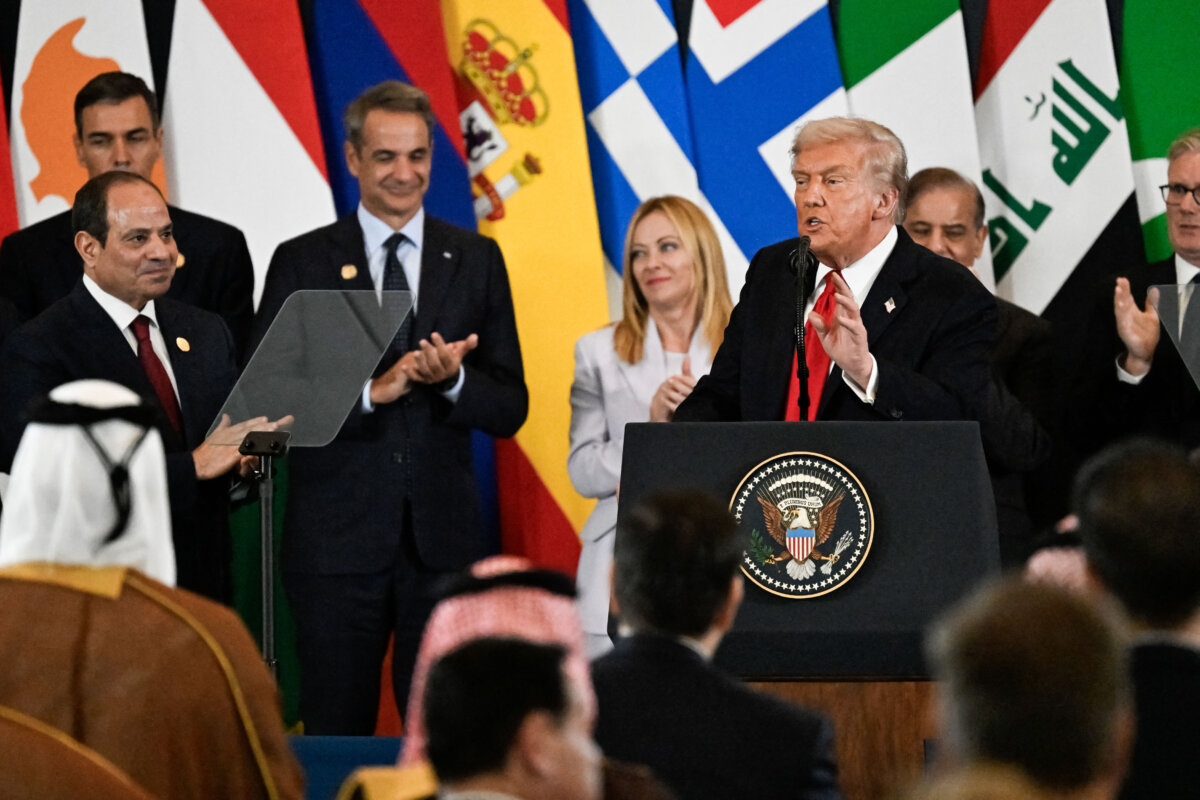

President Donald Trump said a network of nations in and around the Middle East is eagerly seeking a chance to “straighten out Hamas,” but he’s calling for restraint for now.
“Numerous of our NOW GREAT ALLIES in the Middle East, and areas surrounding the Middle East, have explicitly and strongly, with great enthusiasm, informed me that they would welcome the opportunity, at my request, to go into GAZA with a heavy force and ‘straighten [out] Hamas’ if Hamas continues to act badly, in violation of their agreement with us,” Trump wrote on Oct. 21 in a post on his Truth Social platform.
The president’s remarks come after the Israeli government alleged the Hamas terrorist group had violated a cease-fire agreement that the Trump administration helped broker for the Gaza Strip. Qatar and Egypt also worked to mediate the deal.
The president said the outpouring of support to go after Hamas demonstrates a love and spirit in the Middle East that “has not been seen like this in a thousand years!” Still, Trump said he was electing to wait and see how Hamas acts.
“I told these countries, and Israel, ‘NOT YET!’ There is still hope that Hamas will do what is right. If they do not, an end to Hamas will be FAST, FURIOUS, & BRUTAL!” Trump’s social media post said.
In addition to ceasing hostilities, the cease-fire deal calls for Hamas to return all hostages, living or dead, that the group has held in the Gaza Strip. Hamas turned over 20 living hostages in line with the terms of the deal, but has claimed delays in locating and returning the bodies of other deceased hostages.
Twenty-eight of the hostages were believed to be deceased by the time the cease-fire came into effect on Oct. 10. Hamas initially had until Oct. 13 to locate and turn over all of the bodies of the deceased hostages, but has yet to complete this obligation.
As of Oct. 21, Hamas had turned over 13 of the 28 bodies. Hamas has claimed challenges trying to locate other bodies buried under rubble in the war-torn territory, while Israel has raised concerns about the group dragging its feet.
Last week, Hamas denounced delays in reopening the Rafah crossing, saying continued closure of the crossing “constitutes a blatant violation of the ceasefire agreement and a repudiation of the commitments he made to the mediators and guarantor parties.” Hamas said keeping the crossing closed would also prevent the arrival of equipment that could be used to clear rubble in the search for the bodies of hostages.
Allegations Shake Cease-Fire
The Trump administration has presented the current Gaza cease-fire as part of a broader 20-point plan that will include the eventual disarmament of Hamas. For now, Hamas retains its weapons and exercises influence over large areas of the Gaza Strip.
When asked on Oct. 13 about Hamas fighting with rivals and reasserting its control over areas of Gaza from which Israeli forces have withdrawn, Trump said, “We gave them approval for a period of time.” In remarks the following day, Trump said Hamas “killed a number of gang members, and that didn’t bother me much, to be honest with you.”
Hamas has fought with a variety of armed rival groups within the Gaza Strip, including organizations that Hamas leaders have accused of collaborating with the Israeli government.
In more recent days, the U.S. government began to show growing alarm about Hamas reprisals against civilians.
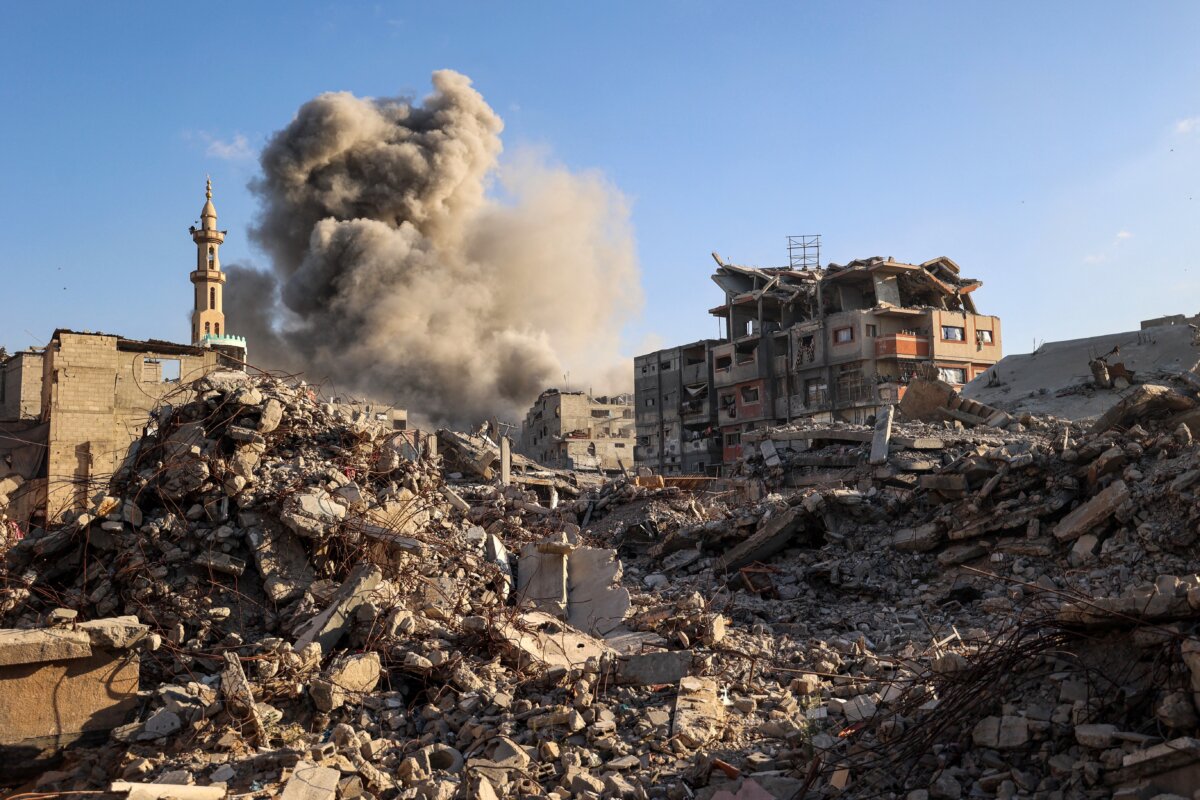
“We strongly urge Hamas to immediately suspend violence and shooting at innocent Palestinian civilians in Gaza,” Adm. Brad Cooper, the commander of the U.S. Central Command, said on Oct. 15.
On Oct. 18, the U.S. State Department issued a message warning that Hamas was still planning attacks targeting the people of the Gaza Strip. The State Department warned that such attacks would represent a violation of the cease-fire.
While Hamas leaders have defended fighting with and executing rivals, they denied the State Department’s claim of a broader attack on the people of Gaza.
Tensions flared later on Oct. 19, as the Israeli military reported Hamas had attacked its forces in Rafah with an anti-tank weapon, killing two Israeli soldiers. The armed wing of Hamas, known as the Al-Qassam Brigades, issued an Oct. 19 statement denying any connection to attacks in the Rafah area, and insisting its forces had not been in contact with groups in that area since March. The Al-Qassam Brigades further insisted its forces remained committed to the cease-fire.
Israeli forces conducted a series of military strikes across Gaza on Oct. 19, following the Rafah incident.
Vice President JD Vance visited Israel on Tuesday and offered assurances that disputes in the current cease-fire process could be resolved.
“There are going to be hills and valleys, there are going to be moments where it looks like things aren’t going particularly well,” Vance said. “But given that and given the history of conflict, I think that everybody should be proud of where we are today.”
Jacob Burg, Melanie Sun, Joseph Lord, Reuters, and The Associated Press contributed to this report.
 Friends Read Free
Copy
Facebook
Tweet
Friends Read Free
Copy
Facebook
Tweet