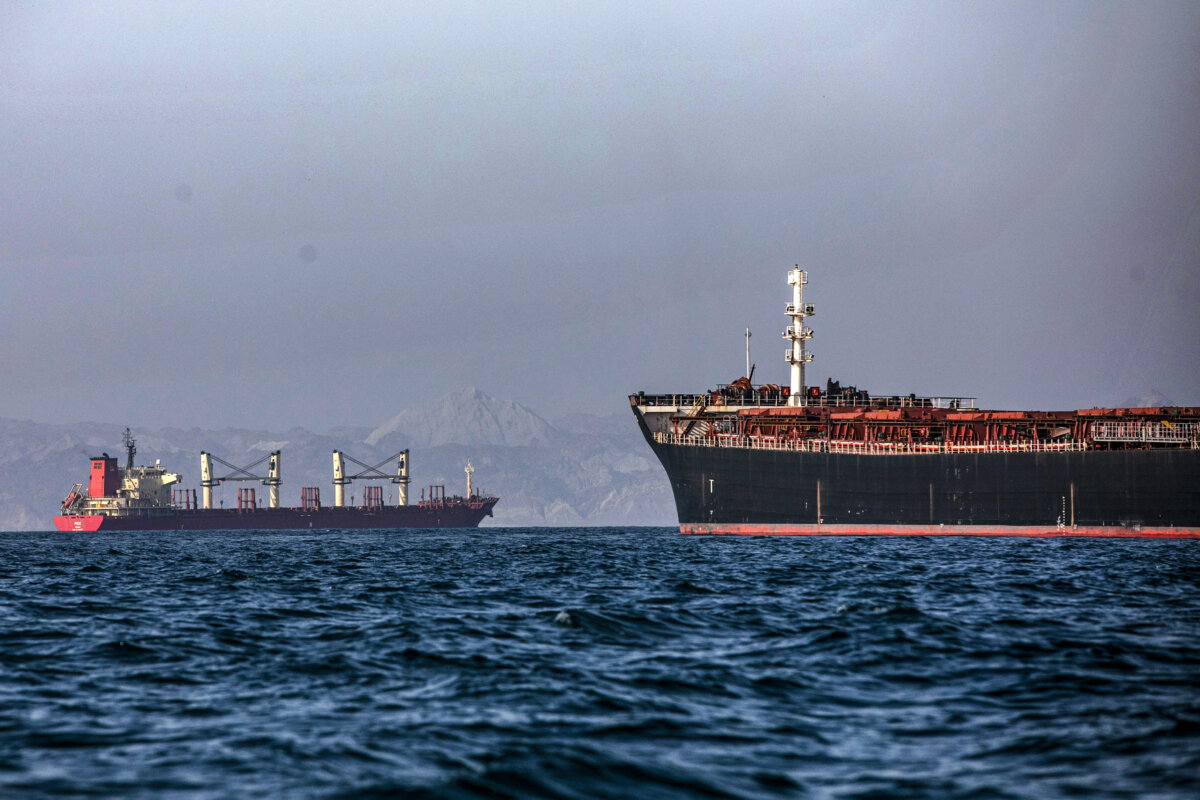

President Donald Trump has accused Iran of violating the ceasefire between the United States and the Middle Eastern country following an Iranian drone attack on a cargo vessel in the Strait of Hormuz.
In a June 26 post on Truth Social, Trump said there were four drone attacks targeting ships transiting the Strait of Hormuz.
One of the drones hit the upper deck of a large cargo ship, causing damage even though the vessel was able to continue its voyage, according to the president.
“We knocked down three other drones. Obviously, this is a foolish violation of our Ceasefire Agreement,” Trump said.
Iran attacked a cargo vessel in the Strait of Hormuz on June 24.
The UK Maritime Trade Operations (UKMTO) reported that a commercial ship was hit off Oman by an unidentified projectile. The UKMTO is operated by the British Royal Navy.
Although the organization did not assign responsibility for the attack, it confirmed that the vessel’s bridge sustained damage.
No injuries to the crew or environmental damage were reported.
A U.S. official later stated that the vessel had been targeted by a drone launched by Iran’s Islamic Revolutionary Guard Corps (IRGC).
Following the incident, the U.N. International Maritime Organization (IMO) temporarily suspended its ship escort operations through the Strait of Hormuz.
“I have decided to temporarily pause its implementation in order to reconfirm that the necessary safety guarantees continue to be in place for the ships on our evacuation list and all those in the region,” said the organization’s secretary-general, Arsenio Dominguez, in a statement.
He added that the attacked vessel had not been traveling under the IMO’s escort program.
The attack occurred despite a recently signed memorandum of understanding (MOU) between the United States and Iran, which called for a halt to hostilities and guaranteed commercial access through the Strait of Hormuz.
On Thursday, statements carried by Iranian state media quoted the IRGC as saying that all vessels passing through the strait must use routes officially approved by Iran.
According to the IRGC, the announcement was prompted by reports that a new shipping lane had been introduced without prior coordination with Tehran.
That same day, Iran’s newly established Persian Gulf Strait Authority warned that any vessel using unauthorized routes would do so at the risk of the shipowner, operator, and captain, who would bear responsibility for any resulting consequences.
The Strait of Hormuz has remained central to tensions between the United States and Iran.
Following U.S. and Israeli strikes against Iran on Feb. 28, Iranian forces moved to restrict access to the strategic waterway, which carries roughly one-fifth of the world’s petrochemical exports.
Under the June 17 MOU, Iran agreed to ensure the safe passage of commercial ships traveling between the Persian Gulf and the Sea of Oman for 60 days without imposing transit charges.
The agreement also committed Iran to removing mines and other military obstacles from the strait within 30 days.
Long-term management of maritime transit through the strait remains under negotiation.
The agreement states that Iran will work with Oman, which borders the opposite side of the strait, along with other Gulf coastal states, to develop a future framework for administering maritime services and navigation in accordance with international law and the sovereign rights of the coastal states bordering the Strait of Hormuz.
Ryan Morgan contributed to this report.
 Friends Read Free
Copy
Facebook
Tweet
Friends Read Free
Copy
Facebook
Tweet