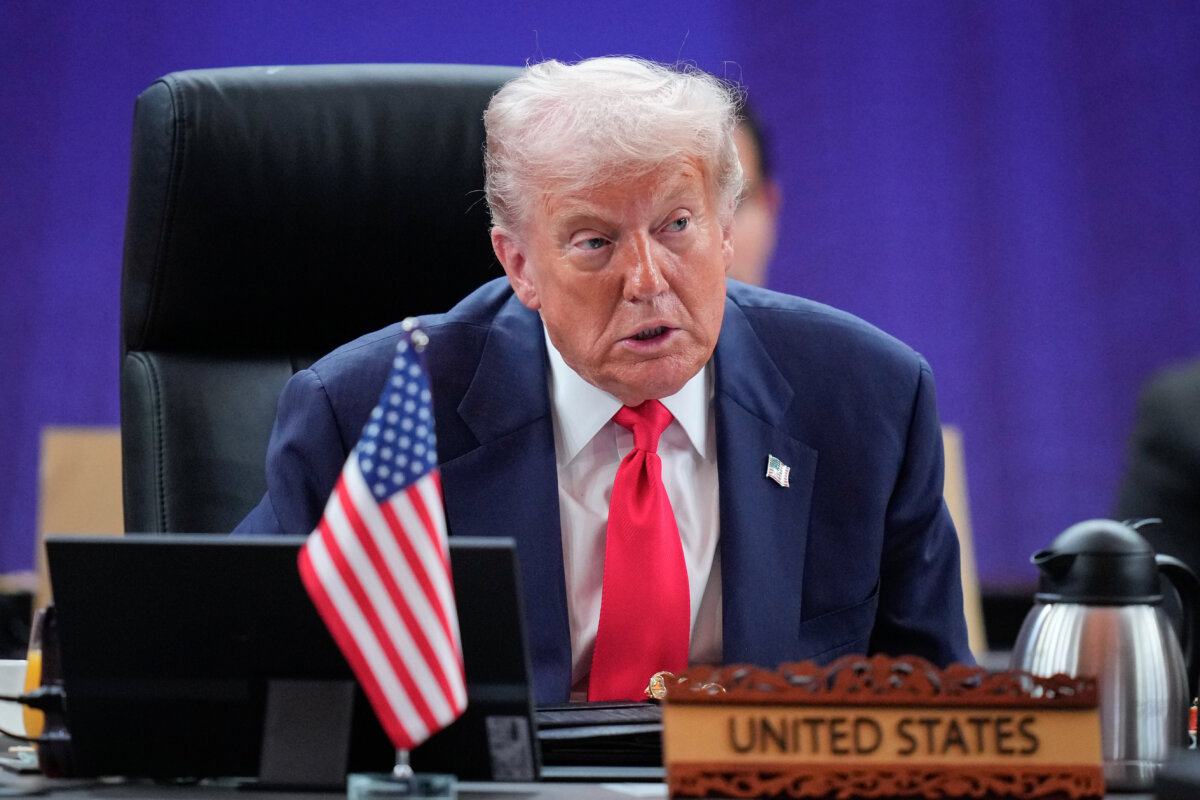

President Donald Trump said on Oct. 25 that he was “watching very closely” to ensure that Hamas releases more bodies of deceased Israeli hostages in the next 48 hours as part of the Gaza cease-fire deal.
Trump warned in a Truth Social post that Hamas terrorists should return the bodies, including those of two Americans, “quickly” or face action by the countries backing a peace deal.
“Some of the bodies are hard to reach, but others they can return now, and for some reason they are not,” Trump said.
“Perhaps it has to do with their disarming, but when I said, ‘Both sides would be treated fairly,’ that only applies if they comply with their obligations. Let’s see what they do over the next 48 hours. I am watching this very closely.”
Under the U.S.-brokered cease-fire, which took effect on Oct. 10, Hamas is required to return the remains of all Israeli hostages. The terrorist group still holds the bodies of 13 hostages.
On Oct. 26, Hamas’s chief in Gaza, Khalil al-Hayya, said on the Telegram channel of Al-Aqsa TV—a Hamas-run media outlet—that the group continues its search for the remaining bodies.
“There is serious commitment and a firm decision from us and the resistance that no Israeli bodies will be left behind,” he said.
“We will continue searching with utmost responsibility and determination, and we call on Israel not to use this issue as a pretext to further harm our people.”
A team from Egypt arrived in Gaza on Oct. 25 to help search for bodies with an excavator and bulldozers.
The Israel Defense Forces (IDF) said it conducted a strike in the Nuseirat area in central Gaza on Oct. 25. It said it targeted a terrorist from the Islamic Jihad terrorist organization who planned to carry out an attack against the IDF.
Israeli Prime Minister Benjamin Netanyahu defended the IDF’s action during a Cabinet meeting on Oct. 26, insisting that the country’s security policy remains entirely under its own control and that Israel will not tolerate attacks.
“Israel is a sovereign state. We will defend ourselves by our own means, and we will continue to change our fate,” Netanyahu said.
Intelligence sharing between the United States, Israel, and other cease-fire mediators allowed them to identify the possible attack on the prior weekend, U.S. Secretary of State Marco Rubio said on Oct. 25, during his visit to Israel.
“So that’s the goal here, is ultimately to identify a threat before it happens,” he said.
Rubio was the latest senior U.S. official to visit Israel and hold talks with Netanyahu. His trip followed visits by U.S. Vice President JD Vance and U.S. envoys Steve Witkoff and Jared Kushner, the president’s son-in-law, who were in Israel last week to advance diplomatic efforts to uphold the peace deal.
Israel and Turkey
Netanyahu also told his Cabinet that Israel would determine which international forces are acceptable in Gaza, noting that this stance had been acknowledged by senior figures behind the cease-fire deal.
An international security force in Gaza under a cease-fire agreement would have to be made up of countries that Israel is “comfortable with,” according to Rubio.
During a joint news conference with Vance on Oct. 22, Netanyahu signaled his opposition to the involvement of Turkish forces in Gaza, saying he has “very strong opinions about that.”
Turkey, alongside Egypt and Qatar, has acted as a mediator in the cease-fire deal and previously said it would join a task force to oversee its implementation.
However, ties between Jerusalem and Ankara have been strained amid Turkey’s criticism over Israeli military action in Gaza. In 2024, Turkey halted trade with Israel until a permanent cease-fire and humanitarian aid are secured in Gaza.
On Oct. 27, Israeli Foreign Minister Gideon Saar said that Israel won’t accept the presence of Turkish armed forces in Gaza.
Speaking in Budapest, Hungary, Saar said it would be unreasonable for Israel to let Turkish armed forces into the enclave, given what he described as Turkey’s “hostile approach” toward Israel.
“We will not agree to that, and we said it to our American friends,” Saar said.
International Security Force
Rubio also said that several countries had expressed interest in joining an international security force in Gaza, with discussions ongoing over whether it would operate under a U.N. mandate.
Rubio said several options were being considered, including a possible U.N. resolution or an alternative international agreement.
Trump, who met with Qatari Emir Tamim bin Hamad Al Thani and Qatari Prime Minister Mohammed bin Abdulrahman bin Jassim Al Thani on Oct. 25, told reporters after the meeting that his plan to stabilize Gaza was moving “pretty quickly” with an international peacekeeping force now taking shape. He said Qatar would join the effort “at the time they need.”
In an interview with the BBC’s “Panorama” program airing on Oct. 27, King Abdullah of Jordan said that Jordan and Egypt were willing to help train Palestinian security forces, but ruled out sending troops into Gaza, saying his country was “too close politically” to the conflict.
“Peacekeeping is that you’re sitting there supporting the local police force, the Palestinians, which Jordan and Egypt are willing to train in large numbers, but that takes time,” he said.
“If we’re running around Gaza on patrol with weapons, that’s not a situation that any country would like to get involved in.”
When asked whether he trusted Hamas to keep its promise to give up any political role in Gaza, the king replied: “I don’t know them, but those that are working extremely close to them—Qatar and Egypt—feel very, very optimistic that they will abide by that.
“If we don’t solve this problem, if we don’t find a future for Israelis and Palestinians and a relationship between the Arab and Muslim world and Israel, we’re doomed.”
Hamas-led terrorists killed about 1,200 people, mostly civilians, and abducted 251 people in the attack on southern Israel on Oct. 7, 2023. In response, the IDF launched a ground offensive in Gaza.
Gaza’s Hamas-run Health Ministry said on Oct. 27 that more than 68,000 people have died in Gaza since the onset of the conflict. The figure does not distinguish between fighters and civilians and includes some deaths from natural causes. The Epoch Times cannot verify these figures.
 Friends Read Free
Copy
Facebook
Tweet
Friends Read Free
Copy
Facebook
Tweet