
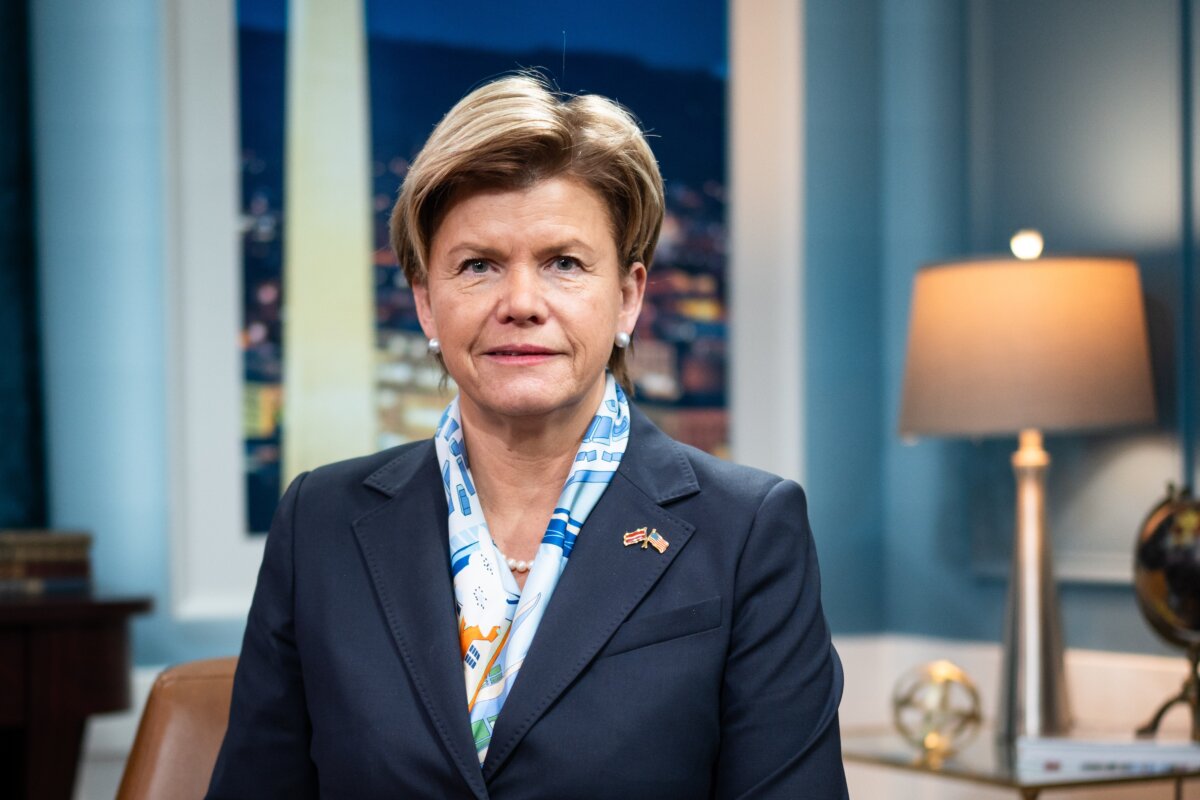

Latvian Foreign Minister Baiba Braze said U.S. President Donald Trump’s new national security strategy should be a spur for Europe to strengthen its own defenses and competitiveness, not a cause for panic about U.S. abandonment.
In an exclusive interview on EpochTV’s “American Thought Leaders,” Braze said Latvian officials have reviewed the Trump administration’s national strategy and see it as more coherent and constructive than many critics in Europe suggest.
“It’s a pretty solid document,” she said, adding that “one needs to look at it as a whole” rather than focus on bits and pieces taken out of context and shared on social media and embellished by commentary.
The document described Europe as beset by structural strains—from mass migration and aging populations to political polarization and a regulatory burden that stifles industriousness and economic growth—and warns that, unless those trends are reversed, the continent faces the prospect of “civilizational erasure.”
It also criticizes “elite-driven, anti-democratic restrictions on core liberties” in some European countries while urging Europe to “regain its civilizational self-confidence” and take on much greater responsibility for its own defense and “abandon its failed focus on regulatory suffocation.”
“America encourages its political allies in Europe to promote this revival of spirit, and the growing influence of patriotic European parties indeed gives cause for great optimism,” the strategy states, noting that one U.S. priority is “cultivating resistance to Europe’s current trajectory within European nations.”
Some European leaders have criticized the strategy. German Chancellor Friedrich Merz has said that “some of it is unacceptable … from the European point of view” and that the strategy shows that Europe must become far more independent from the United States in terms of security policy.
“That the Americans want to save democracy in Europe now, I don’t see any need for that,” Merz told reporters in Mainz, Germany, on Dec. 9. “If it needed to be saved, we would manage that alone.”
European Council President António Costa praised the strategy’s depiction of Europe as an ally but said that “allies don’t threaten to interfere in the domestic political choices of their allies.”
“What we can’t accept is the threat of interference in European political life,” Costa said in Paris at the Jacques Delors Institute, a think tank, on Dec. 8. “The United States cannot replace European citizens in choosing what the good or the bad parties are.”
Braze, by contrast, said Trump’s strategy “clearly” recognizes Europe’s role and the need for allies to shoulder more responsibility for defense and economic resilience.
“With regard to addressing U.S. concerns, whether that’s with regard to China and Indo-Pacific or technology, but also on Europe, clearly recognizing the role of Europe, that Europe needs to take more responsibility, which is what we fully say,” she said. “There’s a whole set of steps that we need to make to be more competitive, to be stronger, to be out there in the world where we want to be.”
Braze expanded on this theme in a Dec. 8 appearance at an event hosted by the Hudson Institute, in which she supported Trump’s call for Europe to regain “civilizational self-confidence” if the continent is to meet the challenges of the moment, including those posed by Russia.
“We are rich, we are strong, there’s a lot of us,” she said.
She said that Europeans have “too many inhibitions at a national level” that must be abandoned if Europe is to step up and bear more of the burden of European security.
Braze said that there is no reason why objectives such as spending 5 percent of gross domestic product on defense could not be achieved.
“It’s less about talking, more about doing,” she said.
She said that Europe must invest more in its relationship with the United States.
Ultimately, Braze suggested that Trump’s strategy, which calls on allies to “step up and spend—and more importantly do—much more for collective defense,” is a deepening of trends already underway, as opposed to a rupture of ties.
‘Very Pro-American’
Braze stressed that the Baltic region’s answer is to lean in toward, not distance itself from, Washington.
“We are very pro-American. I think the Nordic Baltic region is as pro-American as you would get in Europe,” she said. “There’s no bigger sort of club of countries working with the U.S.”
She said that stance is rooted in Latvia’s historical experience, recalling that the United States refused to recognize the Soviet occupation of the Baltic states during the Cold War.
Braze recalled that, as a student activist, she would listen at night to Radio Free Europe and Voice of America on shortwave, even as the Soviets tried to suppress it.
“That was the shining light of freedom that inspired us and made sure that we were able to reinstate our independence and regain it and also become successful again,” she said.
Today, she said, Riga is seeking even deeper American engagement. Latvia already hosts Canadian-led NATO forces and multiple allied contingents, but Braze suggested that the presence of U.S. troops in the region would have a unique deterrent effect against threats.
“We would like more Americans in Latvia, more American troops, more American investment, more relationships,” she said. “We love the U.S.”
Braze also described Latvia as a frontline enforcer of Western sanctions, particularly in efforts to choke off the “shadow fleet” of aging tankers moving Russian oil and to close loopholes in EU export-control regimes.
Latvia has already stopped importing Russian oil and gas, she noted, and now relies heavily on U.S. liquefied natural gas for its energy needs.
Jan Jekielek contributed to this report.
 Friends Read Free
Copy
Facebook
Tweet
Friends Read Free
Copy
Facebook
Tweet


























