

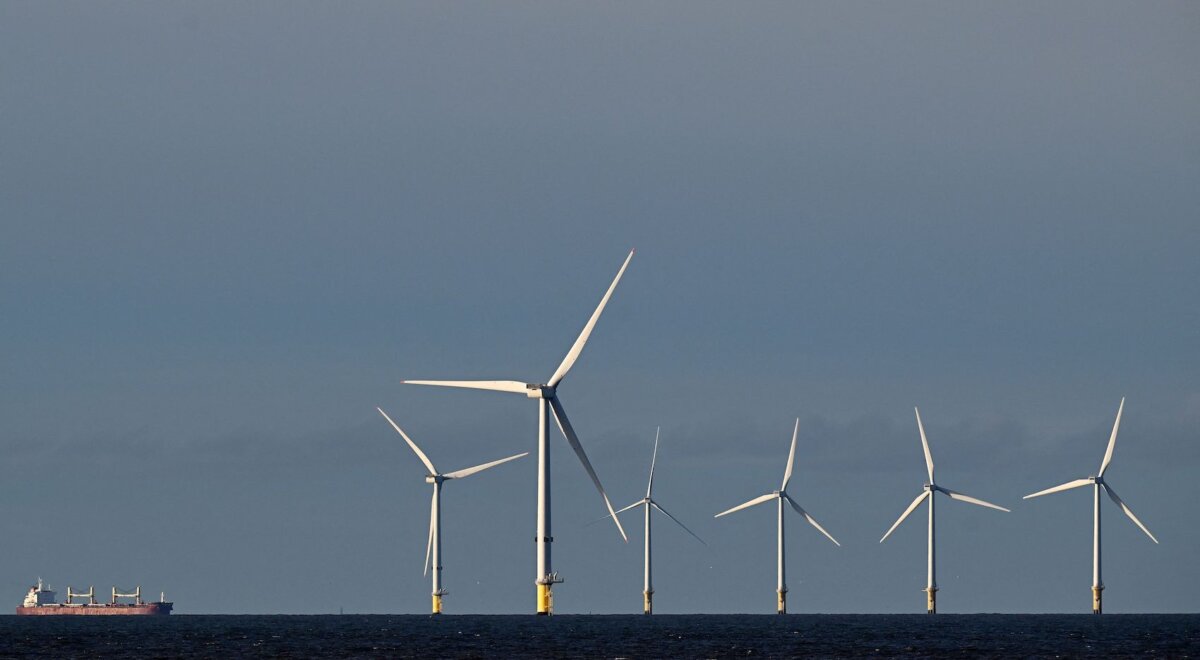
UK Energy Secretary Ed Miliband on Jan. 26 signed an agreement with European partners to expand offshore wind development in the North Sea, backing a build-out that could include the installation of thousands of turbines across the region.
The energy secretary signed the “clean energy security pact” with Germany, Norway, France, Denmark, and other European countries to build 100 gigawatts’ worth of offshore wind projects.
Miliband said the deal will get the “UK off the fossil fuel rollercoaster” and provide “energy sovereignty and abundance.”
The Department for Energy Security and Net Zero said that it is building new “offshore wind hybrid assets,” wind farms at sea that are directly connected to more than one country through interconnectors.
The Labour government said on Jan. 14 that it secured 8.4 gigawatts of offshore wind capacity, the largest offshore wind procurement round conducted in the UK and Europe so far.
Last year, U.S. President Donald Trump wrote in a Jan. 2 post on social media: “The U.K. is making a very big mistake. Open up the North Sea. Get rid of Windmills!”
Scotland is Europe’s largest producer of oil and second largest producer of gas. Most oil and gas activity in Scottish waters takes place offshore, beyond 12 nautical miles from the coastline, according to Scottish nature agency Nature Scot.
The ruling Labour Party’s policy is that it is committed to ensuring a “phased transition” in the North Sea, and no new oil and gas licenses or coal licenses will be issued.
This follows from the previous Conservative administration’s Climate Change Act 2008, which legally commits the UK to achieving net-zero greenhouse gas emissions by 2050.
Net-zero policy critics have said that bills could get higher. Net Zero Watch, a think tank that scrutinizes climate and decarbonization policies, said in a Jan. 26 post on X that “the plans are expected to come under scrutiny amid concerns that connected European energy projects risk pushing prices up and higher bills for consumers.”
Net Zero Watch Campaign Director Maurice Cousins said in a social media post, “Through Net Zero, we are building an energy system defined by intermittency, low energy density, and supply chains dominated by China, which NATO itself describes as a ‘strategic competitor’.”
“The world has not decarbonised warfare,” he said. “It still runs overwhelmingly on dense supplies of oil, gas and coal, and remains a deeply energy and carbon intensive enterprise. Until we have alternatives that match their basic advantages (i.e. density, reliability, ease of storage, and the ability to meet peak demand) those fuels will remain dominant.”
Energy UK, a trade association for the energy industry, welcomed Miliband’s move.
Energy UK Chief Executive Dhara Vyas said in a Jan. 26 statement that the UK’s energy sector is “fully behind the landmark efforts to be announced at the Hamburg North Sea Summit to transform the North Sea into a truly regional clean power hub.”
“Delivering the goal of 100 GW of offshore cooperation projects by 2050 will require a relentless focus on maintaining the momentum of UK-EU alignment on electricity market coupling and [Emissions Trading Schemes] linkage,” Vyas said.
“This deeper cooperation on supply chains, standardisation, and shared infrastructure is not just a strategic necessity, it is the most effective way to bring down energy costs for households and businesses while fuelling sustainable economic growth and high-value jobs for years to come.”
Europe’s ambition to reach net-zero emissions by 2050 hinges on ramping up solar and wind power, potentially tripling the amount of electricity running through the power grid.
Estimates from the EU’s Court of Auditors put total costs for upgrading transmission lines across continental Europe at between 2 trillion euros and 3 trillion euros ($2.2 trillion and $3.3 trillion) by mid-century.
In the UK alone, the National Energy System Operator projected in 2020 that achieving net zero will require about 3 trillion pounds ($4 trillion) of investment over the next three decades.
 Friends Read Free
Copy
Facebook
Tweet
Friends Read Free
Copy
Facebook
Tweet