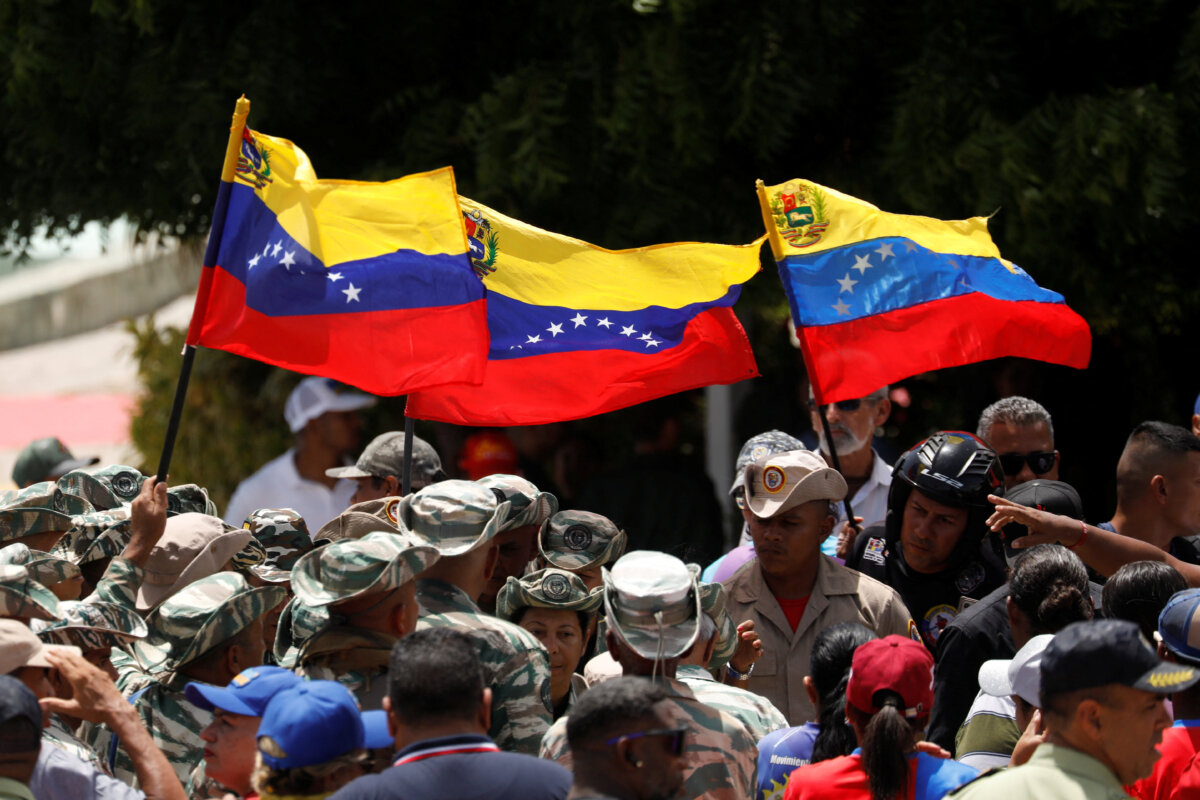

One of the last meetings held at the Venezuelan embassy in Canberra before it was suddenly closed by the government of President Nicolás Maduro was with the Communist Party of Australia (CPA).
The delegation was led by a prominent member of the Construction, Forestry, Maritime and Mining Union (CFMEU), which is currently under investigation over several matters, including allegations of intimidating its opponents.
Reports of the meeting reveal a long history of cooperation between Venezuelan diplomats and Australian communists.
The embassy maintained two websites, an official one under the “.gob.ve” top level domain allocated to official government sites, and another under a “.org.au” domain.
The embassy’s website mentions the visit of the CPA, “led by its national president, Vinnie Molina, who is also a member of the … CFMEU” and said the main topic of discussion was “the deployment of the U.S. military contingent in the Caribbean.”
In 2018, Molina wrote to the then-Australian foreign minister, Julie Bishop, urging her to recognise the presidential elections held in Venezuela and accept the election of Maduro.
There have been questions surrounding every election in which Maduro has been declared the winner.
In August of this year, Maduro started his third term after an election described as “undemocratic” by independent observers, including those of several left-leaning Latin American countries.
Opposition candidate Edmundo González claimed that he had won, but then fled the country and sought asylum in Spain last September after a warrant was issued for his arrest.
The Canberra meeting resolved to develop “a joint action plan between the CPA and the CFMEU, aimed at addressing members of parliament, the media, and lobby groups, in order to generate a counteroffensive that would reveal the true intentions of the most radical factions of the U.S. government.”
“Also present at the meeting was Andrew Carruthers, deputy secretary of the Canberra branch of the CPA, who recently visited Caracas and attended the People’s Summit for Peace and Against War,” the embassy website says.
“From his position as an academic at the Australian National University (ANU), he pledged to contribute to the development and implementation of the aforementioned action plan from Canberra.”
Embassy Ties
The embassy also has ties to the Australia-Venezuela Solidarity Network and reposted material from various chapters of the group on its Facebook page.
The group’s one-page website describes itself as “dedicated to building solidarity with the people of Venezuela in their struggle against U.S.-led imperialism and to building socialism of the 21st century.”
It claims to have groups “in every major Australian city,” and organises a diverse range of events, from film screenings to “solidarity brigades.”
On the group’s Facebook page, Rodrigo Acuña, a researcher and writer on Latin America laments the embassy’s closure.
He attributes it to the 2002 closure of the Australian Embassy in Caracas after operating there since at least 1979, and the refusal in 2019 by the Australian government, led by Scott Morrison, to “align with the United States under Donald Trump in refusing to recognise the administration of Nicolás Maduro.”
“It seems Caracas sees little point in maintaining diplomatic relations with a country that shows no real interest in reciprocation,” he says.
At the same time as it announced that it is closing its embassies in Australia and Norway, Venezuela said it was opening new posts in Burkina Faso and Zimbabwe, which Maduro described as “sister nations, strategic allies in the anti-colonial fight and in the resistance against hegemonic pressure.” Both Norway and Australia are U.S. allies.
Embassy Closure
A spokesperson for Australia’s Department of Foreign Affairs and Trade (DFAT) said it was “aware of reports of Venezuelan embassy closures in Norway and Australia and is monitoring the situation.”
There are an estimated 10,000 to 15,000 Venezuelans living in Australia, who will face significant obstacles accessing consular services such as passport renewals.
Maduro’s government is widely seen as both authoritarian and socialist and regularly issues statements showing support for both the Chinese Communist Party (CCP) and Russia.
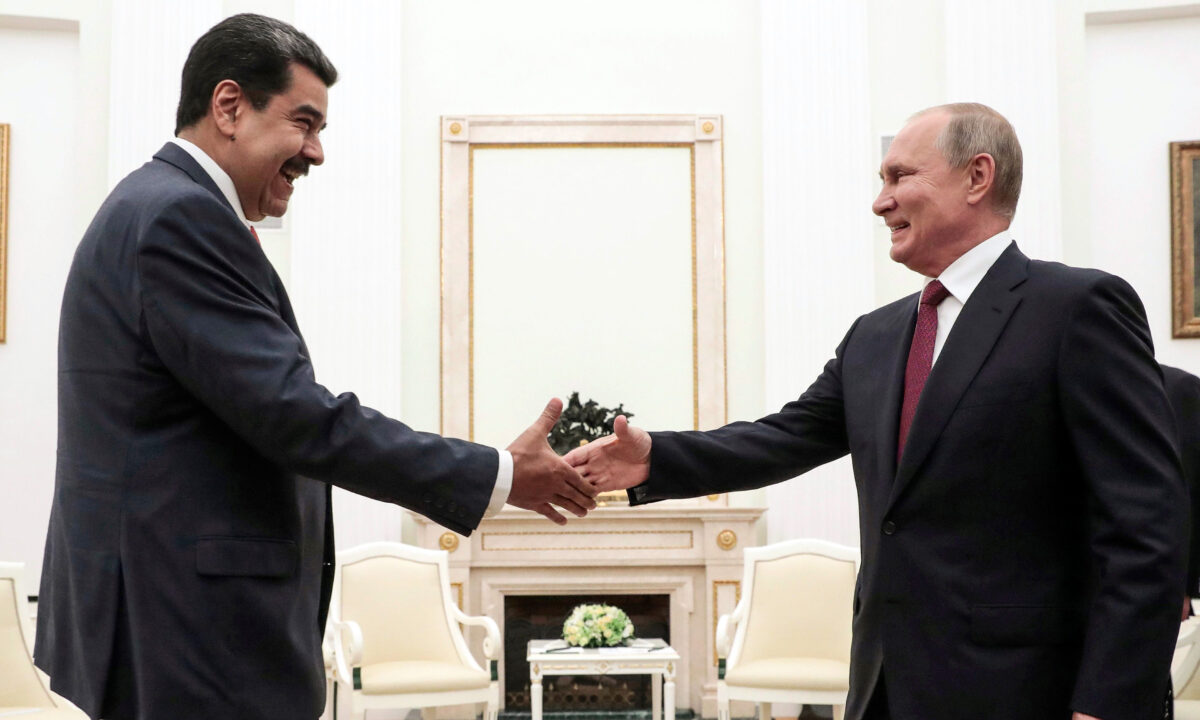 Russian President Vladimir Putin (R) shakes hands with Venezuelan President Nicolas Maduro during their meeting at the Kremlin in Moscow on Sept. 25, 2019. (Sergei Chirikov/AFP via Getty Images)
The decision came three days after the announcement that Venezuelan opposition leader Maria Corina Machado had won the 2025 Nobel Peace Prize for her efforts to restore democracy in Venezuela, which the judges called “one of the most extraordinary examples of civilian courage in Latin America.” In response, Mauro described Machado as “a demonic witch.”
A Norwegian foreign ministry spokesperson called the move “regrettable.”
Tension between Venezuela and the United States has also been growing, with several deadly U.S. military strikes off Venezuela’s coast targeting vessels which Washington alleges were carrying drugs.
Maduro has alleged the United States is seeking a change in government, and Venezuela has said it is expecting an armed attack against the country in the near future.
The Trump administration has not responded to this accusation but has called Maduro the “illegitimate head of a narco-state” and recently doubled the bounty for Maduro’s arrest to A$75 million (US$50 million).
Machado, on the other hand, has explicitly called for American and Israeli military intervention in her country.
Venezuela’s Foreign Ministry said the new diplomatic posts in Burkina Faso and Zimbabwe—both of which are aligned with Russia—would go beyond the usual consular functions and would serve to launch joint projects involving agriculture, energy, education, mining, and other common interests.
 Friends Read Free
Copy
Facebook
Tweet
Friends Read Free
Copy
Facebook
Tweet