
Victorian Premier Jacinta Allan has described the passing of her government’s Treaty Bill with Aboriginals as “two worlds meeting.”
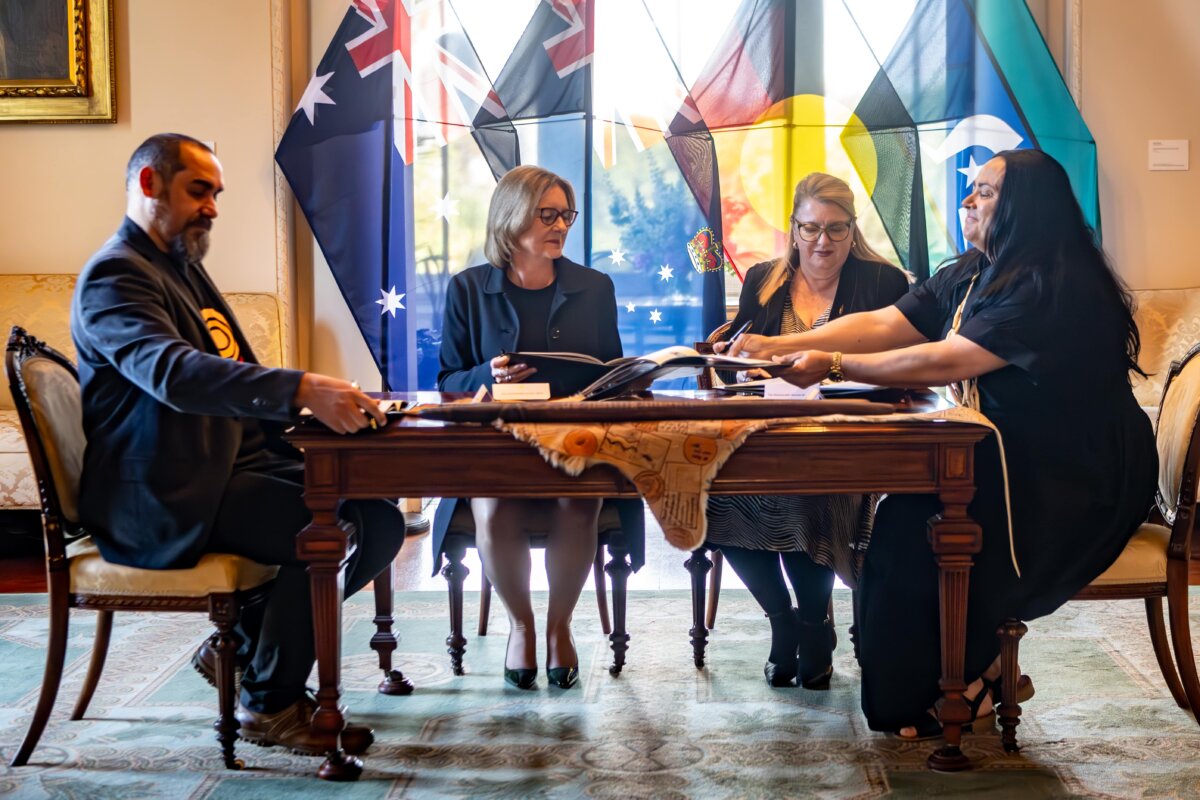
Speaking at Melbourne’s Government House on Nov. 13, the Labor premier lauded the deal that came after a decade-long negotiation as it received Royal Asset from Victorian Governor Margaret Gardner.
“Today is a recognition that ancient systems of law and the modern institutions of our democracy can stand side by side,” Allan said.
“But today also carries a deeper meaning, it is quite literally two worlds meeting in respect and in partnership.”
What Does the Treaty Bill Do?
Premier Allan, alongside the co-chairs of the First Peoples’ Assembly of Victoria, Ngarra Murray and Rueben Berg, signed the agreement at a formal ceremony in the early hours of Nov. 13.
Under the new legislation, the treaty will operate similarly to the proposed federal Indigenous Voice.
A permanent advisory body to Victorian Parliament, called “Gellung Warl,” will be established and must be consulted on laws and policies that impact Indigenous Victorians.
Gellung Warl will also include a truth-telling body (Nyerna Yoorook Telkuna) aimed at uncovering historic wrongs against Indigenous people, and a body focused on accountability with Aboriginal funding (Nginma Ngainga Wara).
Overall, it’s slated to cost taxpayers about $71 million (US$46 million) once fully operational from 2027-28 onward.
Gellung Warl will also be in charge of running the Aboriginal Community Infrastructure Fund, the Victorian Aboriginal Honour Roll, and NAIDOC Week.
The group will have its own room in parliament, but will operate independently of government with its members elected from the First Peoples’ Assembly by Indigenous voters.
The Bill will also create statutory requirements for a quota of Aboriginals seats on the Heritage Council of Victoria.
“Words are cheap, but these words now in a treaty in legislation, these words cannot disappear,” Berg told media.
A ceremonial exchange will be held at Federation Square in Melbourne on Dec. 12 to formally commence the agreement.
UN Chief Backs Treaty
The move has received praise from some institutions, like the Australian Greens party and U.N. Human Rights Chief Volker Turk, who called it a “very significant occasion for all Australians.”
“The state of Victoria is leading an initiative with the potential to be truly transformative, ensuring the First Peoples have a direct voice in advising and shaping laws, policies and practices that affect their lives, in line with Australia’s international human rights obligations,” said Türk.
The Treaty Bill has also been met with criticism.
Nationals MP Melina Bath, the opposition spokeswoman for Aboriginal affairs, said “closing the gap” was only mentioned twice in the legislation. “Closing the Gap” refers to an initiative to try lift the living standards of Aboriginal communities to be in line with mainstream Australia.
“The Liberals and Nationals focus needs to be on supporting those Victorians, our Victorians, our First Nations people to close the gap and bring a better outcome for Indigenous people,” Bath said.
Monica O’Shea contributed to this article.
 Friends Read Free
Copy
Facebook
Tweet
Friends Read Free
Copy
Facebook
Tweet