

“Out on bail.” These three words have become a common occurrence in Canada when reports emerge about the suspect of the latest shocking crime.
This was the case with the suspect of a mass stabbing incident on Hollow Water First Nation in Manitoba on Sept. 4, where Tyrone Simard was accused in the stabbing death of his sister while putting seven others in hospital.
Simard will not face another tribunal, however, having perished in a crash while being pursued by an RCMP officer following the attacks.
The attack on Sept. 4 occurred following Simard’s release with conditions by a Winnipeg court in June, after being charged with assault with a weapon and mischief. As part of his conditions he was to stay away from the alleged victims of his offences, including his late sister.
This is but one gruesome case in an ever-growing list of crimes committed by repeat offenders who were roaming freely within communities across the country. There is a significant amount of criminal recidivism in Canada, with the Department of Justice noting that chronic offenders are responsible for a large proportion of criminal incidents.
Another recent case involves a 12-year-old boy who has been charged with attempted murder following the August shooting of a man in Markham, Ontario. At the time the boy was on release orders for unrelated violent offences, police said.
“Once again, we’re seeing individuals released on bail involved in serious crimes within our community,” stated York Regional Police Chief Jim MacSween. “We must advocate for legislative measures which ensure violent and repeat offenders are kept off the streets, while also focusing on rehabilitating our youth, to ensure public safety, to protect our officers and to maintain public confidence.”
Calls for Reform
Calls for stricter bail laws have been ongoing for years, with the killing of a police constable in Ontario in late 2022 serving as a catalyst.
Ontario Provincial Police (OPP) Const. Grzegorz (Greg) Pierzchala was shot and killed in December 2022 while responding to a routine call about a truck in a ditch near Hagersville. The suspect in the shooting, Randall McKenzie, was out on bail at the time and had a lifetime firearms prohibition. He was facing charges from the year prior for assaulting an officer and for firearm offences.
 (David McNew/Getty Images)
OPP Commissioner Thomas Carrique said at the time the killing of one of his officers should have never happened. “The murder of Constable Greg was preventable,” he said. McKenzie was found guilty of first-degree murder in April this year. He was sentenced to life in prison and must serve 25 years before being eligible for parole.
Pressure on Ottawa for bail reform, coming from the public, law enforcement, and politicians, intensified after Pierzchala’s killing.
All the provincial and territorial premiers sent a letter to then-Prime Minister Justin Trudeau in January 2023, asking for “immediate action” to reform the bail system.
“The justice system fundamentally needs to keep anyone who poses a threat to public safety off the streets,” said the letter. The premiers, similarly to the Ontario Association of Chiefs of Police, called for provisions of reverse onus on bail—or reverse burden of proof—in the Criminal Code for certain serious offences.
The general rule in bail proceedings is that when the Crown seeks to deny bail for an accused person, the Crown prosecutor must demonstrate to the court that there is just cause to detain the accused. When a reverse onus applies, it’s the accused who must show why he or she should be granted bail and released instead of being detained while awaiting trial.
Ottawa’s Response
Ottawa responded to the mounting calls, and a meeting of federal and provincial attorneys general, justice ministers, and public safety ministers was held in March 2023 to discuss concerns around bail laws. The federal government agreed at the meeting to table amendments to the Criminal Code on the issue.
Two months later, then-Justice Minister David Lametti introduced Bill C-48 to make amendments related in large part to reverse onus provisions. The bill received royal assent in December 2023 and the reforms came into force in January 2024.
Among other things, the legislation created a reverse onus provision for a person charged with a serious offence involving violence and the use of a weapon who has been convicted, within the last five years, of a similar offence. Certain firearms offences were also added to existing reverse onus provisions.
During consultations on the bill in September 2023, OPP Commissioner Carrique testified before the Senate Legal and Constitutional Affairs Committee and said he believes Const. Pierzchala would still be alive had the proposed legislative changes been in force.
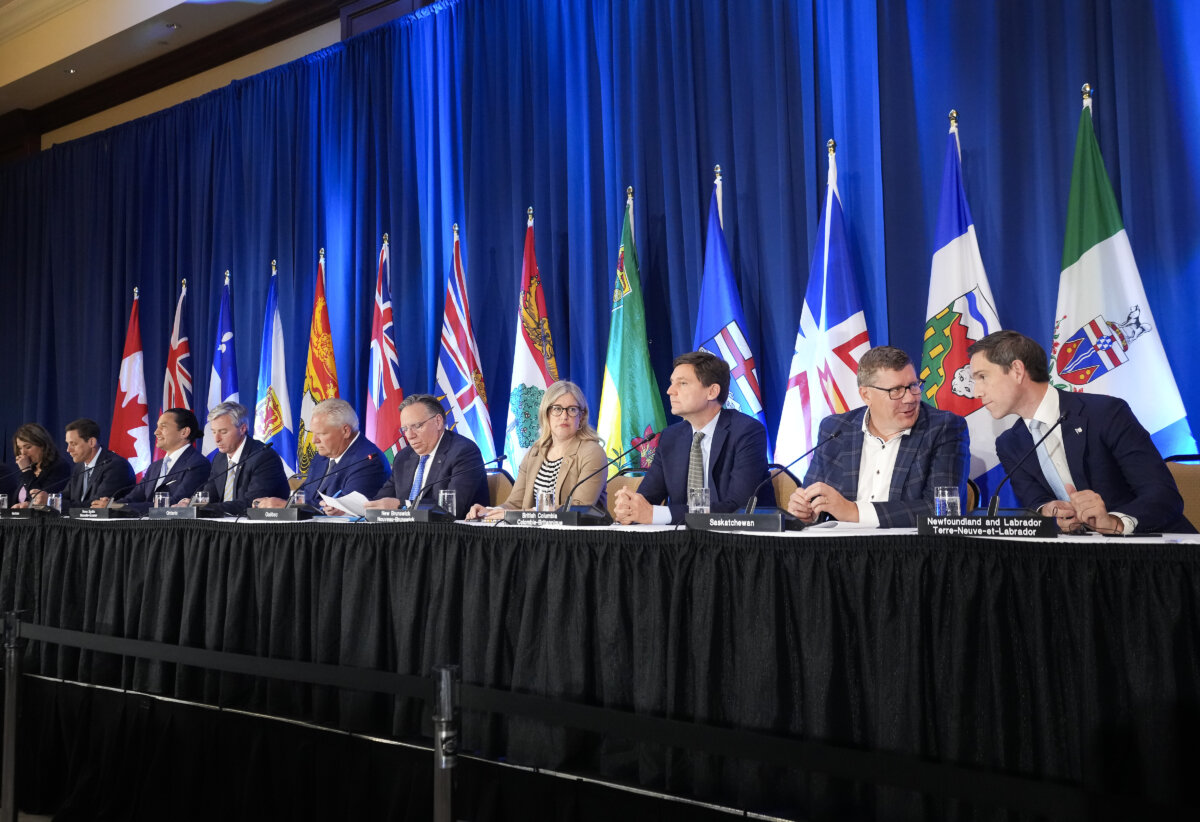 The Canadian premiers speak to the media during the 2025 summer meetings of Canada’s Premiers at Deerhurst Resort in Huntsville, Ont., on July 23, 2025. (The Canadian Press/Nathan Denette)
Fast-forward two years later, calls for tougher laws are still emanating from law enforcement and politicians, amid increased rates of violent crime involving incidents like home invasions and carjackings. Those calling for new reforms say C-48 did not go far enough to stem the violence.
This includes Premier Doug Ford’s government in Ontario, which in October 2024 called on Ottawa to “urgently” make a number of key changes to the Criminal Code to tighten bail legislation. Among the measures they sought was removing the possibility to obtain bail for those charged with “murder, terrorism, human trafficking, intimate partner violence, drug trafficking, criminal possession or use of restricted or prohibited firearms, and robbery (for example, carjackings and home invasions).”
Ontario also requested a “three-strike rule” to deny bail to repeat offenders, and a return of mandatory minimum sentences for serious crimes, which the Liberal government had removed in 2022 with its Bill C-5.
The federal Conservatives also made similar proposals during the election campaign this past spring, with Tory Leader Pierre Poilievre calling for a “three-strikes-and-you’re-out” law to prevent those convicted of three serious offences from getting bail, probation, parole, or house arrest.
On Sept. 11, Poilievre said his party would introduce the Jail Not Bail Act to bring a number of amendments to the Criminal Code. One change proposed would require judges to consider the full criminal history of the accused when deciding on bail.
Police forces have also pushed for stricter laws of late, with one association saying the system is failing Canadians.
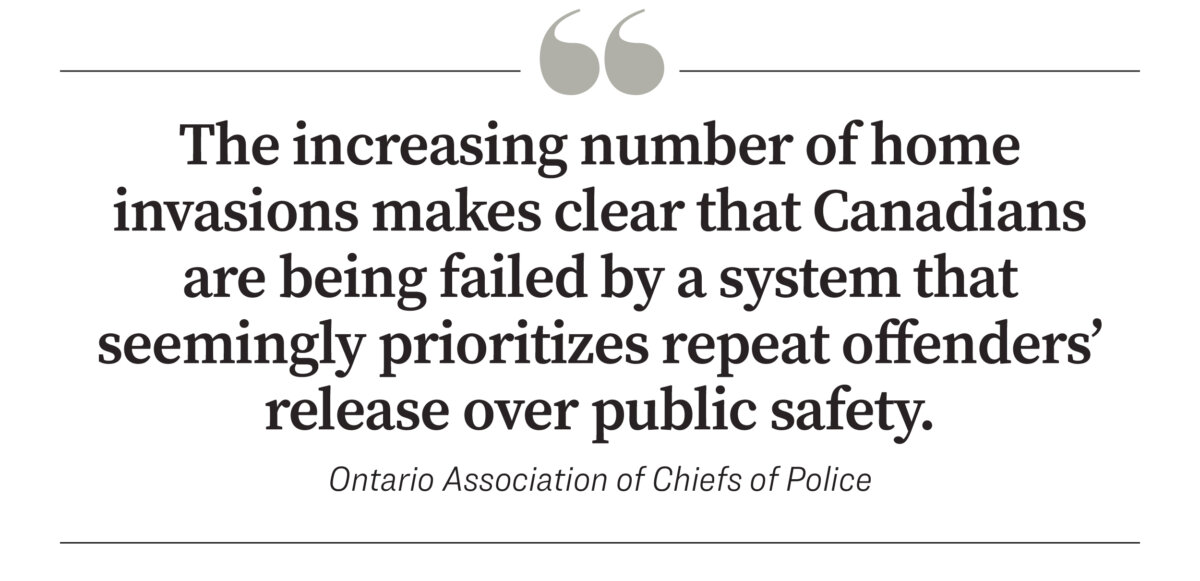
“The increasing number of home invasions makes clear that Canadians are being failed by a system that seemingly prioritizes repeat offenders’ release over public safety,” the Ontario Association of Chiefs of Police wrote in a Sept. 5 statement calling for reforms in the bail and corrections systems.
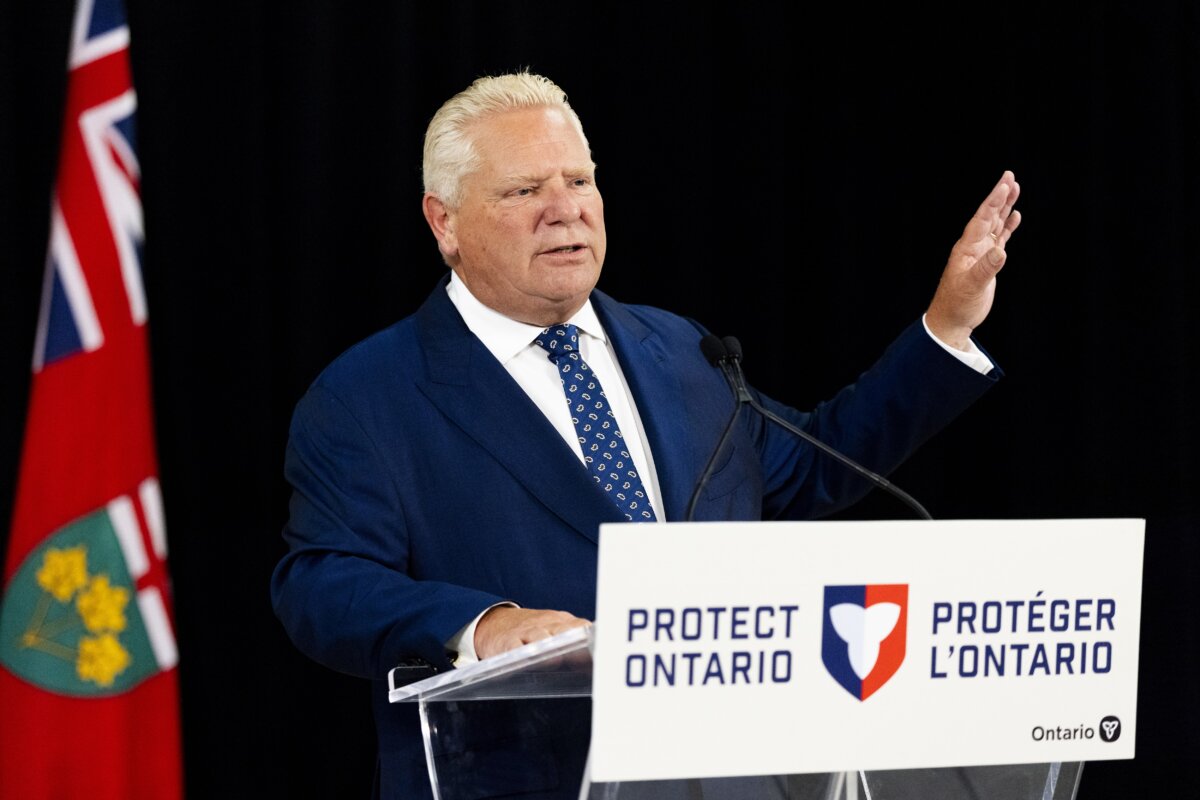 Ontario Premier Doug Ford speaks to the media during a funding announcement in Hamilton, Ont., on Aug. 20, 2025. (The Canadian Press/Carlos Osorio)
The chiefs were reacting to recent events, including the case of a father of four in Vaughan, Ont., who was gunned down in front of his children when confronting three male suspects during a home invasion.
Another case that caught national attention involved police laying aggravated assault and assault with a weapon charges against a man who allegedly used a knife to defend himself against a home invader. The invader was armed with a crossbow and was on probation at the time.
This led federal Conservatives to call for amendments to self-defence provisions in the Criminal Code to lessen the chances of prosecution for someone who uses reasonable force to defend his or her property.
“The fact that we are entertaining public discourse on how individuals should respond to violent repeat offenders shows how broken our justice system has become,” the Ontario police chiefs said in their Sept. 5 statement. Their police association said it recognizes the Charter right to reasonable bail and the presumption of innocence but noted that this needs to be balanced with the need to protect the safety of Canadians.
“We assert that, at this point in our time, the balance is off,” the chiefs said.
The police chiefs also called for minimum sentencing for those convicted to ensure “meaningful consequences.”
Criminal Code Changes
The Liberals under Prime Minister Justin Trudeau passed Bill C-5 in 2022 to repeal mandatory minimum sentences for a variety of violent offences, including robbery with a firearm. The Liberal government said this would be done to “address the overincarceration rate of Indigenous peoples, as well as Black and marginalized Canadians.”
The Trudeau government’s bail reform, by way of Bill C-75 in 2019, also carried the same intent focused on race. The Criminal Code was amended to include a provision for judges to give “particular attention” to the circumstances of an accused who is aboriginal or belongs to a “vulnerable population that is overrepresented in the criminal justice system.”
Such provision was applied when Ontario Superior Court Justice Harrison Arrell in June 2022 granted bail to Randall McKenzie, an indigenous man, who killed OPP Const. Pierzchala some six months later in December that year.
“First Nations people are grossly overrepresented in the prison system, especially in pre-trial custody,” Arrell said during the bail hearing in June 2022. “I don’t mind telling you it’s a very iffy case, but I do feel my obligation is something I can’t ignore—being a status Aboriginal.”
The judge went on to say that McKenzie’s heavy criminal history had “probably to do with his native background and education opportunities and employment opportunities and poverty.”
Bill C-75 also gave new direction to judges in adjudicating bail to primarily focus on releasing the accused as quickly as possible and on the “least onerous conditions that are appropriate in the circumstances.”
The Tories have criticized Bill C-5 and C-75 as being mainly responsible for the steady rise in violent crime seen in recent years.
“It’s Liberal laws, C-75, that allows criminals who have committed 150 or 200 offences to be released within minutes of their latest arrest,” Poilievre said in late August when calling for amendments to self-defence provisions in the Criminal Code. “It is the Liberal law C-5 that allows serious violent offenders to have house arrest or to get early parole.”
Upcoming Reforms
Justice Minister Sean Fraser said in June the Tories’ criticism of the issue is not the reason his government intends to introduce legislation this fall to address the crime wave, saying it’s obvious that changes are needed.
“We will be strengthening the system and cracking down on violent crime with new legislation this Fall,” Fraser said more recently in a social media post.
 (Philippe Huguen/AFP/Getty Images)
Fraser said the changes to the Criminal Code his government will propose include implementing stricter bail conditions and sentencing for offences related to organized crime, human trafficking, home invasion, and car theft.
This is similar to what the Liberals campaigned on during the spring election. In line with the approach of the Liberal government’s Bill C-48 in 2023, the party pledged to make it harder to get bail for those charged with “violent car theft, car theft for a criminal organization, home invasion, and certain human trafficking and smuggling offences” by creating a reverse onus for those crimes.
The Liberals also promised to toughen sentencing guidelines for repeat offenders of car theft and violent and organized crimes, and to allow for consecutive sentencing for these offences.
The Canadian Press contributed to this report.
 Friends Read Free
Copy
Facebook
Tweet
Friends Read Free
Copy
Facebook
Tweet