
Yemen’s Ansar Allah group, otherwise known as the Houthis, has claimed to have sunk a Greek-operated, Liberia-flagged cargo vessel in the Red Sea.
On July 7, Houthi military spokesman Ameen Hayyan said the vessel—named the Magic Seas—had sunk “completely” as a result of a Houthi attack.
In a post on social media platform X, Hayyan claimed that the vessel was targeted for violating the group’s unilateral ban on Israel-linked vessels traversing the Red Sea.
The Epoch Times could not independently verify his claim that the targeted vessel was sunk, nor have independent sources confirmed it.
On July 7, the UK Maritime Trade Operations (UKMTO) coordination center said it had received third-party reports of a cargo vessel coming under attack in the Red Sea by “multiple rocket-propelled grenades from small craft.”
In a subsequent update, it said the targeted vessel had “sustained significant damage and has lost all propulsion” and was “surrounded by small craft and is under continuous attack.”
The UKMTO did not mention the vessel or the Houthis by name but said the incident had occurred about 50 nautical miles off Yemen’s coastal Hodeidah province.
In a statement issued on the same day, Operation Atalanta, a European Union-run anti-piracy naval campaign, confirmed “the successful coordination … of the rescue of the MV MAGIC SEAS crew following an attack in the Southern Red Sea.”
Citing the EU’s Maritime Security Center Indian Ocean, Operation Atalanta said the targeted vessel had been attacked by “multiple small ships using different types of weaponry.”
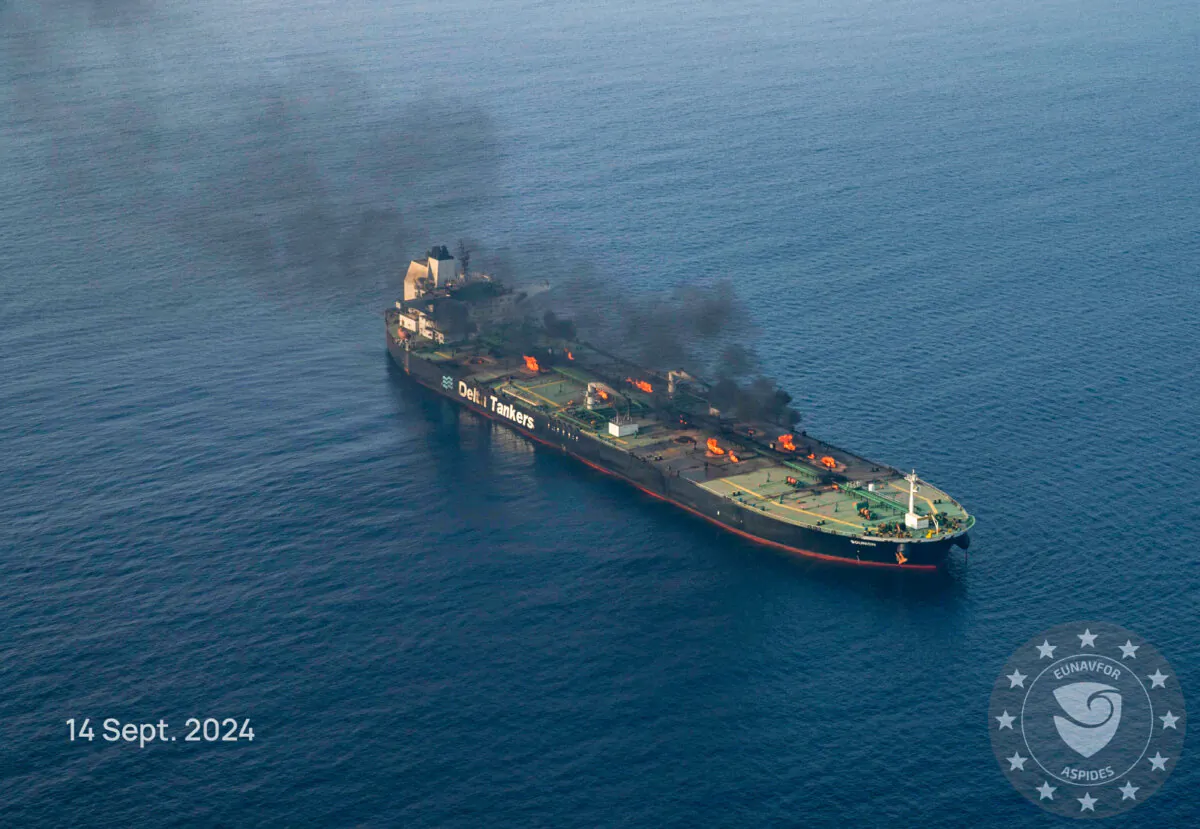
“Due to the damage suffered, which caused a fire on board, the crew abandoned the merchant vessel,” it said in the statement.
All 22 crewmembers were safely recovered, it added, “by establishing direct communication with the Designated Person Ashore of the company operating a passing merchant vessel that has rescued the crew.”
It was the first such attack on commercial Red Sea shipping since last November.
“After several months of calm, the resumption of deplorable attacks in the Red Sea constitutes a renewed violation of international law and freedom of navigation,” Arsenio Dominguez, secretary-general of the U.N. International Maritime Organization, said on July 8.
“Innocent seafarers and local populations are the main victims of these attacks and the pollution they cause.”
Since late 2023, when Israel began military operations in the Gaza Strip, the Houthis have staged intermittent attacks on Israel-bound ships in the Red Sea, causing disruptions to global trade.
Before the attacks, an estimated 12 percent of global commercial traffic had passed through the Red Sea via Egypt’s Suez Canal, including roughly 30 percent of all container traffic.
Repeated Houthi attacks since 2023 have served to reduce Red Sea commercial traffic by forcing international shipping companies to reroute much of their cargo.

2nd Attack Reported
On July 8, a Liberian shipping delegation told a U.N. meeting that two crewmembers aboard a Liberian-flagged, Greek-operated commercial vessel—named the Eternity C—had been killed in a similar attack off Yemen’s western coast.
As of publication time, however, the Houthis had not claimed responsibility for the reported attack.
On July 7, Israel struck Houthi targets in Yemen for the first time in almost one month.
According to the Israeli military, the strikes targeted three ports in Yemen—including one in Hodeidah—and a power facility.
Hours later, Israeli authorities said that two missiles had been fired from Yemen at targets inside Israel.
A May cease-fire deal between the United States and the Houthis does not apply to Houthi missile attacks on Israeli targets.
In a social media post, Hayyan, the Houthi spokesman, said the group’s air defenses were “prepared to confront Israeli attacks.”
Reuters contributed to this report.
 Friends Read Free
Copy
Facebook
Tweet
Friends Read Free
Copy
Facebook
Tweet