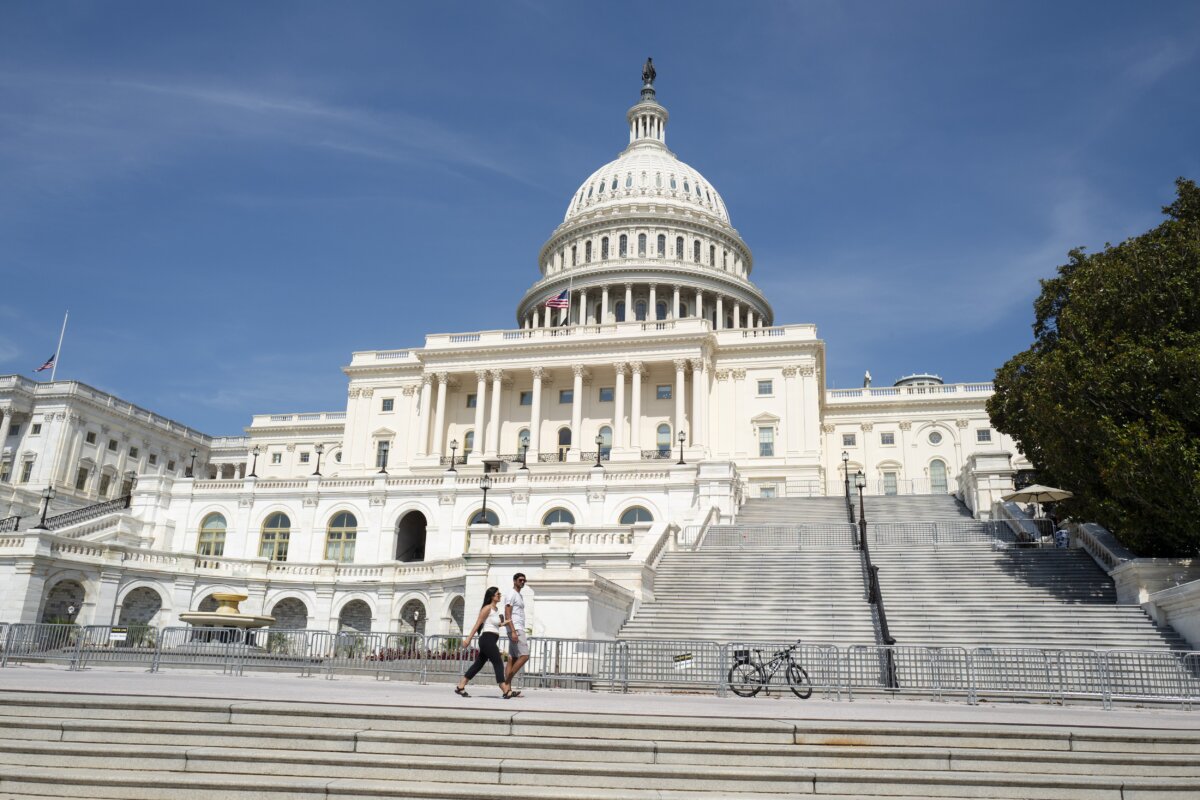

National attention is turning to the elections that will shape the last two years of President Donald Trump’s final term.
The Republican majorities in both the House and the Senate are at stake in November. Voters will also weigh in on key gubernatorial races.
Opinion polling suggests the economy is Americans’ top concern as Election Day—Nov. 3—draws near. Surveys have also found that voters are concerned about the state of the U.S. government, data centers, the Iran War, and immigration, among other issues.
Republicans currently control the lower chamber, with 218 seats to Democrats’ 214 seats. Despite GOP victories during this cycle’s redistricting war, Democrats are widely expected to reclaim the House amid declining approval ratings for the incumbent Trump administration.
In the Senate, Republicans are widely expected to retain their 53-seat majority. However, with Republicans slipping in the polls across key states like Maine, North Carolina, Georgia, and Texas, Democrats are within reach of reclaiming the upper chamber.
The election will also decide critical gubernatorial elections, with Republicans entering the election controlling 26 governors’ mansions to Democrats’ 24. Close races are expected in Ohio, Kansas, Michigan, Iowa, Georgia, and New Hampshire, among other states.
Though polling suggests Republicans face some headwinds, Austin Hein—a Republican strategist working on Bo French’s campaign for the Railroad Commission of Texas—was skeptical they tell the whole story.
Those surveys “always underestimate Republican voters,” he told The Epoch Times. “I believe that a lot of the doom and gloom narrative is overstated.”
Polling shows that the economy is front-of-mind for Americans by a wide margin.
Pew Research found that economic issues have been the driving political force this cycle for 29 percent of Americans. That aligns with data from Gallup and other pollsters.
“Voters are frustrated with gas prices, cost of living, inflation, and are looking for change,” Nicholas Gonzales of the nonpartisan campaign analysis platform Inside Elections said.
He told The Epoch Times that similar concerns drove the Republican victory in 2024.
Morgan Jackson, a Democrat advising former Gov. Roy Cooper in his Senate run, chalked up Democrats’ 2024 losses to the fact that his party “would not talk about the economy.”
“This cycle, you see Republicans caught in this place where they are only talking about crime and immigration, trans and other culture and social issues, when all voters want to hear from people is, ‘How are you going to make my life better?’” he said.
Hein said that while “the economy is not where we want it to be … this is still a bit of a Biden economy hangover.”
The Iran war has divided Americans, with polls from The Associated Press, The Economist, and other sources showing that most Americans disagree with how Trump has handled the conflict, with roughly one-third or fewer respondents backing the administration.
Another major concern for Americans, according to Pew Research, is government ethics and reform, with 9 percent labeling this a top priority.
Meanwhile, 7 percent of Americans described immigration as a top issue. Healthcare, foreign policy, and Trump each polled at around 5 percent.
A recent poll by Emerson College identified the same top-line issues, with economic worries leading the pack, followed by concerns about threats to democracy in the United States.
Data centers and artificial intelligence are also key priorities for voters as the primary season comes to a close.
Polls also suggest that House Speaker Mike Johnson (R-La.) faces a tough fight to keep his gavel in 2027.
Two years ago, with Trump at the top of the ticket, Republicans led the national House ballot by 2.6 percent.
However, without Trump to drive low-propensity Republican-leaning voters to the polls, the GOP has found itself in a more challenging electoral environment—though the party’s victories in the mid-decade redistricting battles could soften the impact.
In RealClearPolitics’ aggregate of generic ballot polls, Democrats lead by 8.3 percent.
If the November vote swings in line with that data—representing a roughly 10.9 percent shift toward Democrats—Republicans may be facing some unexpected losses.
Republicans will enter November controlling 53 seats in the Senate to Democrats’ 47.
Democrats would need to flip a minimum of four seats to unseat Senate Majority Leader John Thune (R-S.D.). Battlegrounds such as Ohio, Maine, and Alaska have long been at the center of the fight.
Over recent months, the battlegrounds have expanded generally, though not entirely, into GOP-leaning territory, including Kansas, Nebraska, Iowa, and Texas.
Observers have steadily raised the party’s odds of reclaiming the upper chamber as polling continues to show a strong lead for Democrats in some crucial races.
Governors’ races tend to be more isolated from national politics. This year, however, some of the same trends are emerging, even as Republicans prepare to enter the midterms with a slight edge.
Some key gubernatorial races are in Wisconsin, Michigan, Maine, Iowa, Georgia, Ohio, and Nevada.
Democrats lead polls in Wisconsin, Michigan, and Iowa.
The races in Georgia and Ohio are toss-ups, with both parties leading or tied in some polls. Recently, Republicans are also seeing tight polls in Texas, where Gov. Greg Abbott is facing a tough challenge from Democrat Gina Hinojosa.
READ MORE HERE
—Joseph Lord and Nathan Worcester
BOOKMARKS
The Pentagon pulled all of its B-1 bombers from a UK base after a suspected Iranian terrorist plot was reported by the British government earlier in the week. The supersonic, long-range heavy bombers belonging to the U.S. Air Force were stationed at RAF Fairford air base northwest of London, The Epoch Times’ Melanie Sun reports. “We can acknowledge … that all U.S. bombers that were deployed to RAF Fairford have re-deployed to their home stations in the United States,” a Pentagon spokesman said in an email.
A broad ecosystem of new-wave Christian influencers is shaping the discourse and taking evangelism online, The Epoch Times’ Beige Luciano-Adams reports. These new-generation influencers are embracing an aesthetically stripped-down approach that departs, at least in tone and technology, from the pomp and production of megachurches and televangelism.
Big hospitals are facing allegations of stifling competition and keeping barriers to entry high. The Epoch Times’ Lawrence Wilson reports on how federal regulators are responding, exploring the case of a struggling Ohio hospital that opens a window to the alleged anti-competitive tactics of healthcare corporations.
Trump over the weekend announced the creation of the Super Intelligence Force to coordinate federal efforts to maintain U.S. leadership in artificial intelligence. The Epoch Times’ Tom Gantert reports the group will engage with the public, various organizations, critical infrastructure providers, technology companies, and others.
 Friends Read Free
Copy
Facebook
Tweet
Friends Read Free
Copy
Facebook
Tweet