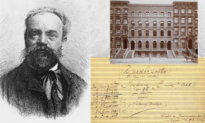
![[Left] Czech composer Antonín Dvořák (1841–1904), c. 1890, by S. Schottlaender of Breslau. (Kean Collection/Getty Images); [Top Right] Façade of the National Conservatory of Music of America (founded by Jeannette Meyers Thurber) in New York City, 1905. (Public Domain) [Bottom Right] The title page of the autographed score of Dvořák’s Ninth Symphony, or “From the New World,” a.k.a. “New World Symphony.” (Public Domain)](https://img.theepochtimes.com/assets/uploads/2026/10/05/id6099522-Antonin-Dvorak_National-Conservatory_Ninth-Symphony-1200x675.jpg)

Commentary
The head of the Hartford Symphony came out on stage for the opening concert of the season to give everyone a quick talk. He suggested that people consider buying full season tickets. It’s not just about saving money on purchases. It’s about having a routine, knowing that there is a concert calling next week, building in a ritual that is binding in some way.
More than that, he said, we live in times that are being gravely threatened by dehumanization. We interact more with digital systems than with people. But at the symphony, he said, there are real people, musicians who have mastered their instruments through thousands of hours of practice, and they are playing physical things.
There are bows drawn on gut and steel strings, real cymbals clanging together, mallets hitting drums, lungs powering brass, and a harpist using hands and figures to make the sounds of heaven appear before us. A season ticket shows your loyalty to the humane arts, to the beautiful, to the truth, to the analog world of genuine human achievement.
I sat there listening with an overwhelming sense that he was exactly right. For I, for the first time in my life, have purchased season tickets to this very venue. When they arrived, I flipped through the book of events and felt a great deal of excitement. They now sit in a drawer ready to be pulled out for the next concert and the next, as if this paper is concealing and then plans to reveal some of the highest achievements in the history of man.
These tickets have given my upcoming winter season a rhythmic center. I felt it that night on opening night. These are my people. This is my music. This is my place. It’s a home away from home. That’s a very nice feeling, one that stops that wandering sense of loss that we’ve all felt during these painful years.
It was all the better that the symphony played a new piece (I know, new pieces are usually terrible) that was a wonderful trombone concerto by British composer Dani Howard. It was in three movements, written in 2021 about the trauma of the pandemic years. It begins with essential workers busying themselves, while the soloist plays something that seems unaware, in his own separate world. It then moved to the second movement of gradually finding others with whom we could experience our sorrows. Then it ends with a rich celebration and hope for the future.
I’ve wondered what would happen to artistic creativity in light of the COVID calamity. This is one look. Loved it.
But nothing could compare with what came after intermission. It was Antonín Dvořák’s “New World Symphony.” He was a Czech composer, who wrote the work during his short stay in the United States. In 1892 the philanthropist Jeannette Thurber recruited him, at a high salary, to direct the National Conservatory of Music in New York, which she had founded to build an American school of composition. He held the post until 1895, when financial trouble ended the arrangement. He wrote this piece as a celebration of this great country.
The entire piece is just spectacular. I had heard recordings my whole life and this was my first hearing of it live. You have heard it said before but there is nothing to compare with live music.
By the time the last movement came around, my heart was racing to the militaristic and heroic melody at the end, unmistakable and justly famous, even if I cannot help but hear it all as slightly menacing in places.
Dvořák called his work “From the New World,” but listening to it live, I heard something older. It was the sound of people refusing to be alone. That militaristic, driving melody does not menace; it summons. It calls us out of our private digital caves and into the light of shared witness.
Anyway, what a joy that was, a perfect way to freshen up the first week of October. There is no way I would have been there but for my prized season tickets! The New World gives me the Old World that we need to re-inhabit, with its demands and its gifts, its obligations and its transcendence.
The symphony CEO was exactly right in what he said. We need rituals, big ones, a schedule that binds and roots us, exposure to many people, a schedule to take us out of the selfish desires of the moment (which usually means: be lazy and tool around on the computer) and impose obligations.
This is about more than developing a habit. It is about remembering what is really important, which is not our personal temporary indulgence, but about becoming bigger, better, and broader people. We must be around people regularly if only to avoid the ultimate trap of dehumanizing human contact.
Weekly church attendance once played this role for most people in the West. It was an obligation by virtue of one’s faith but also an opportunity to leave one’s own head space and think about bigger issues and other people. The loss of the ritual has surely had devastating cultural consequences because no one has really figured out a meaningful replacement. Office cocktails on Friday? I don’t think so.
This imposition of ritual is something that comes to new parents very early on, almost always as a shock. There is no snooze button on a baby, no opportunity to serve only when we want. It is constant, daily, hourly, for years. For many of us parents, having children is a lifesaver precisely because it forces us to give up our natural selfishness and turn over our will to something bigger and outside of ourselves. Children cause the realization: I matter less than those for whom I’m responsible.
This is likely the evolutionary purpose of repeated rituals in general, whether the class reunion, a birthday party, a New Year’s celebration, or even a sports session. The calendar should impose obligations on us so that we are never really tempted to believe that we are actually the sole authors of our own destiny. We are not and finding liturgical meaning in the course of life itself makes the point.
We are coming up to our famous holiday called Halloween. It is a fascinating holiday, widely popular among kids but which really represents a composite of All Souls and the old pre-Christian Day of the Dead which recognized the meaningfulness of ancestry.
That explains all the scary skeletons, ghosts, and ghouls, but the old religions did not treat them as terrible but as friends they could help with prayer and good works. Even now, Catholic and Orthodox religions pray for the dead. Halloween is that time. It also coincides with All Saints, which is another day to capture the sensibility of the old religions for the new one.
It’s true for the entire holiday season. Each day, and regardless of religious tradition, roots us and ties us to ideas and worlds outside ourselves. They force us to leave our selfish concerns and enter into a community activity. They leave us with a sense that the world outside our own brain still exists and still should occupy our main thoughts.
The self-obsessed mind, the person who only lives for himself and within his own self-created universe, too easily falls into psychopathology. Very often the best therapy is otherness, accountability to a social network, and something that forces us to leave personal obsessions in favor of family and community. Autonomy is the path to spiritual and intellectual doom.
The holiday season will come and go, the decorations packed away, but the need remains constant. We don’t need more content, more machines, more scrolling, more self-curated isolation.
What we need are stubborn, repetitive, inconvenient acts of showing up for something that asks more of us than we wish to give, and gives more than we dared to hope. Like church. Like concerts. Like dinner parties. Like spouses, children, and grandchildren. Like picnics, parties, reunions, dinner with friends, and pot lucks.
This is the rhythm that saves us from the smallness of the self. This is the music of life that reminds us we are home.
Views expressed in this article are the opinions of the author and do not necessarily reflect the views of The Epoch Times.
 Friends Read Free
Copy
Facebook
Tweet
Friends Read Free
Copy
Facebook
Tweet