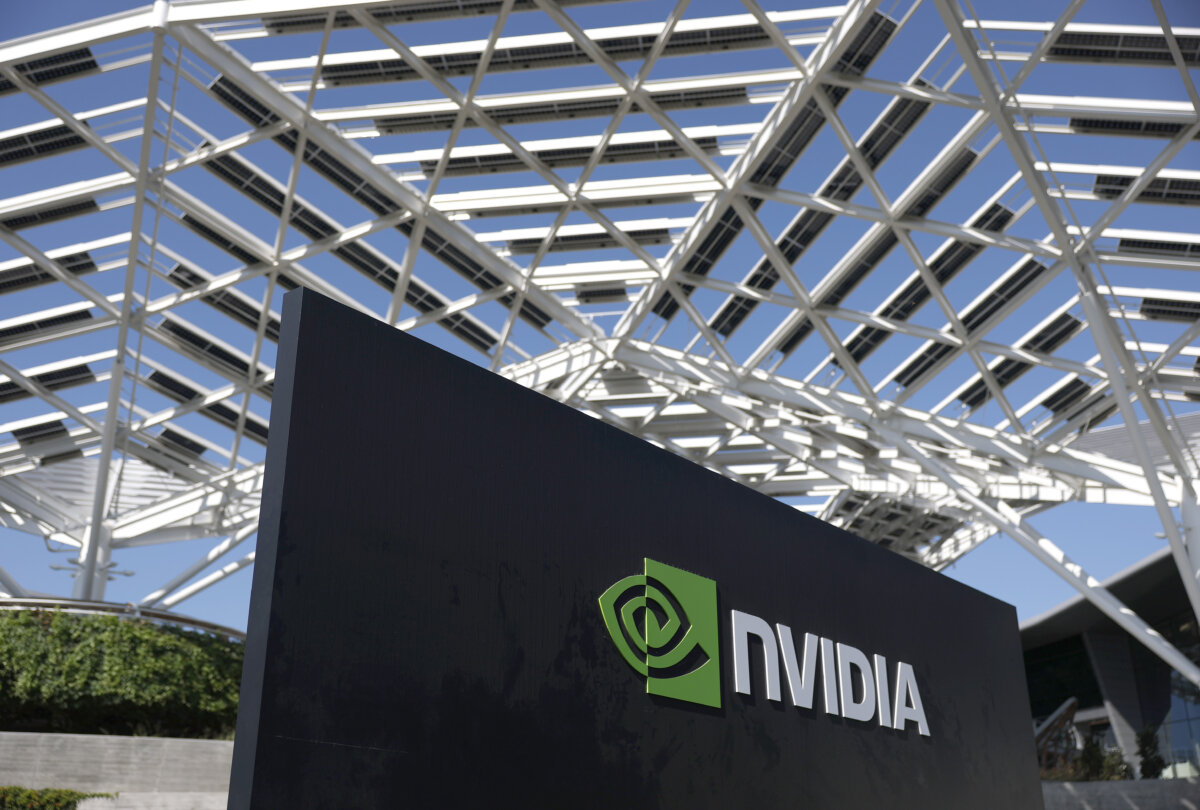


Chipmaker Nvidia reported record fiscal fourth-quarter and full-year 2026 sales on Feb. 25 and forecast revenue above market estimates for the first quarter of fiscal 2027, hedging its bets on a surge in tech industry investment in the company’s artificial intelligence (AI) processors.
Its shares rose by more than 3 percent following the report in extended trading but later pared the gains. As of 6:30 p.m. ET, the stock was nearly unchanged.
Nvidia reported record revenue of $68.1 billion for the November 2025 to January 2026 period—an increase of 20 percent quarter over quarter and 73 percent year over year, driven primarily by record data-center revenue of $62.3 billion. Analysts had forecast revenue of about $66.2 billion for the quarter.
The company reported earnings per share of $1.62 for the quarter, which exceeded the market forecast of $1.52 per share. It also reported record full-year revenue of $215.9 billion, up by 65 percent from fiscal 2025.
Meanwhile, the company expects sales of $78 billion for the first quarter of fiscal 2027, exceeding Wall Street analysts’ estimates of about $72.6 billion, according to data from the London Stock Exchange Group (LSEG).
“Enterprise adoption of agents is skyrocketing. Our customers are racing to invest in AI compute—the factories powering the AI industrial revolution and their future growth,” Jensen Huang, founder and CEO of Nvidia, said in a statement.
Prior to its earnings report, shares of Nvidia surged about 2 percent, lifting their year-to-date gain to almost 5 percent.
Wall Street remains significantly optimistic about the stock.
The consensus analyst rating is “Buy,” and the 12-month upside is 35 percent, according to MarketBeat.
The AI Trade
Similar to other hyperscalers, such asAmazon, Meta, and Oracle, Nvidia remains a crucial part of the AI trade.
With uncertainty surrounding the tech sector this year, market watchers say this has been one of the most crucial earnings cycles for Nvidia, Wall Street, and the AI trade.
Various concerns have arisen over the last several weeks. One is how much return on investment these companies will deliver to investors and even the wider economy.
Traders have been spooked by the likes of Amazon and Meta planning to raise their capital expenditures to keep the AI buildout running.
Jan Hatzius, the chief economist at Goldman Sachs, said last month that AI contributed “basically zero” to U.S. economic growth in 2025.
“We don’t actually view AI investment as strongly growth positive,” said Hatzius at a Jan. 8 Atlantic Council event.
“I think there’s a lot of misreporting, actually, of the impact AI investment had on U.S. GDP growth in 2025, and it’s much smaller than is often perceived.”
This is because a lot of the AI equipment is imported.
So, while this is positive for the GDP report’s investment line, it is offset by the drop in net exports, he said. This means the United States is contributing to the GDP of South Korea and Taiwan rather than domestic growth prospects.
This view contradicts the popular narrative that AI is playing a vital role in the economy’s expansion.
A Jan. 12 paper by economists at the Federal Reserve Bank of St. Louis estimated that AI-related investments accounted for more than one-third of GDP growth in the third quarter of last year.
U.S. economic growth unexpectedly slowed to 1.4 percent in the fourth quarter following a 4.4 percent expansion in the July-September period. For the full year, the U.S. economy expanded 2.2 percent, below the previous year’s boost of 2.8 percent.
The other worry is how much debt the tech giants will take on to continue building AI infrastructure.
Scores of tech companies have been issuing bonds over the last several months, including Google-parent Alphabet, which offered a century bond to capital markets earlier this month.
Still, according to Luke Rahbari, co-portfolio manager at The Rational Equity Armor Fund, investors view Nvidia as a proxy for the AI-fueled market’s health and where AI investing is going
“Everyone looks at Nvidia to see what they’re saying and what they’re doing, and also the investments they’re making in some of the other well-known companies that buy Nvidia chip,” Rahbari said in a note emailed to The Epoch Times.
“They’re the leader, and I think everyone follows,” Rahbari said.
All eyes will be on Nvidia’s GPU Technology Conference next month. Industry observers say the company will likely unveil next-generation AI chips, new software platforms, and expanded partnerships.
The tech-heavy Nasdaq Composite Index rose about 1 percent on Feb. 25, paring its year-to-date loss to around 0.5 percent.
 Friends Read Free
Copy
Facebook
Tweet
Friends Read Free
Copy
Facebook
Tweet