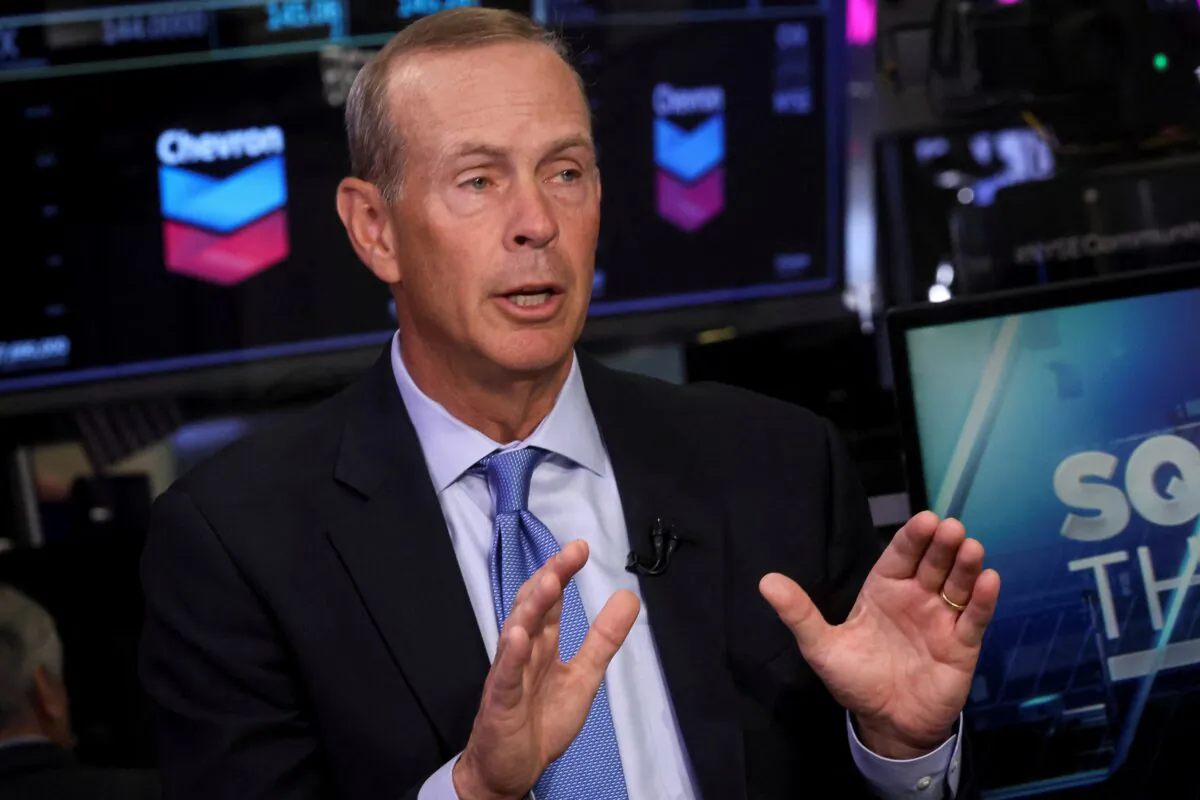
Chevron CEO Michael Wirth said on May 4 that physical shortages in oil supply would begin appearing around the world because of the closure of the Strait of Hormuz.
“We will start to see physical shortages,” Wirth said during a discussion sponsored by the Milken Institute.
“Demand needs to move to meet supply. Economies are going to have to slow.”
Asia is most heavily dependent on the Gulf’s oil production and refineries, with Europe likely to be affected next, Wirth said.
Since the United States and Israel began strikes on Iran on Feb. 28, and Iran’s response targeting its Gulf neighbors and commercial shipping, traffic through the Strait of Hormuz has slowed sharply. U.S. Central Command said on April 13 it began enforcing a naval blockade on vessels entering or leaving Iranian ports.
The overall effect of the Hormuz closure is “potentially as big as in the 1970s,” Wirth said.
Two major supply disruptions—the 1973 Arab oil embargo and the 1979 Iranian Revolution—shook economies around the world during that decade.
In 1973, the oil embargo was triggered by the Yom Kippur War, in which Egypt and Syria attacked Israel in October that year. In response to U.S. and Western support for Israel, major Arab oil producers and members of OPEC cut supplies to those countries, which caused fuel shortages, soaring prices, and a global economic crisis.
In 1979, the Iranian Revolution overthrew Shah Mohammad Reza Pahlavi, a key U.S. ally, and severely disrupted Iran’s oil production and exports.
During a May 4 interview with Bloomberg, Wirth said he advised the Trump administration that the supply situation is tightening.
He said that he had advised people in the administration that the “buffers in the system that help ensure supplies are available to markets are being drawn down.”
“And what that does is it creates more upside price pressure, potentially more volatility, and more risk,” he said.
He said that the United States cannot offset the Hormuz supply shock.
“The U.S. is the largest producer in the world, and we’ve been exporting products, crude oil, gas, in growing quantities in recent years. And so it’s a good thing for the world that the U.S. is able to help meet the need,” he said.
“That said, 20 percent of the world’s energy supply flows through the Strait of Hormuz. That’s oil, that’s liquefied natural gas, it’s refined products,” he said, adding that this goes to Europe and Asia primarily, and both of those regions “are seeing the impact of having that much cut off.”
“The U.S. can’t make up all of that supply. Inventories in the system are being drawn down and the supply situation is tightening, and that’s a concern.”
Because of the Hormuz closure, Spirit Airlines went out of business over the weekend as the cost of jet fuel surged amid tighter supplies.
Spirit was already struggling to turn a profit before the fuel shock and has faced $100 million in incremental fuel costs since March 1.
“The material additional costs to Spirit proved to be too much for its available liquidity to absorb,” Spirit said.
“Having fought valiantly for months to reorganize, and having all but succeeded, [Spirit is] left with no alternative to an orderly wind-down of operation,” Spirit Airlines CFO Fred Comer said on May 4 in a court filing.
The Dutch government on April 20 estimated that the European Union could supply enough kerosene, which is used as jet fuel, to the EU’s economy to last about five months.
International Energy Agency Executive Director Fatih Birol said on April 16 that Europe has “maybe six weeks or so [of] jet fuel left.”
He said that, for Europe, if the Strait of Hormuz isn’t reopened, “I can tell you soon we will hear the news that some of the flights from city A to city B might be canceled as a result of lack of jet fuel.”
Guy Birchall and Reuters contributed to this report.
 Friends Read Free
Copy
Facebook
Tweet
Friends Read Free
Copy
Facebook
Tweet