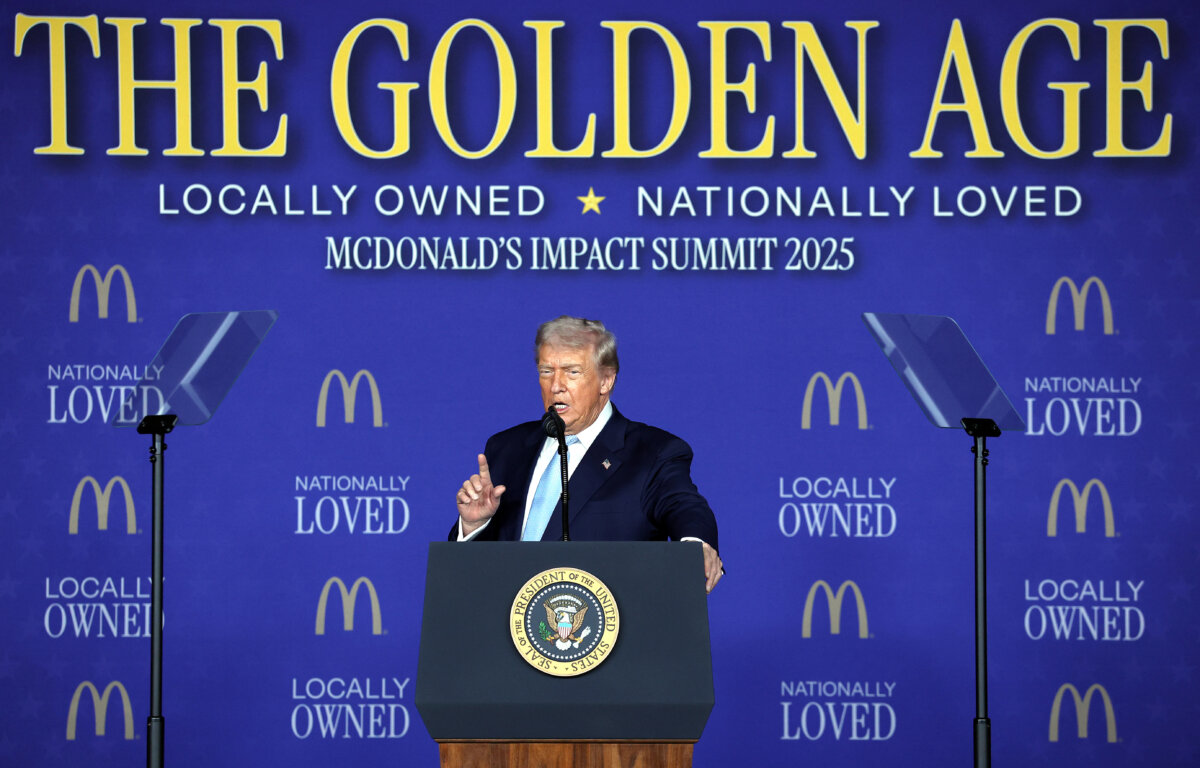


President Donald Trump on Monday evening spoke on affordability in the United States, saying that tax cuts passed by Republicans, as well as increased energy production, will lead to falling costs for American consumers.
Trump spoke at the McDonald’s Impact Summit, with his remarks fitting into an environment of inflation and economic anxiety that has chipped away at Americans’ confidence in the U.S. economy.
Delivering remarks to an audience of owners, operators, and suppliers, the president noted a variety of areas where prices have been falling—including Thanksgiving items at Walmart, McDonald’s food, energy prices, and others.
Trump acknowledged that inflation remained.
“We took over a mess,” he said of his predecessor’s tenure. “We had the highest, think of it, the highest inflation in the history of our country.”
While other periods of U.S. history, most prominently the 1970s, have seen higher inflation, President Joe Biden’s four-year term in the White House was marked by rising costs that were attributed in part to the lingering impacts of the COVID-19 pandemic.
Trump vowed that the administration would take steps to reduce inflation, which he suggested would be achieved partly through his administration’s energy policy.
He also highlighted tax cuts and other provisions of his signature One Big Beautiful Bill Act.
“I proudly gave you the largest tax cuts in American history and signed the One Big Beautiful Bill … into law that includes no tax on tips, no tax on overtime, and no tax on Social Security for our great seniors,” Trump said.
The Big Beautiful Bill Act provided permanent extensions to tax cuts for top earners and other tax cuts included in Republicans’ 2017 tax bill. Deductions for tips and overtime are limited to $25,000 in income, and these deductions will expire three years after taking effect.
Trump suggested that these tax cuts were a critical component of the administration’s affordability push.
He said rolling back regulations would also be part of his administration’s anti-inflation strategy, suggesting that such regulation cuts could reduce costs for consumers.
The fast food titan’s event will feature other speakers, including New York Gov. Kathy Hochul, Maryland Gov. Wes Moore, and former Chicago Mayor Rahm Emanuel.
Renewed concerns about the cost of living have sparked momentum for Democrats, who secured victories in multiple off-year elections, while prompting the White House to try to assuage the public’s economic fears.
On Nov. 14, the president signed an executive order applying exemptions to a wide array of agricultural products, including bananas, beef, cocoa, and coffee.
In recent months, prices for these goods have increased due to tariffs and other non-tariff factors.
Prices for coffee—primarily imported from Brazil, Vietnam, and Colombia—have surged almost 20 percent over the past year. The average cost of a pound of ground roast coffee rose to $9.14 in September, up from $6.47 a year earlier, according to the Labor Department.
Bananas have risen by about 7 percent in the 12 months ending in September. The average price for beef has climbed to $6.33 per pound, up 15 percent from a year ago.
Since January, overall food prices have climbed 1.9 percent—compared to nearly 7 percent in the previous administration’s first year.
The idea of $2,000 tariff rebate checks has been resurrected, months after being proposed by Tesla Motors and SpaceX CEO Elon Musk. Officials later clarified that income limits could be attached to the rebate.
In the past month, the administration has also focused on improving housing affordability, proposing 50-year mortgages, as well as portable and assumable mortgages.
Still, U.S. consumer sentiment in November plummeted to its lowest level since June 2022, as Americans have become increasingly worried about economic conditions—a concerning sign heading into the holiday season.
Trump’s approval rating on the economy, meanwhile, stands at almost 41 percent, according to RealClearPolitics’ polling average.
Grappling With Affordability
Despite his upcoming speech, Trump has dismissed concerns about affordability.
“In fact, costs under the Trump administration are tumbling down, helped greatly by gasoline and energy. Affordability is a lie when used by the Dems. It is a complete con job,” Trump said in a Nov. 14 Truth Social post.
While crude oil prices have declined about 18 percent this year, the national average for a gallon of gasoline is little changed from a year ago, hovering slightly above $3.
Treasury Secretary Scott Bessent, appearing last week on MSNBC’s “Morning Joe,” echoed the president’s remarks.
“I believe even this morning, you had two people come on and say, ‘Well, I look at the price of the pump and I know costs are up.’ Well, gasoline is down. So that is a con job. And I think that’s what’s frustrating,” Bessent said.
In his Nov. 14 post, Trump reiterated his statement from a previous post that prices for a Thanksgiving dinner are down 25 percent from 2024. The president’s comment references Walmart’s annual basket, which costs nearly $40.
This year’s package, which Walmart says feeds 10 people for less than $4 a person, includes fewer food products than its 2024 basket. The 2024 meal served eight people for less than $7 per person, according to the retailer.
That said, the Wells Fargo Agri-Food Institute released its 2025 Thanksgiving Food Report, projecting that the cost of a 10-person Thanksgiving feast will be 2 to 3 percent lower for families compared to a year ago.
Ultimately, Bessent says, the Trump administration inherited elevated inflation from President Joe Biden.
“We inherited this terrible inflation. We are flattening it out. I believe we’re going to push it down, and energy prices are down, interest rates are down,” Bessent told Fox Business’s “Sunday Morning Futures” on Nov. 16. “But the real thing that is going to happen [is] that [this] is going to give Americans real purchasing power increases. It’s going to be through growth.”
The current headline annual inflation rate sits at 3 percent.
In addition to inflation, growing worries over warning signs of a “K-shaped economy” have garnered attention over the last several weeks. Across the U.S. economy, economic observers are pointing to data and trends signaling an increasing divergence in the marketplace, from fast-food patronage to vehicle sales.
The term describes a split economic environment, with one arm of the “K” representing individuals and sectors enjoying robust gains, and the other reflecting deepening hardship among low-income earners and small enterprises.
 Friends Read Free
Copy
Facebook
Tweet
Friends Read Free
Copy
Facebook
Tweet