
The Trump administration announced, delayed, and then enacted 50 percent tariffs in August against an estimated $20 billion worth of goods coming from Canada, citing Section 338 as its authority for doing so.
The White House said on its website that “Canada has been ripping off the United States for decades—and President Donald J. Trump is done letting them get away with it.”
Canadian Prime Minister Mark Carney said on Aug. 22, “We are walking away from a bad deal.”
Carney pledged that his nation would “match Washington’s new tariffs dollar for dollar in order to protect Canadian workers, farmers, families, and businesses.”
Here’s what to know about the law and what goods it affects for American consumers.
What the Law Says
Section 338 was passed as part of the Tariff Act of 1930.
This law is popularly known as the Smoot-Hawley tariff because of the bill’s chief sponsors in the Senate and House. Reed Smoot was a senator from Utah. Willis Hawley was a representative from Oregon. Both were Republicans.
That section of the legislation was titled “Discrimination by Foreign Countries.” It gave the president of the United States some powers to redress discrimination in trade policy through “additional duties,” meaning tariffs.
These additional duties may come into play when the president determines that another nation has imposed an “unreasonable charge, exaction, regulation, or limitation” on a product from the United States “which is not equally enforced upon the like articles of every foreign country.”
The section also gives the president power to ban importation of those specific products, at least, from the country in question if, “after the issuance of a proclamation,” the other country has “maintained or increased its said discriminations against the commerce of the United States.”
What’s Left of Smoot-Hawley
What that means in practice is an open question because Trump is the first president to invoke Section 338 as a basis for leveling tariffs.
“This law is literally a blank canvas because it’s never been litigated,” Ryan Majerus, a partner at King & Spalding and a former U.S. trade official during the Obama and first Trump administrations, said.
One reason for that is that Smoot-Hawley had been seen as a dead letter. It was blamed by many economic historians for contributing to America’s Great Depression, a period of economic stagnation that lasted roughly a decade from 1929 to 1939.
Large sections of Smoot-Hawley have been overwritten by subsequent legislation. The current congressional document, created in 2025, explains that it has been “extensively amended” by trade agreements with Canada and Mexico, and that the first two sections have been wholly replaced by the Harmonized Tariff Schedule of the United States.
Will the Courts Allow It?
The Supreme Court ruled against the administration’s efforts to tariff most nations in February, finding the law that it relied upon—the 1977 International Emergency Economic Powers Act—did not include a broad authorization for the U.S. president to issue tariffs.
Section 338 does include presidential authorization to tariff and even shut down some trade, but that power comes with conditions. The U.S. president must put forward the charge and evidence of trade discrimination, on a nation-by-nation basis.
At least some of that could be subject to judicial review.
After the Supreme Court decision in March, Trump said that he had the “absolute right” to level tariffs in another form, and had “already started to do so.”
Section 338 is one of the justifications the Trump administration has used to pursue tariffs since then. It is one of five grants of power that Congress has made to the president to issue tariffs, according to a report published by the Congressional Research Service in March, and the administration is pursuing several different types of tariff claims at once.
What Goods Are Now Tariffed?
“President Trump is imposing a 50 percent tariff on nearly $20 billion in imports from Canada, which will take effect in 30 days,” the Office of the U.S. Trade Representative announced on July 20.
In the first round of Section 338 tariffs against Canada, goods that are subject to 50 percent tariffs include most dairy products, most alcohol, hockey jerseys, and a broad basket of other products. Items tariffed include agricultural products, textiles, wood products, cement, furniture, consumer goods, and equipment in the categories of refrigeration, filtration, sealing, filtering, mixing, grinding, and screening, according to the law firm Holland & Knight.
What that means in practice is that Americans and Canadians should expect to pay more for imported products from the other nation, or for products that are made from those imported products.
Trump has urged companies in the past to “eat the tariffs,” meaning to pay for the cost increases out of profits, but significant research has suggested that American consumers end up bearing the vast majority of the costs through price hikes.
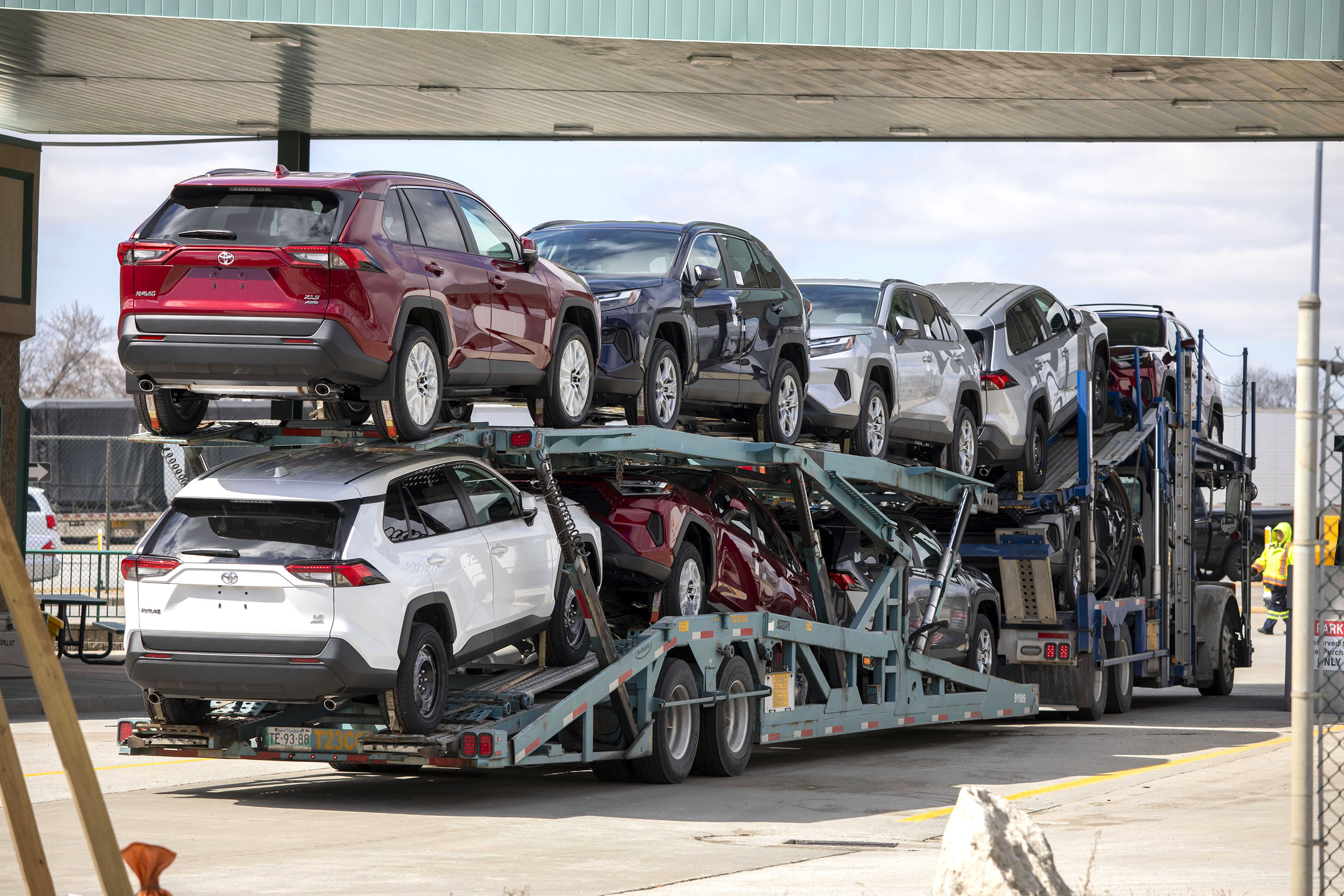 A car hauler truck gasses up at a duty-free station before crossing into Detroit in the United States, in Windsor, Canada, on April 1, 2025. (Bill Pugliano/Getty Images)
What About Cars and Trucks?
The Trump administration has also announced 50 percent tariffs coming next January on Canadian-made cars, trucks, and some steel and automotive parts.
That tariff application does not rely upon Section 338 of Smoot-Hawley but rather on claims under Section 232 of the Trade Expansion Act of 1962.
The auto tariffs would add anywhere between about $10 billion and about $28 billion in additional tariff duties annually, starting next year, according to Global Trade Alert data. The wide range estimate is owing to the fact that the White House has yet to announce all the details.
Auto companies would pay for it on point of entry, and ultimately American consumers would pay more for many of their vehicles. Stellantis, which manufactures its Pacifica minivans in Canada and credited the vehicles, in part, for its great second quarter this year, might be squeezed by the tariffs.
Trump has signaled that he is okay with that. “Tariffs on all Cars, Trucks, both large and small, Automotive parts, and Steel, will be increased to 50%,” he wrote on Aug. 24. “Build in the U.S. and there are ZERO TARIFFS.”
The Associated Press contributed to this report.
 Friends Read Free
Copy
Facebook
Tweet
Friends Read Free
Copy
Facebook
Tweet