



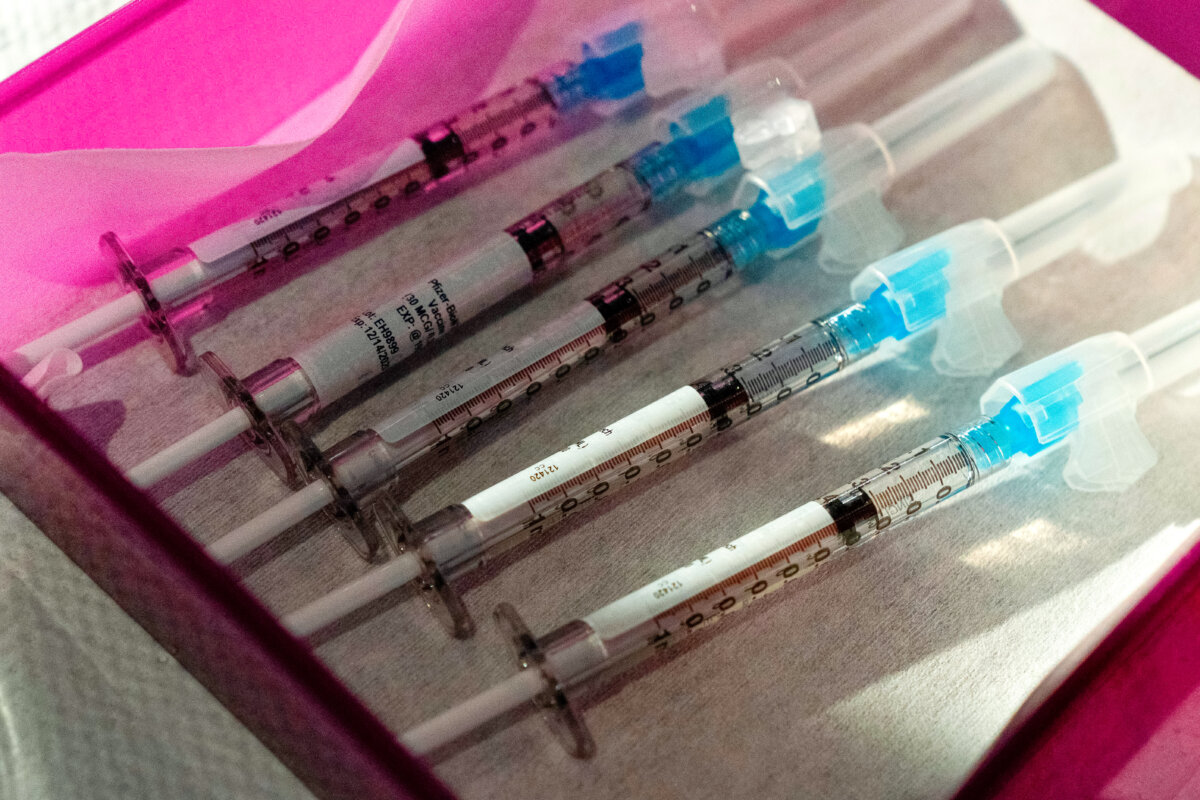
Advisers to the Food and Drug Administration (FDA) on June 5 advised the regulatory agency to direct vaccine manufacturers to produce new COVID-19 vaccines targeting the JN.1 virus variant.
Advisers voted 16–0 to recommend monovalent updated vaccines, after being barred from considering bivalent formulations. They then made clear that the updated vaccines should target JN.1, as opposed to one of the dominant or soon-to-be dominant strains.
According to federal surveillance, JN.1 was dominant as of April 27 but was estimated to have been displaced soon after by KP.2, a JN.1. sublineage.
Officials with Pfizer, Moderna, and Novavax presented data obtained from animal testing that suggested that vaccines targeting JN.1 worked against the variant and its sublineages. While Pfizer and Moderna can more quickly switch to different formulations, Novavax is already producing a protein-based JN.1 vaccine with an eye toward a fall release, helping convince advisers to stick with a recommendation for a JN.1 formulation across the board.
“The potential for immunogenicity from JN.1 vaccine to cover those variants seems to be pretty good. Antigenically, they’re very close,” Dr. Archana Chatterjee, one of the advisers, said during the meeting. “We’re not going to try to chase variants. Whatever we recommend today is probably not going to be circulating a few weeks or a few months from now.”
Dr. Mark Sawyer said that he “did not hear a compelling reason to favor a different strain,” and other panelists said it was important for all three vaccines to be the same formulation to avoid confusion.
“If we’re going to stick with a monovalent for now, the trunk of the tree is the best bet,” said Dr. Bruce Gellin, another panelist.
The vote came after the advisers, who are on the Vaccines and Related Biological Products Advisory Committee, heard that the currently available vaccines provide protection that wanes quickly, particularly against JN.1. The vaccines, cleared in fall 2023, target XBB.1.5, which went nearly extinct in the United States months ago.
“Waning patterns appeared similar to previous COVID-19 vaccine formulations,” Dr. Ruth Link-Gelles, a government health official, told the committee.
Although a year has not gone by since those vaccines were cleared, with former versions of the vaccines, “the protection by the end of a full year out from a vaccine against hospitalization was about zero,” she later noted.
Pfizer, Moderna, and Novavax say that their vaccines will be ready by August, in time to introduce a fresh fall vaccination campaign.
The World Health Organization and European Medicines Agency previously recommended updating the COVID-19 vaccines to target JN.1. or one of its sublineages.
The FDA has already signaled that it wants updated shots, but officials can choose to disregard the committee’s advice and tell manufacturers to target KP.2 or another subvariant, although the agency typically follows the advice. The FDA could also opt to have Novavax’s JN.1 shot and KP.2 vaccines from Pfizer and Moderna in play at the same time.
“I think we hear loud and clear that you’re happy with the JN.1,” Dr. Peter Marks, director of the FDA’s Center for Biologics Evaluation and Research, said after the vote.
If they decide to go with JN.1, then the agency would likely direct all three manufacturers to target the strain, he said.
No timeline on the decision was offered.
Ninety-five percent of the COVID-19 vaccines administered in the United States in 2023 were from Pfizer or Moderna, according to Dr. Marks. Both vaccines use modified messenger RNA technology; Novavax’s shot is protein-based.
A fourth vaccine, from Johnson & Johnson, was cleared by the FDA in 2021 but later pulled from the market after it was linked to often fatal blood clotting.
The three available vaccines can cause heart inflammation and other serious conditions, but authorities say the problems are rare enough that the benefits of the vaccines outweigh the risks. Some experts say that’s not true, particularly for populations such as healthy young people who face little risk from COVID-19. The United States recommends COVID-19 vaccination for virtually every person six months old or older, while many other countries recommend the vaccines for higher-risk groups such as the elderly.
Officials did not present updated safety data on the XBB.1.5 vaccines, drawing criticism from some of the panel members. Dr. Michael Nelson, one of the panelists, said there was a “striking absence” of gender, race, and safety data.
“There were no new safety concerns with this year’s vaccines,” Dr. Marks said.
He said that next time around, the FDA would arrange safety presentations.
The COVID-19 vaccine model in the United States seems to have fully transitioned to an annual update, similar to influenza vaccines.
“I think we’ve pretty much settled on once a year is practical,” Jerry Weir, director of the FDA’s Division of Viral Products, said during the meeting. “More than that will depend on other circumstances like emergencies.”