



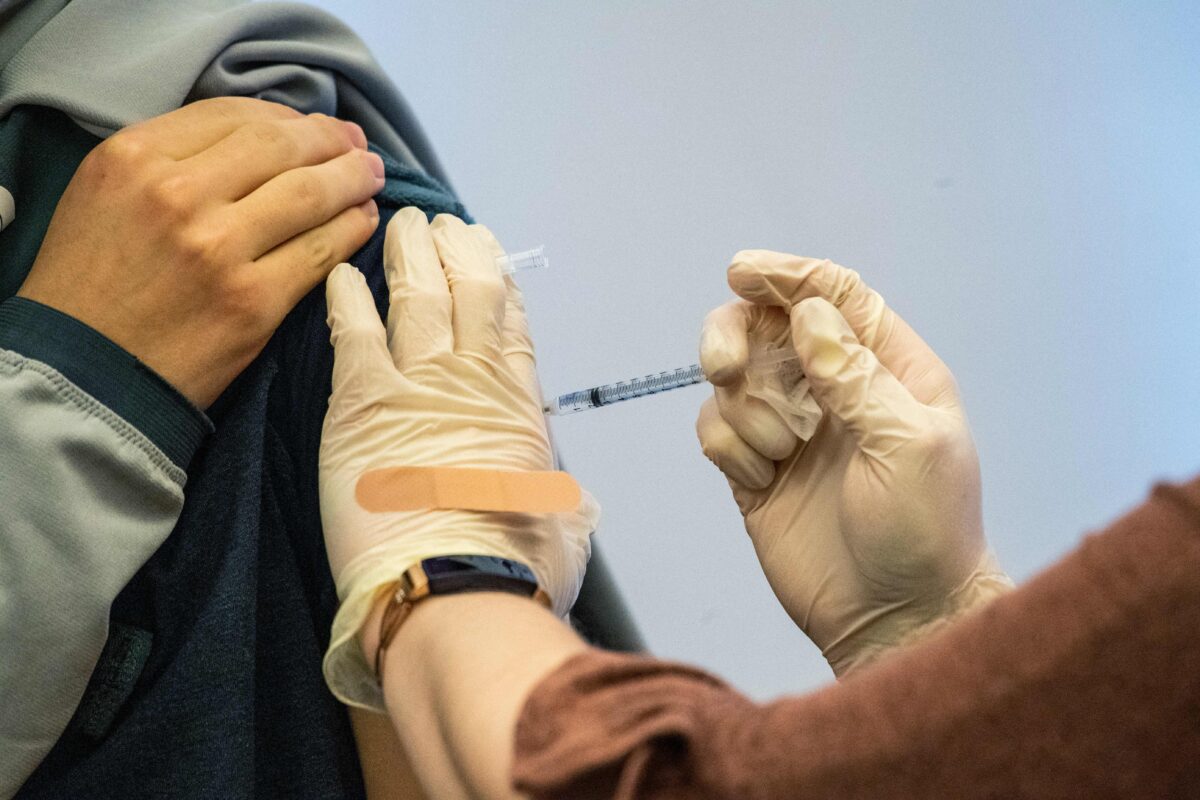
The Pfizer-BioNTech COVID-19 vaccine may become unavailable for some children, according to an email sent to state health officials.
The Food and Drug Administration, which has granted Emergency Use Authorization (EUA) for the vaccine for some children, “recently notified Pfizer of its intent to potentially NOT renew the EUA,” the Centers for Disease Control and Prevention said in an Aug. 8 memo, a copy of which was reviewed by The Epoch Times.
If the EUA is not renewed, the shot will no longer be available for children aged from 6 months to 4 years.
For children aged 5 to 11, Pfizer has told the CDC that it expects approval of its vaccine for the upcoming virus season, which starts in the fall and runs into the winter.
“We are currently in discussions with the agency on potential paths forward and have requested that the EUA for this age group remain in place for the 2025–2026 season,” a Pfizer spokesperson told news outlets in a statement.
Inquiries sent to the FDA and CDC were referred to their parent agency, the Department of Health and Human Services (HHS).
“The COVID-19 pandemic ended with the expiration of the federal public health emergency in May 2023,” Andrew Nixon, an HHS spokesman, told The Epoch Times via email.
“We do not comment on potential, future regulatory changes. Unless officially announced by HHS, discussion about future agency action should be regarded as pure speculation.”
The CDC said in its email that officials are in discussion with Moderna, which manufactures a COVID-19 vaccine called Spikevax.
Pending FDA approval of an updated formulation for Moderna’s vaccine, the company has confirmed it plans to increase the supply of its vaccine for children aged 11 and younger, according to the CDC.
“Moderna is currently finalizing internal planning to determine specific volume and timing and is actively working to help mitigate any potential supply gap,” the CDC email stated.
A Moderna spokesman did not respond to a request for comment.
Novavax’s vaccine is only cleared for individuals 12 years of age and older.
State health officials said they are working with partners after learning Pfizer’s vaccine may not be available for younger children.
The Washington State Department of Health “will begin working with our vaccine providers across the state to update plans for orders given this information,” a spokesperson for the department told The Epoch Times in an email.
“Our goal is to ensure continuity of access to vaccines as we approach the winter respiratory virus season.”
Different Approach
The FDA under new leadership has taken a different approach to COVID-19 vaccines. Instead of continuing to approve the shots for all individuals aged at least 6 months, officials have only approved three shots—two from Moderna and one from Novavax—for people younger than 65 who have at least one condition that the CDC says places them at higher risk of severe disease, as well as all the elderly.
In its next meeting, the CDC’s vaccine advisory committee is expected to consider which populations should be advised to receive the vaccines. The FDA clears vaccines, while the CDC issues recommendations for them.
The FDA last took action on Pfizer’s vaccine for children in 2024. Regulators at the time extended EUA for all children aged 6 months to 11 years.
Pfizer’s Comirnaty was approved in 2024 for all individuals aged 12 and older.
The FDA’s recent approval of Spikevax included children as young as 6 months of age.
Just 5.6 percent of children aged 6 months to 4 years, and 15 percent of children aged 5 to 11, received one of the COVID-19 vaccines in late 2024 or early 2025, according to the CDC. During that time, the shots were available to those aged 6 months and older, regardless of risk condition.
The Pfizer and Moderna vaccines are made with messenger ribonucleic acid (mRNA) technology.
Health Secretary Robert F. Kennedy Jr. said, when recently canceling $500 million in investments in mRNA projects, “mRNA vaccines don’t perform well against viruses that infect the upper respiratory tract.”
Dr. Jay Bhattacharya, director of the National Institutes of Health, said in a Washington Post op-ed on Tuesday that lingering questions about aspects such as biodistribution, as well as flagging demand, resulted in the investment cancellations.
While some praised the cancellations, others opposed the action.
“The science clearly supports utilizing mRNA medicines to protect Americans,” the Alliance for mRNA Medicines, of which BioNTech is a member, said in a statement.
Kennedy had previously ordered the removal of the vaccines from the childhood vaccine schedule, and they are now only recommended for children with weaker immune systems.
“There’s no evidence healthy kids need it today, and most countries have stopped recommending it for children,” Dr. Marty Makary, the FDA’s commissioner, said in a statement at the time.