
News Analysis
The U.S.–Canada trade talks broke down on Aug. 21. Although both sides hold completely different views, they agreed on two common dealbreakers: bilateral coordination on Canada’s future trade deals with third countries and how deep tariff-rate cuts should go across sectors like autos, steel, and aluminum.
A third, exempting U.S. companies from having to feature French-language content on streaming platforms, was resolved on Aug. 27 when the United States dropped the demand.
Analysts say both sides share one other thing: the China factor, which neither names but looms over both positions.
Neither the Canadian Prime Minister Carney nor U.S. Trade Representative Jamieson Greer, in their own public accounts, named China as a reason for the collapse, although both cited the same three sticking points: tariff-rate cuts, trade-deal coordination, and French-language protections.
The United States is concerned that Canada could be used as a backdoor for Chinese overcapacity to flood the U.S. market despite tariffs on Chinese imports. For Canada, China is also part of the calculus for offsetting U.S. pressure, but analysts say that could bring long-term damage to Canadians.
Meanwhile, Yeh Yao-yuan, professor of international studies at the University of St. Thomas in Houston, sees Beijing’s hand in Ottawa’s approach to Washington.
He told The Epoch Times that it’s “very likely” Beijing is involved behind the scenes because Ottawa is taking an “unnecessarily hardline position” against Washington that may harm the Canadian economy.
The Epoch Times has contacted Carney’s office for comment.
Stephen Nagy, a senior fellow at the Canadian think tank Macdonald-Laurier Institute, lays out a more specific mechanism.
He warned on Aug. 25 in an article published by nonpartisan Canadian think tank MLI that Canada “must prepare for a targeted wave of Chinese cognitive warfare designed to exploit our domestic anxieties regarding the failed trade pact.”
He wrote that Beijing is exploiting the diplomatic impasse between Washington and Ottawa to play wedge politics and further divide North America.
‘Chinese-Styled Counterattack’
Global Times, the English-language mouthpiece of the Chinese Communist Party (CCP), celebrated the U.S.–Canada rift.
In an editorial, it called Canada’s tariff retaliation a “Chinese-styled counterattack.” It claimed that Canada, a member of NATO and the Five Eyes intelligence alliance, dealt a heavy blow to the United States’ “unilateral bullying.”
Carney on Aug. 22 described his position as defending sovereignty when he was explaining why he suspended trade talks with the United States the night before.
“We were not prepared to compromise Canada’s sovereignty, or to undermine our key industries,” he said on national television.
On the same day, a 50 percent tariff on $20 billion worth of Canadian goods, previously paused pending a deal, took effect. Three days later, Canada announced its retaliatory tariffs—its prime minister called them “dollar for dollar”—effective Sept. 8.
“Canada is the only country to retaliate against us besides China,” Greer said in an interview with Canada’s national public television network, CBC, on Aug. 26.
In the same interview, Greer clarified that the United States wants bilateral coordination when Canada strikes a trade deal with another country.
“When it comes to things like steel and aluminum, the idea is if we’re going to lower our tariffs and give you the best deal in the world on steel and aluminum, we can’t have Canada be a place where you can get flooded with steel and aluminum from other countries and be used as a backdoor into the U.S.,” he said. “We have to have mutual protection.”
The idea of coordinating economic security has not been one-sided. In May, Carney mentioned at the Global Progress Action Summit in Toronto that “Canada remains open to deeper integration, including options for fortress North America in selected sectors.”
The core issue is the “economic boundary of the North American economy,” Ian Fletcher, trade-policy author, told The Epoch Times.
He has written two books, “Free Trade Doesn’t Work” and “Industrial Policy for the United States,” and also serves on the advisory board of the Coalition for a Prosperous America, a trade advocacy group for American manufacturers and farmers.
Sometimes, transshipments don’t literally mean goods shipped from Shanghai to Vancouver and then to U.S. ports.
He added a scenario he called a “virtual transshipment situation,” in which the Canadian market is overtaken by, for example, steel and aluminum from China and then Canadian businesses export freed-up domestic production to the United States. That’s not illegal and is very hard to control with rules of origin.
Such potential transshipment is a major concern for the White House.
In the report “The Great Transshipment Scam,” released on Aug. 13, the White House identified Canada as a tier 1 risk, categorizing transshipments as “embedded in broad legitimate trade flows.” The report estimated lost tariff revenue due to transshipment through all countries at between $15 billion and $27 billion.
Therefore, requiring Canada to control its economic border directly affects U.S. interests. For that reason, a similar clause is in effect in the United States-Mexico-Canada Agreement (USMCA).
Under Article 32.10, any of the three countries shall inform the other two countries three months before negotiating a free trade agreement with a non-market economy, and the others have the right to exit the USMCA with six months’ notice.
Yet Canada said such a right-to-know request violated its sovereignty. Yeh said the framing echoes CCP-style logic, suggesting Ottawa’s posture may not be its own.
Using Beijing to Counter Washington
Carney’s approach to Beijing may have also added to the Trump administration’s concerns.
Carney visited Beijing in January. During his visit, he announced a deal allowing China to export up to 49,000 electric vehicles to Canada each year at the most-favored-nation tariff rate of 6.1%. That reversed the 100 percent tariff on Chinese EVs that the Trudeau government implemented following the United States.
The Biden administration imposed the tariff over national-security concerns that connected Chinese EVs could be used to surveil the United States, echoing the Alliance for American Manufacturing’s 2024 warning that Chinese autos entering the U.S. market could be an “extinction-level event” for the industry.
The 49,000 quota in the Canada-China deal might increase in the future. The deal also allows Chinese green investments in Canada. In return, China lowered its tariffs on Canadian agricultural products.
Along with the EV deal, Beijing and Ottawa also announced a new Canada-China “strategic partnership.”
In Carney’s defense, the deal was not a free trade agreement and therefore was not applicable under Article 32.10 of the USMCA. It was unclear whether he coordinated with Washington on the Chinese EV deal.
Washington didn’t react favorably. President Donald Trump threatened a 100 percent tariff on Canadian goods if Canada integrated further with China.
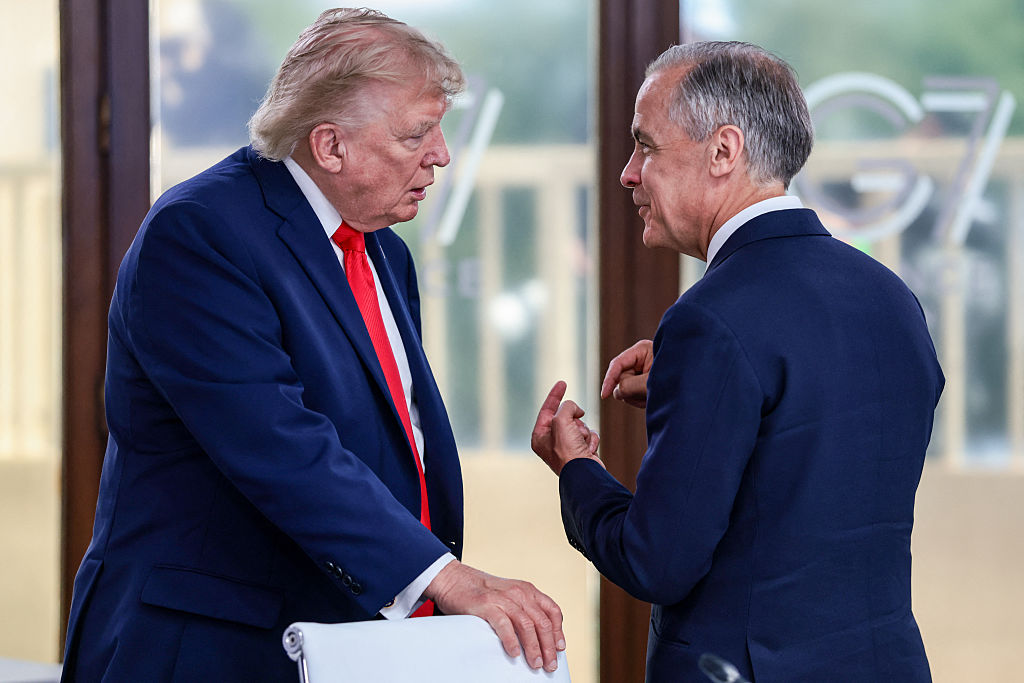
In June, a hot mic moment captured Carney and Trump discussing the EV deal Canada struck with China. Carney assured Trump it would not open the floodgates to Chinese products, and Trump responded, “That’s good.”
Electric vehicles are one of the high-stakes issues on which China uses “selective, reward-heavy pressure” to prevent Western coordination, Nagy said, arguing that breaking apart a North American manufacturing alliance is a bigger prize for Beijing in maintaining its global economic leverage.
That tension resurfaced as the scheduled USMCA review began on July 1.
William Lee, chief economist at consultancy Global Economic Advisors, doesn’t believe that Canada’s integration with China will stop at the EV deal.
“The [lowered EV] tariff rate is the biggest piece of evidence the United States has about how earnest Prime Minister Carney is about allowing China into the supply chain,” Lee told The Epoch Times.
“That’s really the camel’s nose under the tent. If it’s successful, that will be the beginning of even more industrial inputs from China into the United States,” he added, acknowledging the difficulty of curbing Chinese products at the U.S.–Canada border.
He cautioned that there could also be large volumes of “Chinese proxies”—transshipments from Cambodia and Malaysia.
His read is that Carney is determined to address inflation in Canada by allowing cheap Chinese imports. The resulting job loss won’t show up in the economic data for a while.
Carney is enjoying the rising tide of nationalism. Three in four Canadians support his decision to suspend trade talks with the United States, according to nonprofit research organization Angus Reid Institute.
Before the trade talks collapsed, his approval rating fell from 63 percent in February to 51 percent in July, according to the same nonprofit. His hard line against the United States will reverse the slide, said Lee.
Because Canada’s economy depends so heavily on the United States, and cheap Chinese imports carry their own long-term costs, both Yeh and Lee think Carney is pursuing political gain at the expense of longer-term damage to the Canadian economy and the lives of average Canadians.
“The lesson here is: be very careful of nice, glittery, pretty stuff that is offered by China, because that glitter will not last,” Lee warned. “You’ll wind up in worse trades than when you started.”
 Friends Read Free
Copy
Facebook
Tweet
Friends Read Free
Copy
Facebook
Tweet