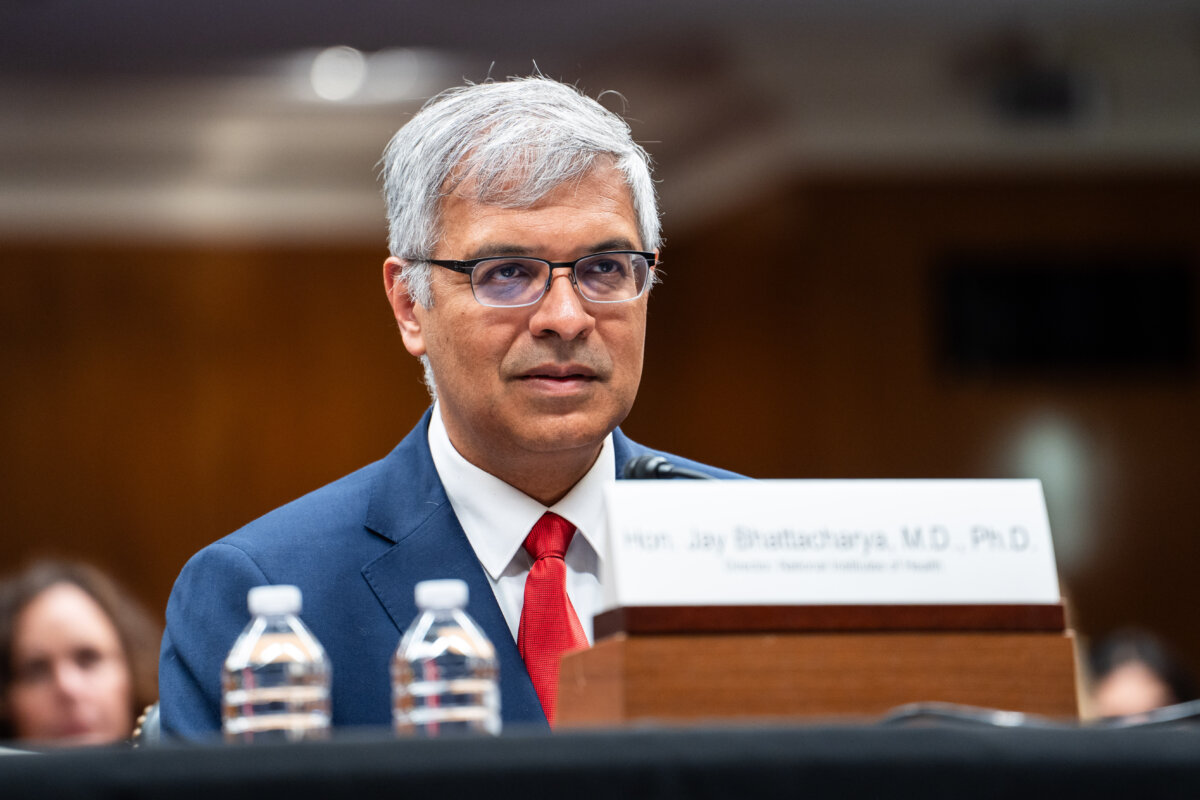

The National Institutes of Health (NIH) will soon impose a cap on money that can go to journals to publish the results of taxpayer-funded research, officials announced on July 8.
The NIH is going to impose the cap starting in fiscal year 2026, which runs for 12 months beginning Oct. 1, 2025, the NIH said in a statement.
“This policy marks a critical step in protecting the integrity of the scientific publishing system while ensuring that public investments in research deliver maximum public benefit,” Dr. Jay Bhattacharya, the NIH’s director, said.
The specific cap has not been outlined.
“The specific details on caps for scientific publication costs are still being finalized and dependent upon the type of publication,” a spokesperson for the NIH told The Epoch Times in an email. “The NIH expects to save millions of dollars in the next fiscal year while simultaneously increasing scientific transparency.”
Some publishers charge as much as $13,000 per article, according to the agency. Costs are higher if researchers want their research to be available to the public without charge, which is known in the industry as open access.
The NIH has recently introduced a number of policies aimed at opening access to taxpayer-funded research, including a policy unveiled in 2024 that requires manuscripts accepted by journals for publication to be made available to the public via a government platform called PubMed Central without embargo once the journal publishes the papers.
That policy was slated to take effect on Dec. 31, 2025, before Bhattacharya moved the effective date to July 1, 2025.
Even with those new policies, “I am gravely concerned about the overall financial burden placed on the public—who may fund the original research, then pay again to access the resulting data, publications, or commercial products,” Bhattacharya said in a statement emailed to The Epoch Times explaining the reasoning behind the cap on fees to publishers.
“We remain firmly committed to fostering transparency, accessibility, and responsible stewardship of public funds in pursuit of its mission to improve human health,” he said.
The move comes after several agencies, including the Department of Health and Human Services—the NIH’s parent agency—cut contracts with Springer Nature, which publishes multiple journals.
A spokesperson for the department said the contracts were funding “unused subscriptions to junk science.”
A spokesperson for Springer Nature told The Epoch Times in an email: “We are proud of our track record in communicating U.S. research to the rest of the world for over a century and continue to have good relationships with U.S. federal agencies. We don’t comment on individual contracts, but across our U.S. business there is no material change to our customers or their spend. We remain confident about the strength of the service we provide.”
Bhattacharya and Health Secretary Robert F. Kennedy Jr. have also discussed how they view replication tests as important, and plan to create a new NIH journal that will publish the work of government researchers.
“The NIH can stand up and will stand up a journal where these replication results can be published and made searchable in an easy way,” Bhattacharya said in June.
 Friends Read Free
Copy
Facebook
Tweet
Friends Read Free
Copy
Facebook
Tweet