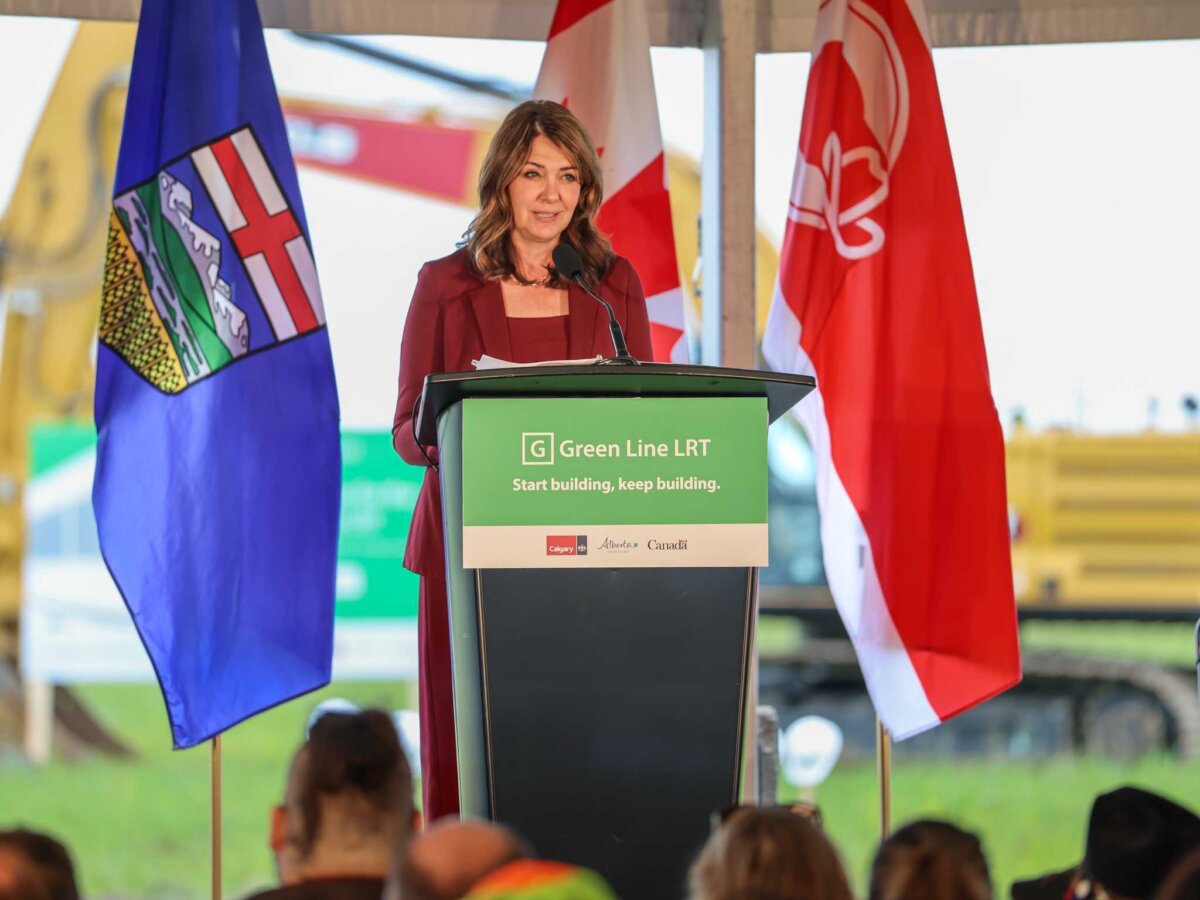

Alberta Premier Danielle Smith says the desire among Albertans to separate from Canada is the highest she has ever seen, and that Ottawa has the tools to address the grievances fueling the sentiment.
Smith made the comments at an unrelated press conference in Calgary on June 26, citing the nearly 18 percent of the vote won by separatist candidate Cameron Davies in a recent provincial byelection in the rural riding of Olds-Didsbury-Three Hills.
She said separatist sentiment may subside if Ottawa changes the policies she says have hindered the province’s economy over the past decade.
“I’ve never seen such a high level of separatist sentiment,” she said. “I take that seriously, and I hope that the federal government takes that seriously.”
A recent study found that support for the Western separatist movement is reaching levels seen during the initial surge of Quebec’s independence movement in the 1980s.
A survey conducted post-federal election by Innovative Research found that 34 percent of Albertans said they would “probably” or “definitely” support separation, while a Mainstreet Research poll released in early May determined that 36.5 percent of Albertans would “strongly” or “somewhat” support separating.
Smith said changes by Ottawa have previously helped ease Albertans’ desire to leave the Confederation, pointing to the repeal of the National Energy Program (NEP) in 1985. The program, widely opposed by Albertans, was introduced by former Prime Minister Pierre Trudeau and was intended to control the supply and price of oil and gas and increase Canadian ownership of the industry.
A byelection in the former Alberta riding of Olds-Didsbury in 1982, while the NEP was in place, saw a separatist candidate win with more than 40 percent of the vote.
“A couple of years later, after [then-prime minister] Brian Mulroney got rid of the National Energy Program, the sentiment evaporated,” she said. “This is really in Ottawa’s hands.”
She also said the fact that her United Conservative Party candidate had won in the riding where the separatist Republican Party of Alberta recorded the most votes was a sign the public wants her to work with Ottawa to address the province’s grievances.
The premier had made similar comments on the separatist sentiment earlier in the week while introducing the Alberta Next Panel, a group tasked with gathering public input and exploring ways to “protect” the province against current or future “hostile policies” from Ottawa.
She said the separatist sentiment was “no joke,” adding it is the result of “bad policies in Ottawa.”
She also said that Prime Minister Mark Carney can take swift action to address the province’s requests, as he did when he reduced the consumer carbon tax to zero upon taking office in March.
Alberta’s requests include the removal of policies such as the Impact Assessment Act, the oil and gas emissions cap, clean electricity regulations, the oil tanker ban off B.C.’s northern west coast, and the net-zero vehicle mandate.
“I think it really is in his court,” Smith said, referring to Carney. “I’ve told him he does need to take this sentiment seriously, and that he can very easily see it subside if he just addresses these issues.”
Federal Response
Federal Transport Minister Chrystia Freeland, who was with Smith during the June 26 press conference in Calgary, said she hopes Albertans will see recently passed legislation to speed up the approval process of major projects as a sign that Canada has reached a “turning point.”
The One Canadian Economy Act, a bill aimed at speeding up major project approvals and reducing interprovincial trade barriers, received Royal Assent on June 26.
“I think we are on a really good path recognizing we need to be united,” Freeland said. “We need to find ways to build Canada.
“With that approach of positive intent—a shared recognition of the challenges Canada is facing, Alberta is facing—I really think that we are at the beginning of a new chapter where we’re going to get a lot more done a lot faster.”
Ottawa had rejected Alberta’s requests to remove legislation such as the Impact Assessment Act and the emissions cap. However, Carney has said he will work with the provinces and stakeholders to develop projects of national interest, including pipelines—which Smith has been a vocal advocate for—if there is “consensus” for their development.
Those projects must meet certain criteria, including their potential to advance Canada’s economy, the interests of indigenous peoples, and the government’s climate goals.
When asked previously to comment on the possibility of Alberta holding a referendum on separation, Carney emphasized national unity.
“Canada is stronger when we work together,” Carney said in May. “I am Albertan. I proudly believe in Canada. So one can ask the question, but for me the answer is clear.”
‘National Unity Crisis’
Ahead of this year’s federal election, Smith outlined key demands she wanted the next prime minister to address to avoid a “national unity crisis.” Those demands included many of the same policy changes she has been calling for in recent months.
Following the federal Liberals’ re-election to a fourth term, the premier said Albertans were “deeply frustrated,” and called on Carney to “immediately” begin work to reset Ottawa’s relationship with the province.
The premier then announced a series of measures for the province to decide a path forward after the Liberals’ return to government. These included the creation of the Alberta Next Panel and a Special Negotiating Team to work with the federal government on several of Alberta’s key demands.
She also said that while she does not support separation, she would allow a referendum on the issue to take place if a citizen-led petition meets the requirements.
Last week, Smith issued a joint statement with Saskatchewan Premier Scott Moe calling for particular changes to federal policies, many of which both premiers had previously raised separately, including in Smith’s earlier demands to Carney.
Smith later said while announcing the Alberta Next Panel this week that despite the repeated demands, the province has not seen any “meaningful change.”
However, during the press conference with Freeland on June 26, the premier said Ottawa’s major project legislation gave her hope that change was happening.
Paul Rowan Brian and The Canadian Press contributed to this report.
 Friends Read Free
Copy
Facebook
Tweet
Friends Read Free
Copy
Facebook
Tweet