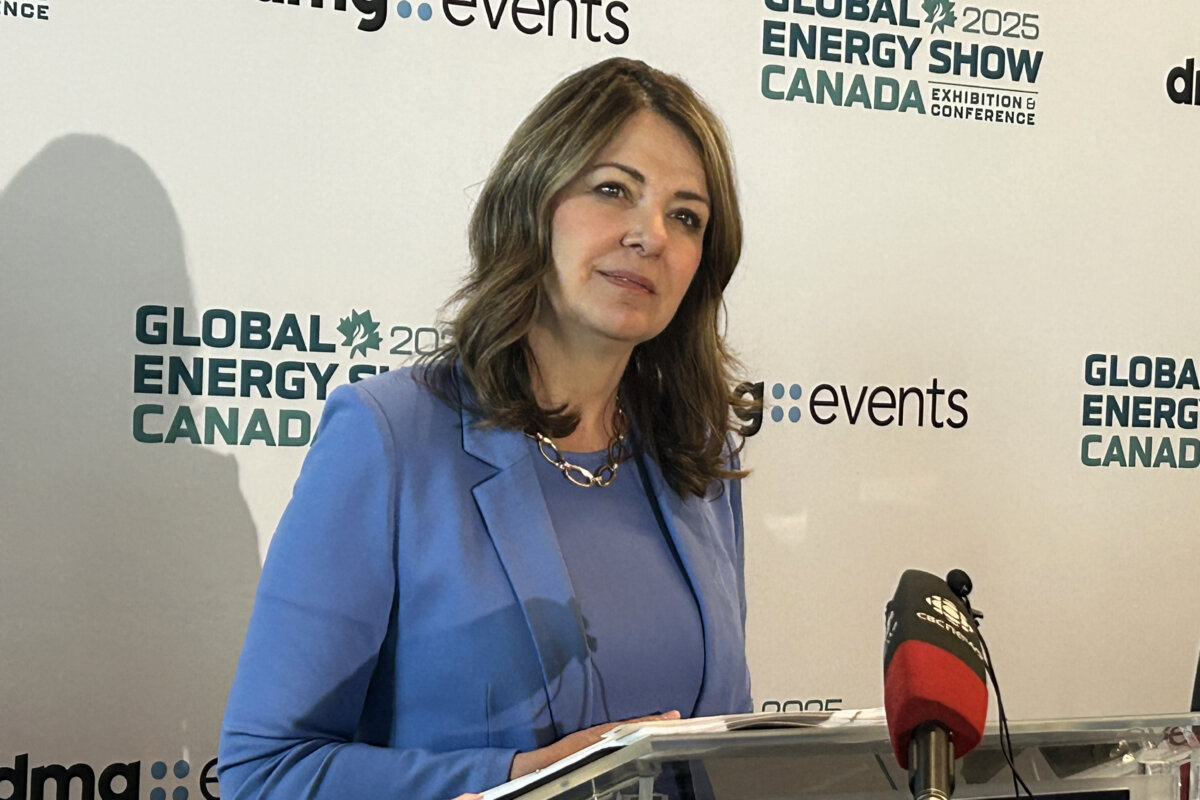

Alberta Premier Danielle Smith says that while she is encouraged by Prime Minister Mark Carney’s recent comments about building a new pipeline and agrees that it should be driven by private interest, she wants to see Ottawa scrap laws she says have negatively impacted private investment.
Smith said in a July 7 interview with CBC News that pipeline companies have raised concerns about the emissions cap for the sector, which Smith has equated to a production cap, as well as the ban on oil tankers off B.C.’s northern coast, and elements of Bill C-59 around greenwashing and environmental claims, which Smith argued “makes it criminal behaviour” for oil companies to talk about their emissions reductions efforts.
According to Smith, these pieces of legislation have resulted in there being “not a lot of enthusiasm” among private sector companies to build additional oil pipelines.
“We need to address those bad laws in order to create an environment where there’s a lot more investor confidence, and if those two things can happen together, I also share the prime minister’s enthusiasm,” she said.
Smith said nine unspecified federal laws have been identified in Alberta’s business community as creating a “chill” on investment. Aside from the emissions cap, the tanker ban, and C-59, Smith has previously called on Ottawa to scrap the Impact Assessment Act, the Clean Electricity Regulations, and the federal industrial carbon pricing backstop.
Prime Minister Carney recently said it was “highly likely” that Ottawa would approve a new oil pipeline to the West Coast as well as a massive carbon capture network proposed by a consortium of Canada’s largest oilsands producers. Smith previously said the pipeline would generate roughly $20 billion a year in revenue.
Carney said the private sector would be driving the development while people at the federal level would help “get things done.”
Smith said in the July 7 interview that putting projects on a list approved by Ottawa is a good step but it won’t be sufficient to attract investors.
“If we want anything to be built, to be drilled, to go into that pipeline, we need to change the overall investment climate,” she said.
The two leaders’ comments come after Parliament passed government Bill C-5, which aims to remove barriers to interprovincial trade while also supporting the development of major projects of national interest.
Potential projects are currently being studied in Ottawa and will be announced at a later, unspecified date. Following a meeting with the premiers back in June, Carney said they had discussed specific projects like a Western and Arctic energy corridor, an Eastern energy partnership, critical minerals pathways, small modular reactors, and other port and rail projects.
Ottawa will be holding further consultations with provinces, territories, indigenous groups, and private sector proponents to identify “nation-building” projects and implement measures to streamline the processes for other projects.
Smith said that the pipeline companies her government had spoken with had said the “highest value, easiest to build” project would be a pipeline to the West Coast to ship oil to new markets in Asia.
The premier said she wants to see a pipeline “on the projects list for the fall” and that Alberta would work with the federal government to get the permitting approved within two years.
Smith added that the policies of the previous Liberal government under Prime Minister Justin Trudeau had eroded investor confidence over the last decade, and that the country’s investments in energy weren’t going to “turn around on the basis of a few words of encouragement from the prime minister.”
“But I think when you start seeing that every single premier is looking for ways that we can move from the historic answer of automatic ‘no,’ to automatic ‘yes,’ I think that that’s encouraging,” she said.
Smith and Ontario Premier Doug Ford signed two agreements on July 7 focused on developing infrastructure and strengthening interprovincial trade. One memorandum of understanding encourages the development of infrastructure like pipelines and railways for Alberta’s and Ontario’s oil, gas, and critical minerals to reach global markets.
The other agreement is meant to increase interprovincial trade opportunities, with Alberta committing to prioritizing Canadian-made vehicles for its government fleets, and Ontario expanding the availability of Alberta-made alcohol products in its retail stores.
 Friends Read Free
Copy
Facebook
Tweet
Friends Read Free
Copy
Facebook
Tweet