On Sept. 10, 2025, the “Bloquons tout” (“Block Everything”) movement became active in an attempt to bring France to a halt over major government spending cuts.
The protest has called for blockades and a national strike to take place on Sept. 10.
Block Everything is a loosely organized online protest born this year, which so far has no clear leaders but has been embraced by progressive and militant activists.
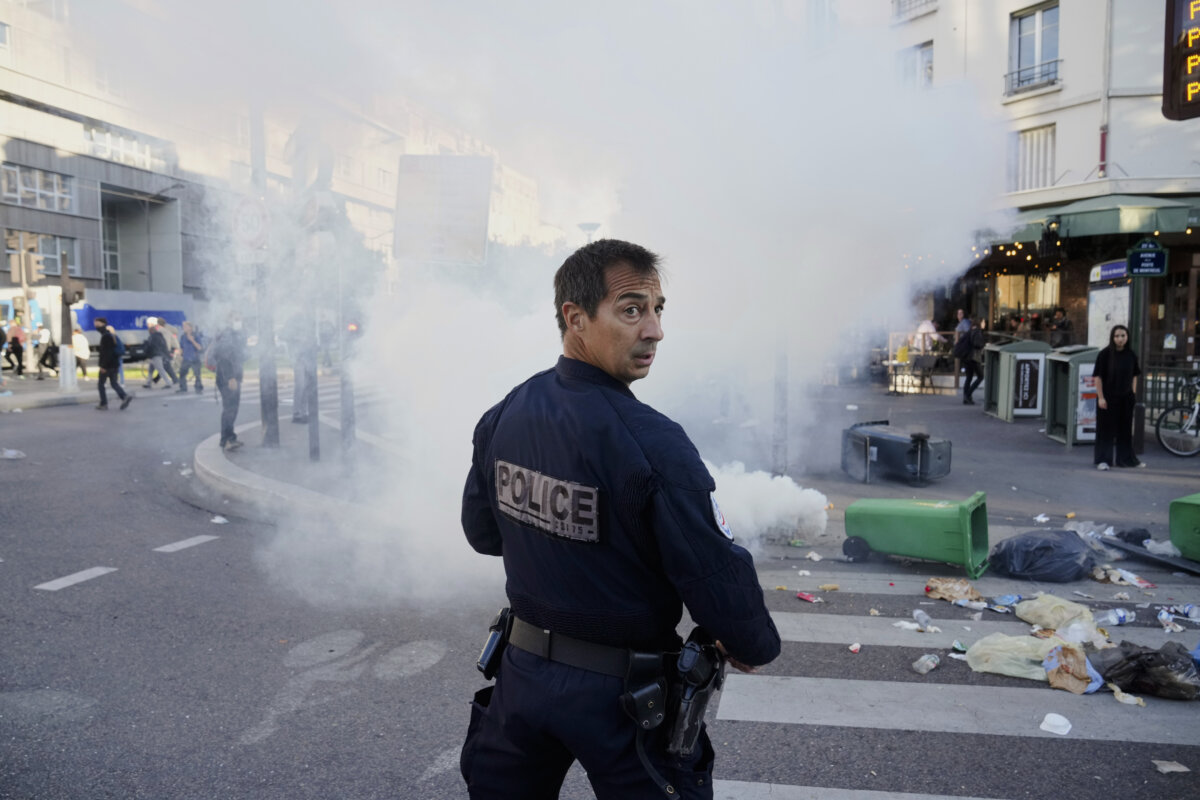
To date, protesters have disrupted traffic and clashed with police, declaring their goal was to “block everything” in opposition to France’s political class.
On Sept. 8, the government deployed 80,000 police and gendarmes throughout the country.
Nearly 300 arrests have been made amid scattered actions in cities including Paris and Marseille.
Highway operator Vinci also reported traffic disruptions on highways throughout the country.
Discontent
The protests reflect broader discontent with President Emmanuel Macron’s leadership.
On the eve of the demonstrations, Macron appointed Sebastien Lecornu, a former conservative and ally who signed on with Macron’s policies in 2017, as his fifth prime minister in less than two years, upsetting opposition parties.
Rivals on both sides of the political spectrum have accused Macron of authoritarianism.
France is no stranger to protests. Observers have drawn comparisons between this protest and the “Yellow Vest” movement of 2018, which began with anger at a fuel tax and evolved into a revolt against Macron’s reforms.
Accusations of Extremists
Critics, including police unions and politicians, accused the Block Everything movement of being hijacked by extremists and exploited by the far left.
Writing on X on Sept. 8, Police Nationale Association spokesperson Rudy Manna was critical of roads being blocked in Marseille.
“What was supposed to be a citizen gathering of workers tired of their daily struggles has been hijacked by antifas, far-left extremists … who are there to smash things and sow chaos,” he said, according to an English translation.
Aurélien Véron, a conservative politician and a Paris councillor for the Paris Centre and spokesperson for the Changer Paris group, blamed the progressive France Unbowed (LFI) party for sowing “chaos.”
“Instrumentalized by LFI, which sows chaos in the streets as in parliament, the Block Everything movement has already transformed into break everything,” he said in a post on X, according to a translation.
Coalition of Support
Elected to the European Parliament last June on the France Insoumise ticket, Rima Hassan on X on Sept. 10 called the protest “the gathering of civic and political conscience against a capitalist, neocolonial, antisocial, authoritarian system, complicit in the genocide in Gaza.”
“Across France, local and democratic popular resistance is organizing in citizens’ assemblies,” she added.
LFI youth branches have been encouraging high school students to take part in the protest.
Jean-Luc Mélenchon, a leading figure of the LFI party, said on Sept. 6 on X: “We want to give birth to the New France, that of women, of the sea, of space, and so many others. Free the homeland from the chains of money, of capitalism! Free humanity.”
Encouraging the protest on Sept. 10, Mélenchon posted on X: “Good ideas keep blossoming anew when the soil is fertile.”
Debt Problems
The protests are in response to Prime Minister François Bayrou’s austerity plan.
In July, Bayrou, who on Sept. 8 was removed from his role, announced 43.8 billion euros ($51.3 billion) in budget cuts by 2026, including freezing welfare spending and scrapping some public holidays such as Easter Monday and Victory in Europe Day.
France’s debt is projected to exceed 3 trillion euros ($3.5 trillion) this year, about 110 percent of gross domestic product (GDP), well above EU guidelines.
Officials in Brussels forecast that the deficit will remain above 5.5 percent of GDP through 2026.
Reuters and Joseph Lord contributed to this report.
 Friends Read Free
Copy
Facebook
Tweet
Friends Read Free
Copy
Facebook
Tweet