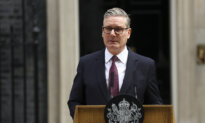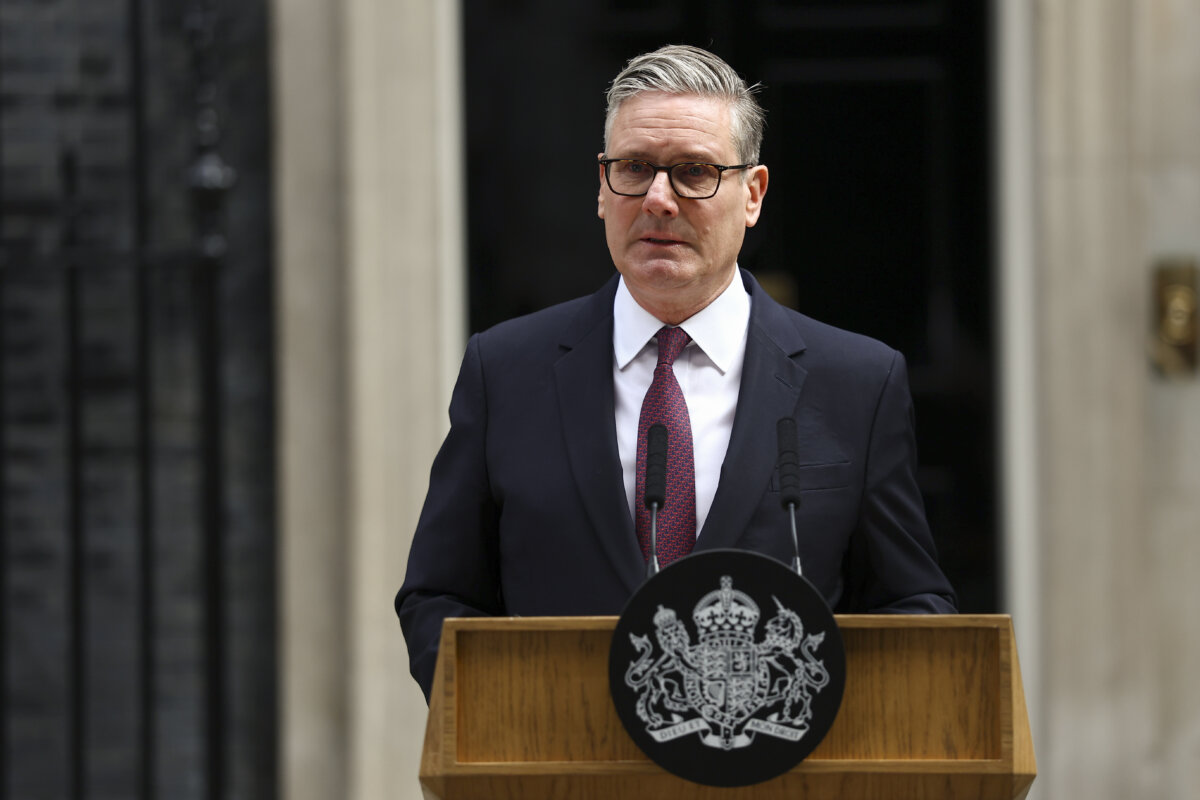


UK Prime Minister Keir Starmer said on June 22 that he would resign as leader of the Labour Party, bowing to growing pressure from within his own party to step down and opening the door to a leadership contest to replace him.
“The question my party is asking now is whether I am best placed to lead us into the next general election,” Starmer told reporters on June 22 in London. “I have heard the answer of my parliamentary party to that question, and I accept that answer with good grace.”
Starmer said he will remain prime minister until a successor is chosen and pledged an orderly transfer of power, as Britain prepares for its seventh leader in a decade.
“I will also give my successor my full and unequivocal support, knowing that they will inherit a Britain that is far stronger and fairer than the one I inherited two years ago, better prepared for the challenges ahead, and better able to ensure the Labour Party secures a second term in office,” he said.
Starmer said the party’s National Executive Committee will open nominations on July 9 and complete any leadership contest before Parliament’s summer recess, ensuring a new leader is in place before lawmakers return in September.
Seventh Leader Since Brexit
The resignation marks a dramatic fall for a leader who swept Labour to a landslide election victory less than two years ago, and it paves the way for the UK’s seventh leader since it voted to leave the European Union.
There may not be a leadership contest. Intense focus is now on Andy Burnham, the former Greater Manchester mayor whose return to Parliament piled pressure on Starmer amid Labour’s declining poll numbers and growing concern among lawmakers about the party’s electoral prospects.
Starmer’s resignation came in the morning, and Burnham headed to London to be sworn into Parliament as the newly elected MP for Makerfield in the afternoon.
Burnham confirmed on social media, following the prime minister’s announcement, that he will put himself forward as leader.
“Keir has given huge service to our country and I want to thank him for his leadership and dedication during such a challenging period,” Burnham said.
“His decision marks the beginning of a transition and it is important that this process is conducted in an orderly and responsible way. I will put myself forward as part of this process.
“The country expects stability, seriousness and a continued focus on the issues that matter most and that is what it will get. As we move forward, our priority must be to work together to get the country back to where we all want it to be.”
All Eyes on Burnham
If Labour lawmakers decide to unite behind Burnham, 56, a career politician who served in the governments of Tony Blair and Gordon Brown and in the shadow cabinets of Ed Miliband and Jeremy Corbyn, a leadership contest will not have to take place.
Labour rules state that 20 percent of the party’s MPs have to nominate a candidate for the candidate to be able to stand to be leader. If no other candidate can secure the backing of enough lawmakers, Burnham could effectively be coronated as prime minister. Polling shows he is the most popular Labour politician to succeed as leader among the party members.
Starmer’s former health secretary, Wes Streeting, was the most high-profile minister to resign in the days following disastrous local election results for Labour in May, saying he intended to fight in any leadership contest.
Following the prime minister’s resignation, Streeting announced that he would not stand and gave his backing to Burnham.
Streeting paid tribute to Starmer for leading Labour to victory in 2024 and for keeping the UK out of the Iran War, but Streeting said that Burnham’s victory in Makerfield showed that the former mayor was the right man to lead the party into the next general election, not due until 2029.
“Andy has shown what Labour can be when we are inclusive, united and in touch with the lives of the people this party was founded to represent,” Streeting wrote in a letter posted to X.
Starmer’s announcement came a day after U.S. President Donald Trump predicted that the British leader would step down. Trump said that he wishes Starmer well while blaming him for having “failed badly on two very important subjects—immigration and energy.”
Starmer spent part of last week at the G7 summit of leading industrialized nations in the French Alps, where he met with Trump and other world leaders amid the growing calls for his resignation in Britain.
Trump and Starmer are set to meet again next month at the NATO summit in Ankara, Turkey, on July 7 and July 8.
Tumultuous 10 Years
There is no requirement in the UK for a general election when the leader of the ruling party is replaced, meaning Britain will have another unelected prime minister when a new Labour leader is installed.
The new leader could choose to call an early general election, but because of how poorly Labour performed in the local elections, this is unlikely.
The UK has been through a tumultuous 10 years politically since the country voted for Brexit on June 23, 2016. The result caused a political earthquake and led to a decade of division for the country as well as continued internal debate within both main Labour and the Conservatives, alongside the rise of Nigel Farage’s populist Reform party.
Starmer has faced criticism over a series of U-turns and scandals. A growing crisis over immigration, both legal and illegal, and a cost-of-living crisis caused his personal standing in the polls to plummet, while Reform surged in popularity.
His personal judgment came under fire over the appointment of Peter Mandelson as the UK’s ambassador to the United States. Mandelson’s association with convicted sex offender Jeffrey Epstein was in the public domain at the time of his appointment, although Starmer said he was misled by the New Labour grandee about the extent of their friendship.
The threat to Starmer, which had been building for months, ramped up on June 19 with Burnham’s decisive victory against Reform.
That victory appears to have given hope to Labour lawmakers that Burnham might be the leader to turn around the party’s fading fortunes.
‘Britain is Broken’
Faced with the prospect of a Burnham coronation, Farage immediately called for a general election, sharing a link to an essay on his Substack, in which he wrote: “The British public have made their voices clear in May this year and last: Britain is broken and they want a radical reforming government that will fundamentally fix our country. But instead, Westminster wants to crown Andy Burnham off the back of a single by-election.”
Burnham, who served as health secretary under Brown, has yet to make clear what his approach would be to foreign affairs, the economy, and defense. He has previously said he would like to see the UK back in the EU if the circumstances were right, although more recently he has retreated from that controversial position.
The Brexit result prompted the immediate resignation of Conservative Prime Minister David Cameron, who was succeeded by his fellow Conservative Theresa May. She resigned in July 2019 after she was unable to get her Brexit deal over the line with the EU.
Boris Johnson succeeded her and completed a modified Brexit deal as prime minister. He resigned in the wake of a ministerial revolt against him following a series of scandals in July 2022.
Liz Truss succeeded Johnson as prime minister and held the position for just 49 days. She resigned following economic ructions triggered by her “mini-budget” and a subsequent loss of confidence within her own party. She was succeeded in October 2022 by Rishi Sunak, who was uncontested as leader, having finished second to Truss.
Sunak was prime minister until July 2024, when he called an early election, in which Labour, led by Starmer, won by a clear majority of 174 seats.
 Friends Read Free
Copy
Facebook
Tweet
Friends Read Free
Copy
Facebook
Tweet