French police have arrested the captain and the chief mate of an oil tanker, Boracay, which French President Emmanuel Macron alleges is part of Russia’s shadow fleet and has been linked to drone incidents in Denmark and Norway.
Stéphane Kellenberger, prosecutor of the port city of Brest in western France, said on Oct. 2 that the two crew members had been in custody since at least Oct. 1.
Kellenberger said a preliminary investigation was opened into the crew’s “refusal to cooperate” and “failure to justify the nationality of the vessel” after the Atlantic Maritime Prefect alerted the French legal authorities.
Macron on Oct. 1 said the crew of Boracay had committed “very serious wrongdoings” after it was linked to drone incursions over Denmark.
Copenhagen airport and Oslo airport in Norway both had to be closed on Sept. 22, after drones were sighted, and on Sept. 25, Denmark said it was considering whether to invoke Article 4 of the NATO treaty following more drone incursions into its airspace, which also affected military bases.
On Oct. 2, French Prime Minister Sebastien Lecornu said on X, “Thanks to our marine commandos and the crews of the French Navy who intervened this weekend aboard a tanker from the Russian shadow fleet, currently at anchor off Saint-Nazaire as part of a state investigation.”
According to the Marine Traffic website, the Boracay was destined for the Vadinar oil refinery in India, which was sanctioned by the European Union in July for buying Russian oil.
Marine Traffic said the vessel was also known as the Pushpa, and was flying under the flag of Benin.
According to Marine Traffic, Boracay left the Russian oil terminal at Primorsk, near Saint Petersburg, on Sept. 20, sailed through the Baltic and around Denmark last weekend, and is now anchored off the port of Saint-Nazaire in western France.
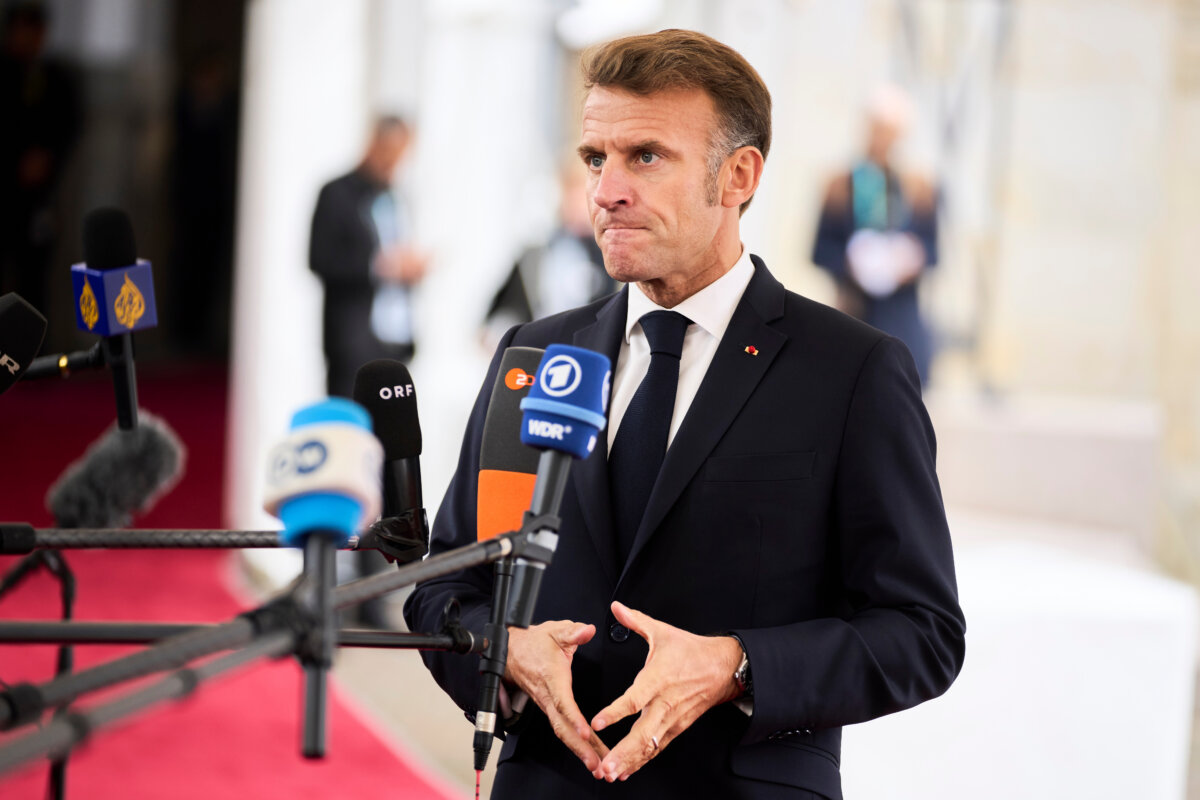
Macron, who was at a European Union leaders’ summit in Denmark, praised the intervention of the French police and said, “It’s a good thing that this work has been done and that we’ve been able to stop it.”
“There were some very serious wrongdoings made by this crew, which is why there are legal proceedings in the case,” he said.
The French president said the incident highlighted the reality of a phenomenon that France has been “describing and denouncing for a long time.”
‘Notorious Shadow Fleet’
He said between 600 and 1,000 ships in the “notorious shadow fleet” transport Russian oil despite sanctions imposed following the invasion of Ukraine in February 2022.
It is estimated to be an industry worth tens of billions of dollars.
Russia has been growing its shadow shipping fleet for several years, but concerns escalated last year after some of these vessels were linked to a series of incidents involving undersea infrastructure.
Last month, Nir Ayalon, founder and CEO of Cydome, a maritime cybersecurity firm based in Israel, told The Epoch Times that the operators of ships, including those in the shadow fleet, often use GPS spoofing in order to disguise their location or identity.
He said there were an estimated 1,000 “shadow ships” in existence and added: “Obviously, their data is manipulated. We know that this is not real data, or they’re unregistered.”
In December 2024, Germany, Denmark, Britain, and nine other European countries agreed on measures to “disrupt and deter” Russia’s shadow fleet.
Kremlin spokesman Dmitry Peskov said on Oct. 1 that he had no information about the vessel, but said the Russian military had to act sometimes to restore order when foreign countries took what he described as “provocative actions.”
Russian ships traveling from ports on the Baltic, like Primorsk, can only access the open seas by passing through the straits between Denmark and Sweden, known as the Kattegat.
Under the 1857 Copenhagen Treaty, international law prevents any ship from being stopped while traveling through the straits.
It was a clause that was scrupulously adhered to throughout the Cold War, when Soviet submarines and battleships would pass through on their way to the open seas.
The Associated Press and Reuters contributed to this report.
 Friends Read Free
Copy
Facebook
Tweet
Friends Read Free
Copy
Facebook
Tweet