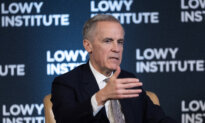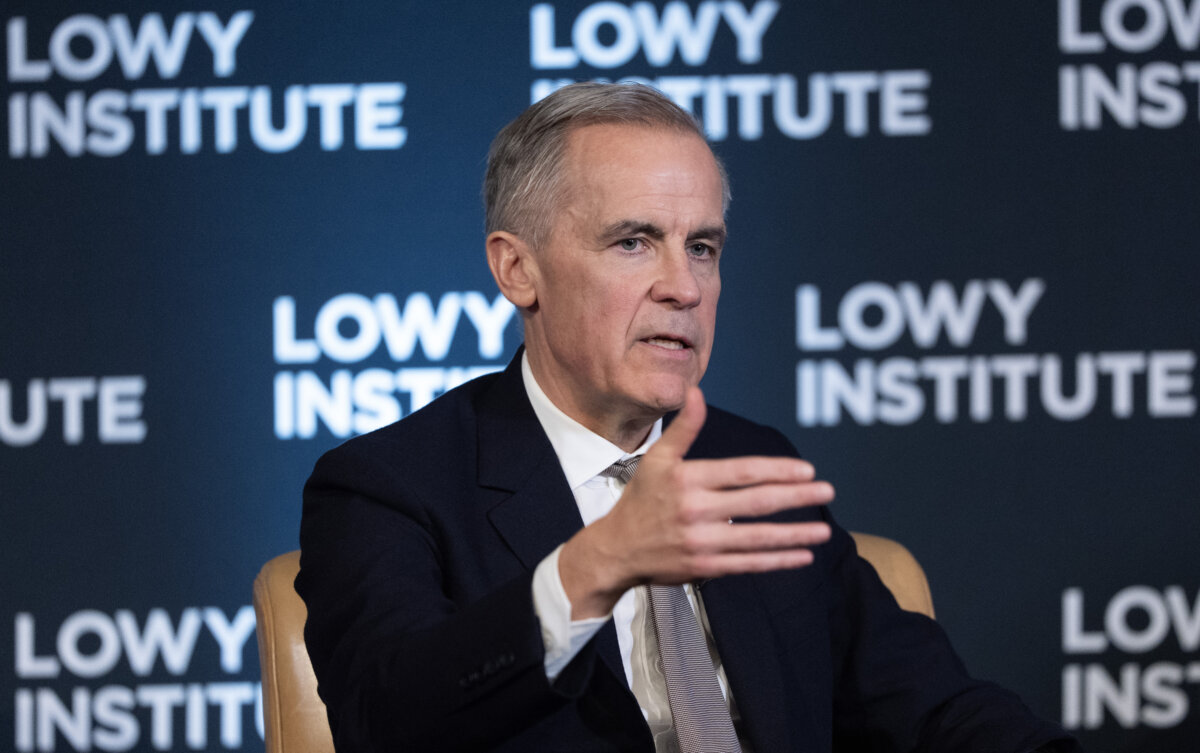

Prime Minister Mark Carney spoke of his relationships with U.S. President Donald Trump, Chinese leader Xi Jinping, and Indian Prime Minister Narendra Modi during a fireside chat in Australia this week.
Carney spoke with Michael Fullilove, executive director of the Lowy Institute, an Australian think tank, during the event in Sydney on March 4, where he discussed his relationships with world leaders and touted “middle power” cooperation.
When asked to describe his system for dealing with Trump, Carney said he approaches the U.S. president with “respect, but not obsequiousness.” He added that Trump is “president for a reason,” saying he is a “very successful” politician, and has had success in other areas.
Trump appreciates directness—discussing issues openly and being clear about your position, “particularly in private,” Carney told Fullilove.
“You don’t want to say anything in public that you can’t back up,” he added, noting that it’s best to be “careful in terms of the language that you use with him, but in a way that’s consistent with what you really think.”
In private, Trump is “more interested in your viewpoint on various things,” and this “creates an ability to work through things,” Carney said.
Carney’s comments on Trump come as relations between the two leaders have soured in recent months. Trade relations between Canada and the United States worsened in October 2025 after Ontario aired an anti-tariff TV advertisement on American networks.
Relations between Carney and Trump further deteriorated following Carney’s speech at the World Economic Forum (WEF) in Davos in January, where he directed thinly veiled criticism at U.S. foreign policy and protectionism, and said middle powers should band together against unspecified “great powers.”
Trump said during his own speech at the WEF the following day that Carney “wasn’t so grateful” and that “Canada lives because of the United States.”
Carney said on March 4 that “middle powers working together cannot only build true sovereignty, we can also help underscore, help shape the next global order.”
Carney-Xi Relations
Carney was also asked by Fullilove about his relationship with the Chinese leader, and about the risks of dealing with an authoritarian country like China.
The prime minister said the first time he met with Xi as Canada’s prime minister, which was at the Asia-Pacific Economic Cooperation (APEC) summit in South Korea in late October, Xi “chose to spend the first 10 plus minutes discussing how he wanted the personal interaction to be.”
Carney said the Chinese leader told him “no surprises” and “if you really care about something, be clear,” which Carney said he interpreted as “don’t lecture me in public” and “bring issues to me directly.”
Carney also said in dealing with Xi he has been very clear about where Canada and China are looking to cooperate and where the two countries will not cooperate, which he described as putting “guardrails” on the relationship.
Carney’s comments come after he visited China in January and signed several agreements with Beijing, including on electric vehicles, law enforcement cooperation, energy, and finance. During the visit, Carney said Canada and China were in a “strategic relationship” and relations between the two countries had entered “a new era.”
The Liberal government has faced criticism from opposition parties for seeking closer ties with the Chinese regime when it is a known security threat to Canada and has engaged in human rights violations.
Conservative Leader Pierre Poilievre said during an interview with retired Canadian news anchor Peter Mansbridge last week that while he doesn’t object to Canada opening its doors to discussions on trade and diplomacy with China, Canada “cannot sacrifice” its relationship with the United States “in favour of a tenuous and risky partnership” with Beijing.
While speaking at the Lowy Institute, Carney said his government is seeking to reset relations and integrate with China on a “very low base.”
“We’re not heavily integrated with China. We’re not running a big risk in terms of increasing our activity with China,” Carney said. “To be clear, the areas where we’re cooperating… it’s in both our interest [and] there’s a very strong alignment.”
Canada-India Relations
When asked about his “assessment” of Modi, Carney said the Indian prime minister is “unique,” noting that Modi has not taken a day off work from his roles in government in 25 years. Carney also said Modi is “very focused” on ensuring resources go directly to individuals.
Carney met with Modi in New Delhi earlier this week and announced a series of agreements, including a $2.6 billion uranium deal. The two countries also agreed to expedite negotiations on a Comprehensive Economic Partnership Agreement, with discussions expected to wrap up by the end of this year. Carney has said this is part of his bid to diversify Canada’s trade away from the United States amid tariffs imposed by Trump.
Carney said on March 4 that he and Modi had discussed potential areas of cooperation for the two countries and why cooperation is in the economic and strategic interests of both countries.
He noted that his government has made “a lot of progress” with India over the last 11 months, and there is more to be done, “without question.”
Diplomatic relations between Canada and India had deteriorated more than two years ago when then-Prime Minister Justin Trudeau accused the Indian government of being responsible for the assassination of B.C. activist Hardeep Singh Nijjar, who was killed in Surrey, B.C., in June 2023. India has denied the allegations.
Carney’s government has sought to repair relations with India since he took office last spring and invited Modi to the G7 summit in Alberta last year, which Carney said triggered the reset. Canada and India have since had multiple engagements at the ministerial level.
Jennifer Cowan and Omid Ghoreishi contributed to this report.
 Friends Read Free
Copy
Facebook
Tweet
Friends Read Free
Copy
Facebook
Tweet