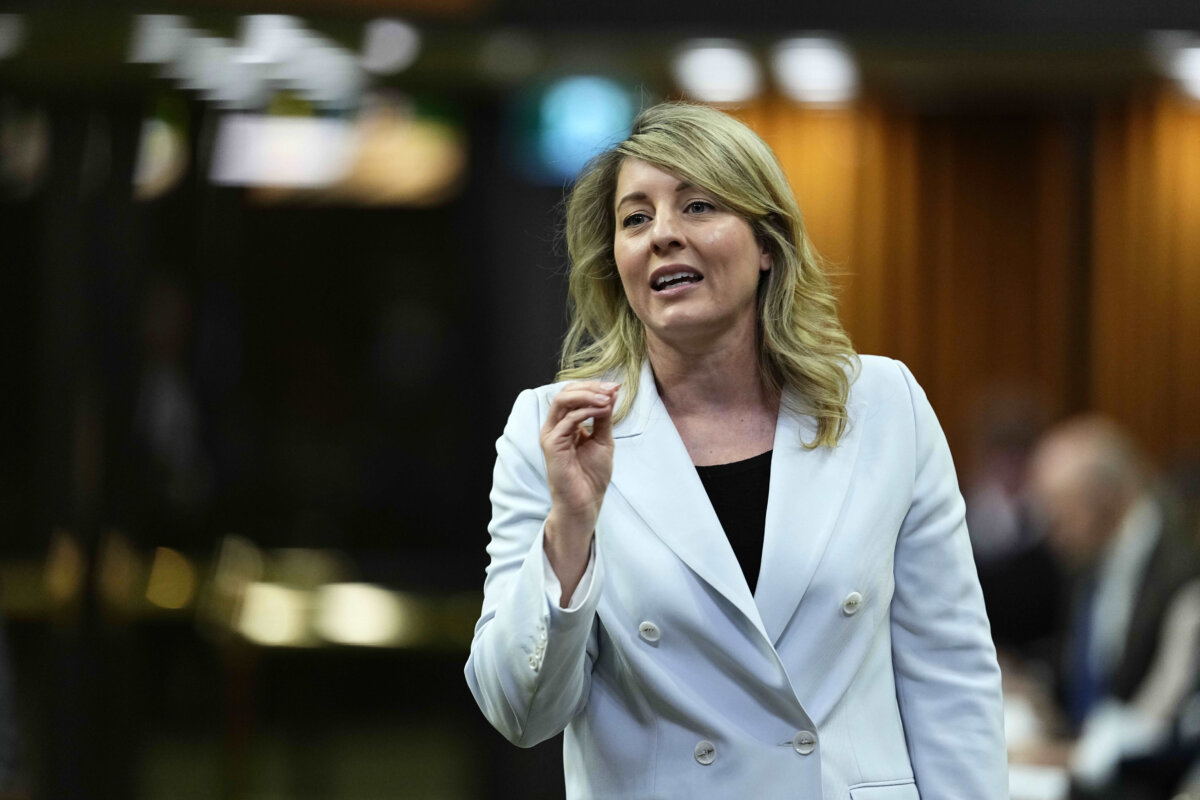

Industry Minister Mélanie Joly is on a visit to China this week in search of commercial opportunities, according to her department.
After China, Joly is expected to travel to Japan. The visits, set to take place from June 14 to 23, were announced by Industry Canada in a June 15 news release.
The prime minister’s parliamentary secretary, Kody Blois, is also on the trip, which aims to “advance Canadian priorities and promote economic growth.”
Industry Canada says that, in China, Joly will meet with government officials and stakeholders to “advance commercial opportunities with appropriate guardrails,” in line with commitments made by Prime Minister Mark Carney during his visit to Beijing in January.
The departmental news release does not add further details on which commercial opportunities are being pursued nor which officials and stakeholders Joly will be meeting.
Joly told the Globe and Mail in an interview she will be meeting with four Chinese companies that are considering manufacturing electric vehicles (EVs) in Canada, including BYD, Chery, Geely, and Shanghai Launch Automotive Technology.
Joly said she wants Canadian companies to build Chinese EVs in Canadian factories.
“What is important is how can we make sure that we offer great vehicles to Canadians that are actually affordable, and with the latest technology, while keeping and protecting our 500,000 auto workers,” she said.
Ottawa is ramping up its efforts to facilitate the entry of Chinese EVs in the Canadian market.
International Trade Minister Maninder Sidhu said last week he met with representatives of Chery to discuss the carmaker’s joint ventures in other countries and see how they could work in Canada.
The push follows Carney’s visit to China during which he agreed to let in an initial 49,000 Chinese EVs at a preferential tariff rate. The number is set to climb in subsequent years.
Part of the agreement with Beijing to get tariff relief on some Canadian agricultural and seafood products also includes Chinese EV investments in Canada, the details of which were not released at the time.
The Canadian car industry has pushed back against Ottawa’s plan to introduce Chinese EVs into the Canadian market.
“The Canada-China strategic partnership undermines Canada’s auto sector while putting the integrated North American supply chain at risk,” Brian Kingston said in reaction to the news of Joly meeting with Chinese carmakers. Kingston represents the interests of Ford, GM, and Stellantis in Canada.
“There are no guardrails in place to ensure a level playing field or to protect Canadians from cyber risks,” Kingston said in an X post, a message he has also carried in several testimonies before parliamentary committees in recent weeks.
Ontario Premier Doug Ford, whose province is the car manufacturing hub, previously said companies need to produce 220,000 autos to break even in Canada, with most of the production being shipped south of the border.
The United States is unlikely to allow the import of Chinese cars made in Canada due to trade and security concerns. Carney’s EV deal with China has been sharply criticized by U.S. President Donald Trump and his trade officials.
The U.S. Department of War last week also added Chinese carmaker BYD to a blacklist, accusing it of supporting China’s military-industrial strategy.
Japanese carmakers with a sizeable manufacturing presence in Canada are also speaking out on Ottawa’s Chinese EV plan.
Honda Canada President and CEO Dave Jamieson told an industry summit on June 9 that government policies are making the Canadian car industry less competitive.
“When trade uncertainty is looming, regulations are evolving, and government policies are misaligned to consumer demand, it becomes increasingly difficult to move forward with capital-intensive, long-term investments of this scale,” he said, in reference to Honda suspending a $15 billion EV plan for Canada.
Jamieson also implicitly criticized Ottawa’s plan around Chinese EVs, saying Canadian carmakers are facing increasing competition from “low-cost, state-subsidized, non-market-oriented producers.”
 Friends Read Free
Copy
Facebook
Tweet
Friends Read Free
Copy
Facebook
Tweet