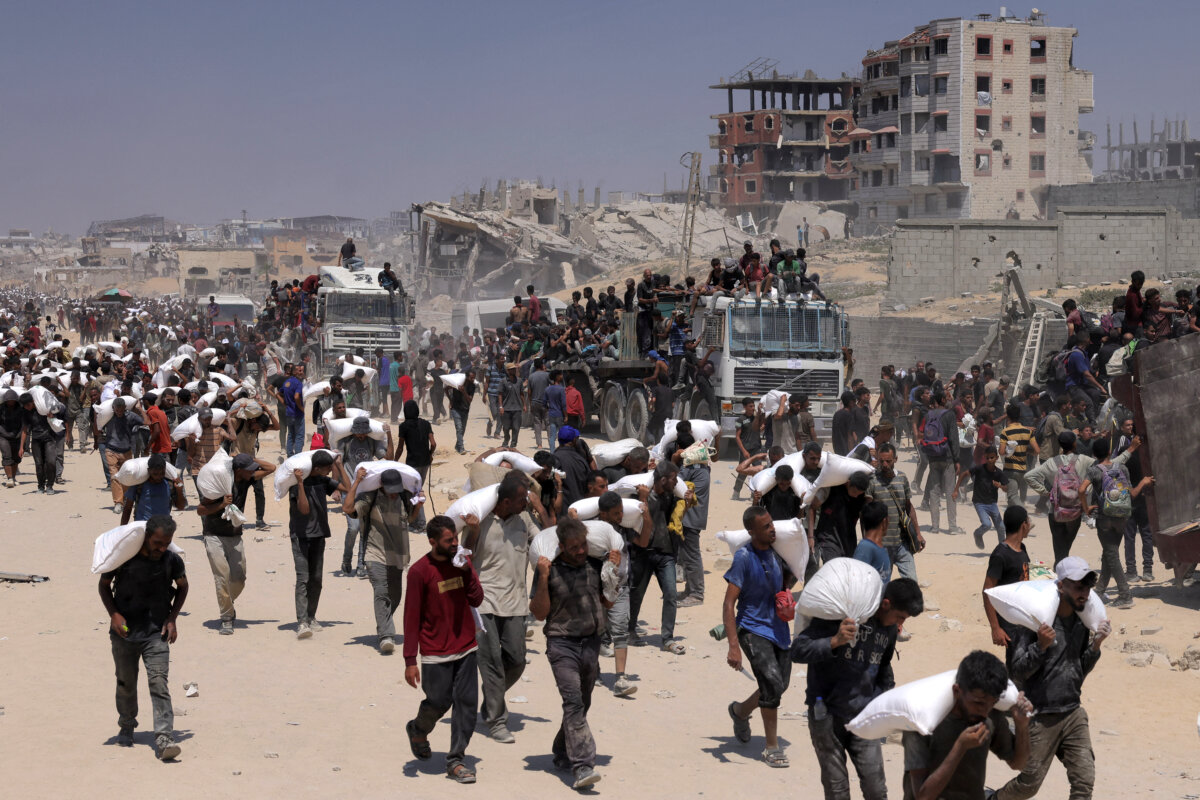

Israel on July 28 maintained a tactical pause on military operations in parts of the Gaza Strip to allow for the increased delivery of humanitarian aid.
The pause, which began on July 27, will be in effect from 10 a.m. to 8 p.m. local time every day, until further notice. It will apply to areas where the IDF is not currently engaged in operations, including Al-Mawasi, Deir al-Balah, and Gaza City, the military said.
Designated secure routes for humanitarian convoys will also remain open from 6 a.m. to 11 p.m. daily, enabling the United Nations and international aid organizations to deliver and distribute food and medicine across the coastal enclave.
The move is led by the Coordination of Government Activities in the Territories (COGAT), which operates under Israel’s military, and is being coordinated with the U.N. and international organizations, according to the Israel Defense Forces (IDF).
The U.N. and its agencies, including UNICEF and the World Food Programme, which have been warning of famine-like conditions in Gaza, welcomed the pause in military activity.
United Nations humanitarian chief Tom Fletcher described the pause in military activity as “progress” and called for a permanent cease-fire.
COGAT refutes what it describes as “false claims of deliberate starvation in Gaza” and is critical of the U.N. for overlooking Israel’s aid delivery efforts. It said in a July 28 post on X that more than 120 trucks carrying food were collected and distributed by the U.N. and international agencies.
“An additional 180 trucks entered Gaza and are now awaiting collection and distribution, along with hundreds of others still queued for UN pickup,” its statement reads. “More consistent collection and distribution by UN agencies and international organizations = more aid reaching those who need it most in Gaza.”
Israeli Prime Minister Benjamin Netanyahu said on July 28 that there is no starvation and no policy of starvation in Gaza.
A U.S.-backed aid initiative led by Israel, known as the Gaza Humanitarian Foundation, has been distributing aid in the enclave since May.
However, major international aid organizations, including U.N. agencies, have declined to participate, citing concerns over civilian safety and the foundation’s military ties.
U.S. President Donald Trump said on July 28, during his visit to Scotland, that he plans to discuss the humanitarian crisis in Gaza with UK Prime Minister Keir Starmer.
Speaking to reporters, Trump was asked whether he agreed with recent assessments that there is no starvation in Gaza.
“I don’t know. I mean, based on television, I would say not particularly, because those children look very hungry,” he said.
“But we’re giving a lot of money and a lot of food, and other nations are now stepping up. I know that this nation is,” Trump said, referring to the UK.
Starmer described the situation in Gaza as “an absolute catastrophe,” emphasizing the urgency of reaching a cease-fire and increasing humanitarian aid.
“Nobody wants to see that,” Starmer said. “And I think people in Britain are revolted at seeing what they’re seeing on their screens. So we’ve got to get to that cease-fire.”
Starmer thanked Trump for taking a leading role in cease-fire negotiations and efforts to increase humanitarian aid to Gaza.
He noted that the United States had made significant contributions, alongside other nations, and said the UK was now working with Jordan to facilitate the proper delivery of direct aid.
Aid Airdrops
Israel, the United Arab Emirates, and Jordan resumed coordinated humanitarian airdrops over the Gaza Strip on July 27, delivering 28 aid packages containing food for residents in both the northern and southern parts of Gaza, according to the IDF.
COGAT said that Israel would continue cooperating with international partners to improve aid access.
UAE Foreign Minister Sheikh Abdullah bin Zayed Al Nahyan said the humanitarian situation in Gaza had reached what he described as a critical and unprecedented level.
He said the UAE remained committed to delivering life-saving assistance to the Palestinian population, and was determined to ensure that essential aid reached those most in need, whether by land, air, or sea.
Jordan’s leadership, which last week discussed security and stability in the Middle East in talks with the Trump administration, has called for aid to flow to all areas of Gaza to alleviate the crisis.
Cease-fire Talks
The pause in military operations comes as diplomatic efforts to reach a cease-fire appeared to falter on July 24 after Israel and the United States withdrew their negotiating teams from talks in Qatar. The two countries blamed the terrorist group Hamas for obstructing progress and said they were evaluating alternative options.
Tensions also rose between Israel and France after French President Emmanuel Macron announced plans to formally recognize a Palestinian state in the near future.
The move came ahead of a U.N. conference on the two-state solution on July 28, following a call by the U.N. General Assembly in 2024.
The United States and Israel will not be taking part in the conference, co-hosted by France and Saudi Arabia, after Washington in 2024 said it would “not support actions that jeopardize the prospect for a long-term, peaceful resolution to the conflict.”
The war in Gaza began after Hamas attacked locations in southern Israel on Oct. 7, 2023, killing more than 1,200 Israelis and foreign citizens, and kidnapping 251.
Israel says Hamas is responsible for prolonging the conflict by refusing cease-fire terms and holding onto hostages. The Israeli position remains that military pressure will continue until Hamas is defeated or disarmed.
“We will continue to fight till we achieve the release of our hostages and the destruction of Hamas’s military and governing capabilities. They shall be there no more,” Netanyahu said on July 28.
On the issue of hostages held by Hamas, Trump told reporters the terrorist group “did a horrible thing” and paid a significant price.
He said that he always believed Hamas would refuse to release the final group of 10 to 20 hostages, using them as human shields.
“And it’s a very tragic situation, frankly, but we got a lot out, and now possibly the fight will have to be a little bit different,” Trump said.
Asked whether a cease-fire was possible, Trump said it could happen, adding that the conflict ultimately needs to be brought to an end.
 Friends Read Free
Copy
Facebook
Tweet
Friends Read Free
Copy
Facebook
Tweet