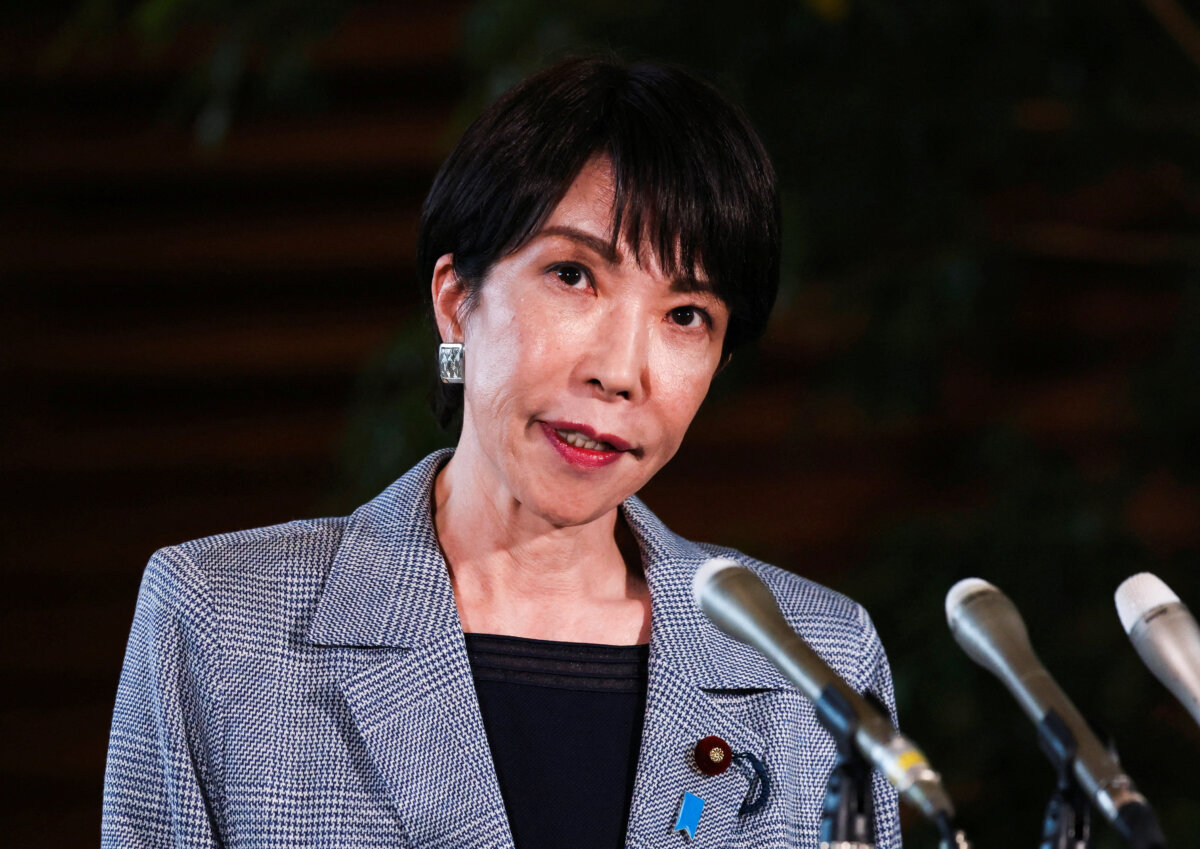

U.S. President Donald Trump has invited Japanese Prime Minister Sanae Takaichi to visit the United States this spring, as the two agree to deepen bilateral ties, Japan’s Foreign Ministry said on Jan. 2.
The ministry stated that Trump extended an invitation to Takaichi during a phone call on Jan. 2, and the leaders agreed to coordinate details for the visit.
During the 25-minute call, they discussed the Indo-Pacific region and affirmed they would “further deepen the friendly relations” between their countries, including in economic and security matters.
They also agreed to promote cooperation with “like-minded partners,” such as South Korea, according to the ministry.
The White House has not released a statement about the call.
Takaichi described the talk as “extremely meaningful” and said she would work with Trump to “carve out a new chapter in the history of the Japan-U.S. alliance.”
“We confirmed the close cooperation between Japan and the United States under the current international situation,” Takaichi stated on X.
She called the United States an “important ally” to Japan.
Takaichi did not elaborate on what was discussed during the call.
The two leaders previously met on Oct. 28, 2025, during Trump’s visit to Japan, where they signed an agreement to promote a “new golden age” in the U.S.–Japan alliance.
Takaichi’s planned visit to the United States came amid strained relations between Japan and China, following Takaichi’s remarks during a parliamentary session in November that a hypothetical Chinese attack on Taiwan could constitute an existential threat to Japan and therefore prompt a military response.
Beijing considers the self-governing democratic island its own territory, and the Chinese communist regime has not ruled out taking control of the island by force.
In response to Takaichi’s remarks, China imposed a travel boycott on Japan and demanded that Takaichi retract her remarks, a request she rejected.
Earlier this week, Japan said it conveyed its concerns to Beijing after the Chinese Communist Party conducted live-fire military drills around Taiwan. The drills, which involved large numbers of fighter aircraft and naval vessels, simulated a blockade of Taiwan’s major ports and attacks on maritime targets.
The Japanese government warned that China’s military actions would escalate tensions in the Taiwan Strait and called for a peaceful resolution between the two sides.
Washington also issued a statement on Jan. 1 urging Beijing to exercise restraint and cease its military pressure against Taiwan. The State Department said the United States “opposes unilateral changes to the status quo, including by force or coercion,” in the Taiwan Strait.
Michael Zhuang contributed to this report.
 Friends Read Free
Copy
Facebook
Tweet
Friends Read Free
Copy
Facebook
Tweet