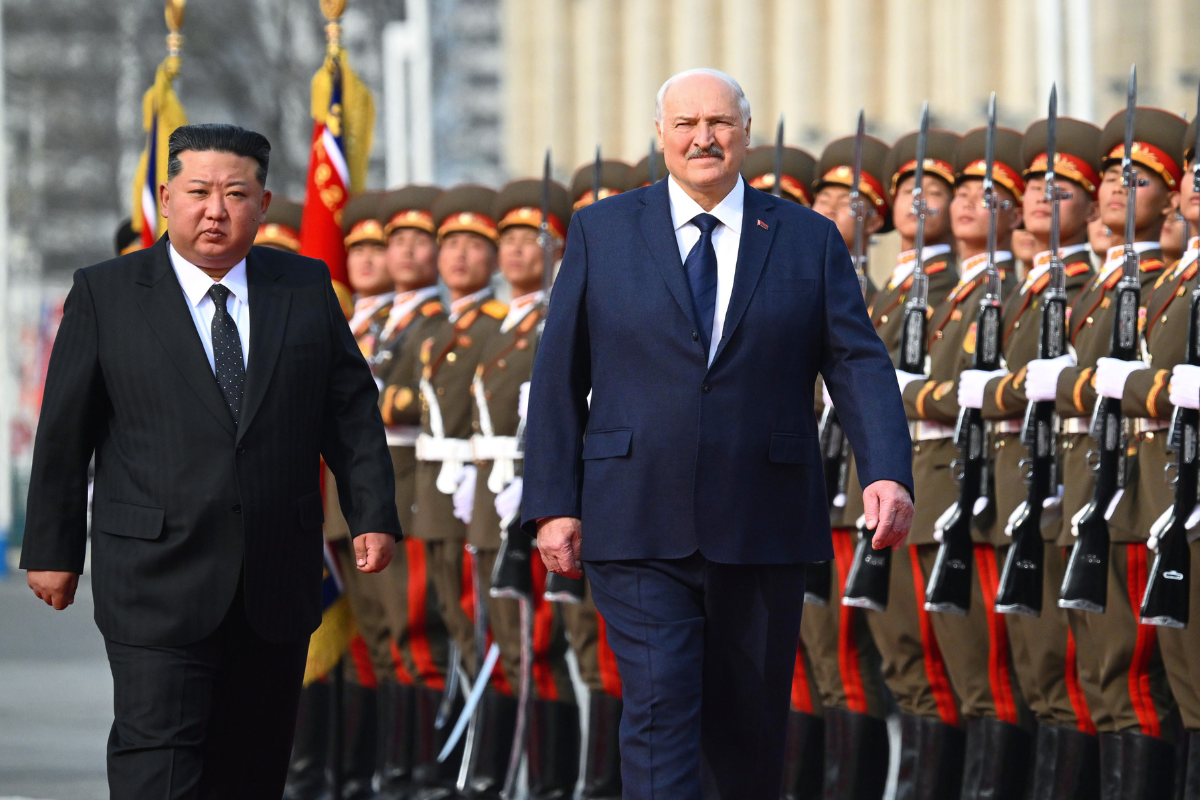

North Korean leader Kim Jong Un and Belarusian President Alexander Lukashenko signed a cooperation and friendship agreement on March 26, Belarusian state media, Belta, reported.
North Korean state-run news agency KCNA said that Lukashenko and Belarusian ministers arrived in Pyongyang on March 25, where Lukashenko was met by Kim. The Belarusian delegation was welcomed with a ceremony at Kim Il Sung Square that included a 21-gun salute and a march past by the North Korean military’s guard of honor.
Speaking on his first trip to North Korea, Lukashenko said the friendship between the two nations originated in the days of the Soviet Union, of which Belarus was a republic for nearly seven decades, and “has never been interrupted.”
“Today, as a result of comprehensive progressive development, we are transitioning to a fundamentally new stage,” he said.
‘Yes, we did not have close cooperation, largely our fault. But I am sincerely glad to see that our interaction has now significantly intensified.”
Belarusian Foreign Minister Maxim Ryzhenkov said the treaty sets out goals for developing bilateral relations between the two countries, including expanding contacts between their ministers and government agencies.
Belta quoted Kim as saying he was similarly a proponent of developing bilateral relations “without looking back at other countries, which, of course, will not be thrilled about our relations.”
“Because they are competitors,” he was quoted as saying.
Belarus and North Korea are two of a handful of countries that openly support Russia in its invasion of Ukraine.
Lukashenko allowed Russian President Vladimir Putin to use Belarusian territory as a staging ground for Russia’s invasion of Ukraine in February 2022, when Russian forces crossed into Ukraine from the north in the opening days of the war.
Pyongyang has also strengthened its military ties with Moscow, with North Korea supplying weapons and troops to support Russia’s military action.
Russia has also made moves to deepen ties with North Korea, including starting regular commercial flights between Moscow and Pyongyang.
Pyongyang’s Relationship With Seoul, Washington
After Lee Jae Myung became president of South Korea last year, Seoul has sought to de-escalate tensions with Pyongyang, including scaling back some military activities near the demilitarized zone and ending propaganda broadcasts.
However, Pyongyang has rejected such attempts to ease tensions, saying it is not interested in a dialogue with its southern neighbor.
The United States and South Korea still view North Korea as a military threat, and there is particular concern over North Korea’s nuclear arsenal.
North Korea has about 50 nuclear warheads and sufficient fissile material to produce up to 40 more and is accelerating further production, according to a 2025 report by the Stockholm International Peace Research Institute.
Last year, Secretary of War Pete Hegseth said that the U.S.–South Korean alliance will stay focused on deterring North Korea.
“There’s no doubt flexibility for regional contingencies is something we would take a look at, but we are focused on standing by our allies here and ensuring the threat of the DPRK is not a threat to the Republic of Korea and certainly continue to extend nuclear deterrence as we have before,” Hegseth told reporters in South Korea on Nov. 4, 2025.
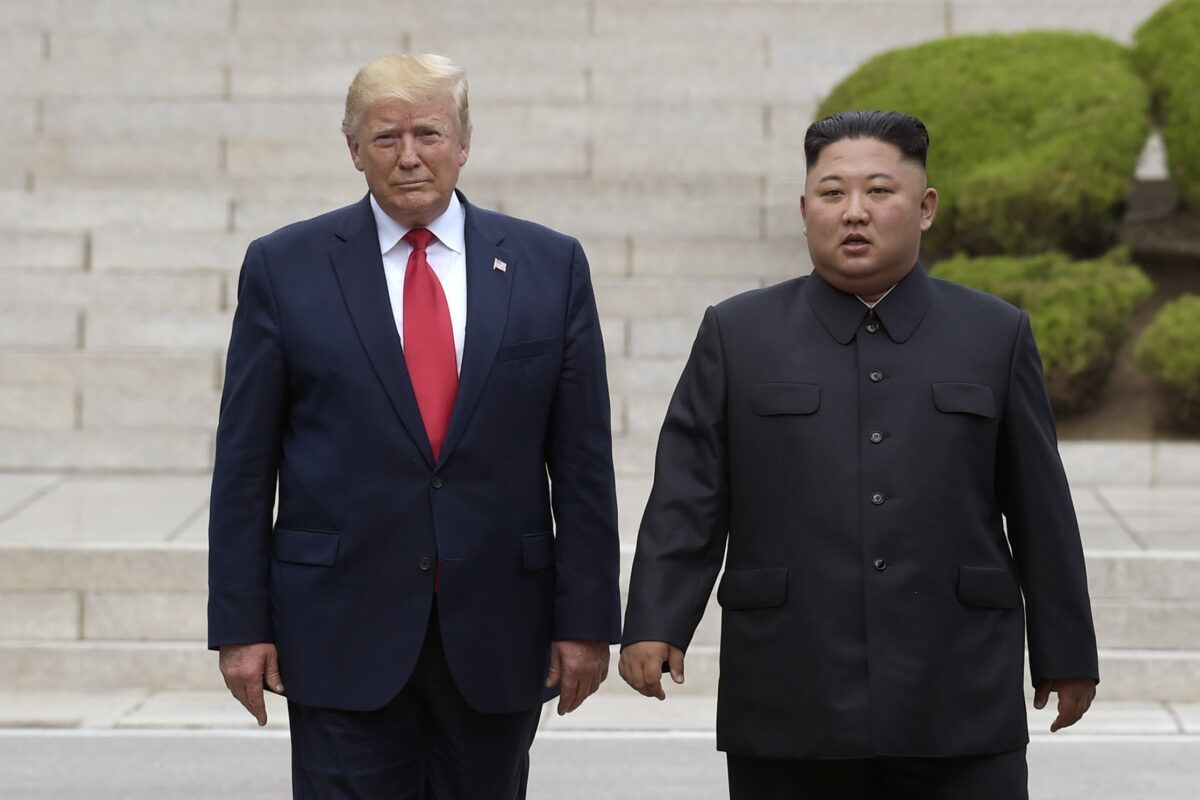
Kim said last month that relations between North Korea and the United States could improve if Washington drops what he described as a “hostile policy” toward his country.
At the same time, he said that Pyongyang would “fully prepare” for confrontation, if necessary, continuing to expand its nuclear arsenal.
Kim met President Donald Trump in 2018 and 2019 during Trump’s first term, before negotiations over Pyongyang’s nuclear arsenal collapsed.
Evgenia Filimianova contributed to this report.
 Friends Read Free
Copy
Facebook
Tweet
Friends Read Free
Copy
Facebook
Tweet