
The federal government has tabled legislation to strengthen Canada’s legal framework to prevent goods made with forced labour from entering the Canadian market.
The bill comes after the U.S. administration on June 2 threatened to impose additional tariffs on 60 countries, including Canada, for allegedly failing to institute forced labour restrictions.
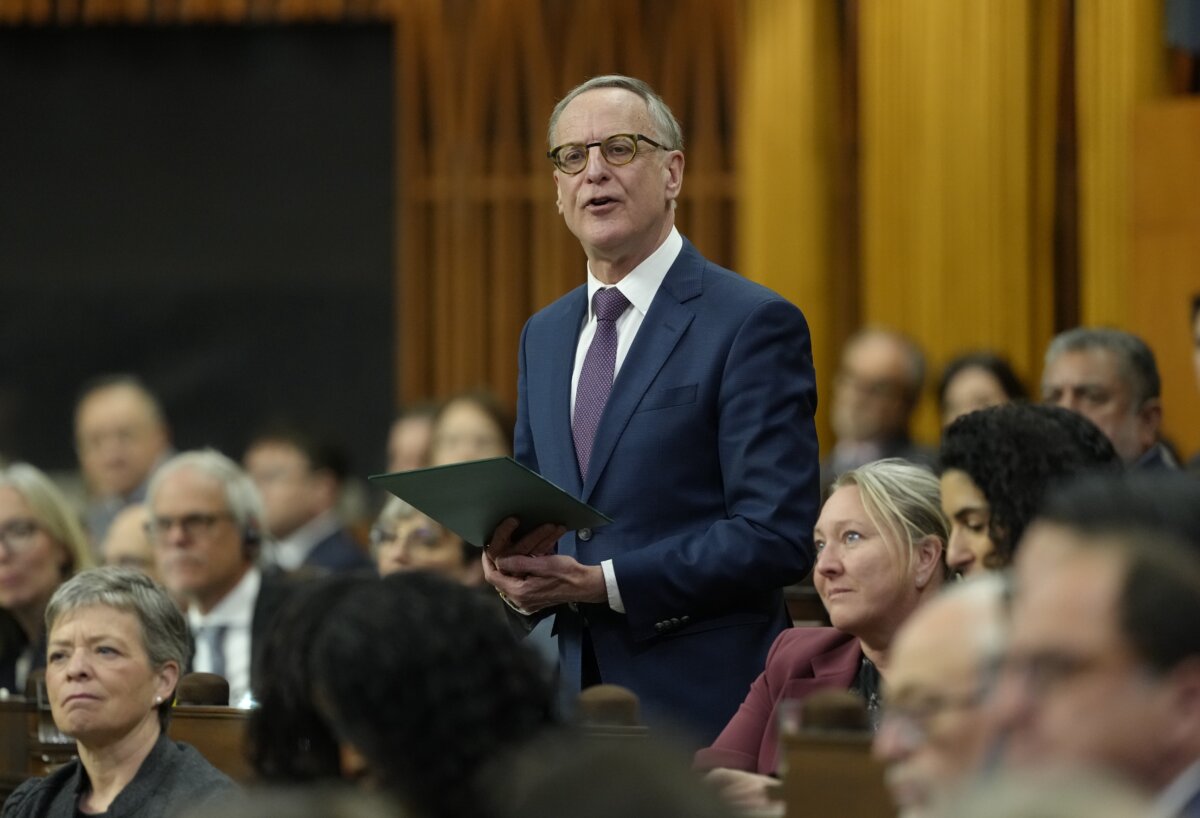
Foreign Affairs Minister Anita Anand was in Paris, France, with Prime Minister Mark Carney when the bill was tabled by her parliamentary secretary, Rob Oliphant, on June 12.
Bill C-35, An Act respecting the prohibition of the importation of goods produced by forced labour, would allow Anand to establish a list of goods for which there are “reasonable grounds” to suspect they are produced by forced labour.
Oliphant told reporters on June 12 that the list would also indicate regions or countries where forced labour is a possibility.
It would also mean that anyone importing goods on the list would have to prove to the Canada Border Services Agency (CBSA), at the request of a customs officer, that the products are not made with forced labour. Otherwise, the goods would be deemed prohibited from importation.
Oliphant said the onus is on the CBSA to enforce the legislation based on the list.
The bill would also make consequential amendments to the Customs Tariff, which Canada amended in March 2020 to include “mined, manufactured or produced wholly or in part by forced labour,” meaning the country forbids such imports.
“Canada will not tolerate the presence of goods produced through forced labour in our markets,” Anand said in a statement. “This legislation strengthens our commitment to human rights and fair, transparent trade by giving us stronger tools to stop these goods at the border and protect the integrity of our supply chains.”
Oliphant noted that the government has identified gaps in its forced labour regime. Bill C-35 will “not only strengthen it, but actually make some very significant changes as we are doing it,” he told reporters.
He also said the bill builds on Canada’s obligations under the Canada-United States-Mexico Agreement (CUSMA) on free trade, which came into force in July 2020, to prevent goods made by forced labour from entering the country.
“We do not want dumping of cheaper materials, cheaper goods into Canada that are produced with forced labour,” Oliphant said. “It’s unfair to small, medium, and large businesses in Canada who have to compete.”
He said that the threat of new tariffs by the U.S. administration is “not the principal reason” the Canadian government decided to introduce the legislation, adding that the government had proposed similar legislation in 2024 that was never enacted.
“We believe at the same time, concurrently, this will satisfy any concerns that any other country would have, including the United States.”
USTR Investigation
The United States Trade Representative (USTR) launched an investigation in March into the trade practices of 60 U.S. trade partners over concerns of countries failing to ensure they do not allow products made with forced labour to enter U.S. markets.
The investigation concluded that Canada has failed to impose and effectively enforce its prohibition on forced labour, which the USTR said “burdens or restricts U.S. commerce.”
The USTR has proposed an additional 10 percent tariff on 16 countries, including Canada, Mexico, the UK, and the European Union for failing to institute forced labour restrictions, and a 12.5 percent tariff on the other countries, including China, India, and Japan.
“Although Canada’s import prohibition came into effect nearly six years ago, the number of enforcement actions Canada has taken to prevent the entry of forced labor goods is minimal,” the USTR report said in a June 2 report.
Canadian statistics indicate very few shipments suspected of containing goods made from forced labour have been detained and denied entry since 2020.
The CBSA told The Epoch Times in April that, of the 48 shipments it detained from 2020 to late 2025, only two were prohibited entry, including a shipment of textile products in 2024 and a shipment of frozen seafood in 2025—both from China.
Comparatively, U.S. customs denied entry to nearly 23,000 shipments suspected of containing goods made from forced labour over a similar time span under its Uyghur Forced Labor Prevention Act.
The CBSA said that while the country or region of origin “may serve as a risk indicator,” Canadian legislation does not allow goods to be prohibited solely on that basis.
In addition, the border agency said that while U.S. legislation allows border services officers to prohibit goods “unless proven otherwise,” Canadian legislation does not and CBSA officers must make determinations on imported goods on a case-by-case and shipment-by-shipment basis.
The U.S. trade office pointed to a 2021 report by Canadian human rights organization Above Ground which found a “high risk” that Canadian companies are profiting from forced labour abroad, including in markets such as seafood, coffee, cocoa, and cotton.
The USTR is set to hold hearings on its proposed tariffs on July 7.
Carney told reporters on June 3 that most Canadian exports would remain exempt from Washington’s proposed tariffs under CUSMA.
Conservative MP and foreign affairs critic Michael Chong said in the House of Commons on June 12 that the federal government has insisted for weeks that “strong measures are already in place to combat the importation of products using forced labour.” He asked why the government is introducing Bill C-35 if that’s true.
 Friends Read Free
Copy
Facebook
Tweet
Friends Read Free
Copy
Facebook
Tweet