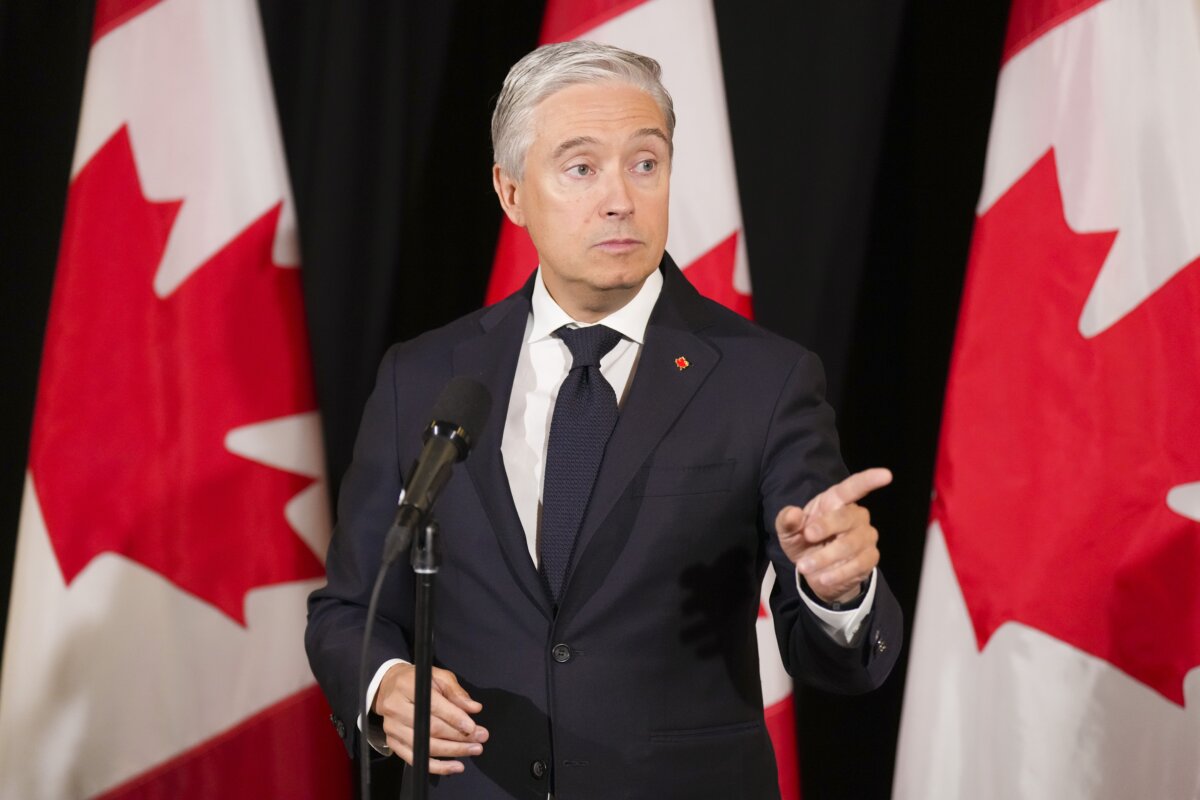

Finance Minister François-Philippe Champagne says Canada’s public service will need to go through “adjustments” as Ottawa looks to reduce its spending ahead of the release of its fall budget.
Speaking to reporters on the second day of a two-day federal cabinet meetings in Toronto on Sept. 4, Champagne said fellow cabinet colleagues have responded to his request to find savings in their departmental budgets over the next three years.
He sent a letter to his colleagues in July asking them to make cuts to their budgets to achieve 7.5 percent savings starting in fiscal 2026, increasing to 10 percent savings in 2027, and then reaching 15 percent in 2028.
When asked whether the federal government’s spending reduction plan would include public service layoffs, Champagne said the government will “find adjustments.” He said “a lot” of people have been added to the public service during the pandemic period, and that now is a time to make adjustments to reduce spending.
According to Statistics Canada data on federal public service employees, the total number of employees has increased by 100,931 in the last decade, but the biggest jump came over the COVID-19 pandemic years. In 2019, there were 287,983 federal public service employees, which increased by nearly 80,000 to 367,772 employees by 2024. In 2025, the number dropped by nearly 10,000 to 357,965 employees.
The finance minister said he is “on the same page” as Prime Minister Mark Carney in terms of the government’s spending review, adding that the increase in spending over the last decade, which equated to an average of 7 percent per year, is “not sustainable.”
Carney told reporters ahead of the cabinet retreat on Sept. 3 that such a spending growth rate is twice the growth rate of the economy on average and noted that the government needs to “rein in” spending and “find efficiencies.” He said Ottawa needed to “spend precious taxpayers’ dollars as carefully as possible.”
“Having a leaner and more efficient government to provide services to Canadians, that is needed as you’re looking to rebuild this nation for the 21st century,” Champagne said.
Staffing Reductions
Public Service Alliance of Canada President Sharon DeSousa says the federal government’s spending reduction plan is “putting everyone in Canada at risk.”
“Slashing public service jobs means cutting services,” DeSousa said in a statement. She says the cuts mean “longer wait times for passports, employment insurance and child care benefits,” in addition to impacts to other services.
Champagne said the adjustments to public service will not impact service to Canadians, adding that public service workers will be given modernized tools to better serve the public. He said that “in many ways,” Canada’s public service is currently using outdated technology and that modernization will allow public service workers to become more efficient.
Champagne said that while there may be “turbulence” in the short term as a result of the spending cuts, “the Canadian economy is resilient.” Canadians have had to reduce their household spending due to the cost of living, and Ottawa should be expected to do the same, he said.
Meanwhile, Conservative Leader Pierre Poilievre has accused Carney of increasing spending by 8 percent since taking office five months ago, as well as doubling the deficit.
Speaking at a press conference on Sept. 4, Poilievre said Carney’s “extra spending” has gone to operating costs, increasing the size of the bureaucracy, consultants, and foreign aid. The Tory leader also commented on how Carney has yet to release a budget. When asked how he would approach a spending review, Poilievre said “We need fewer bureaucrats.”
The federal government is set to table its first budget under Carney in October.
Matthew Horwood and The Canadian Press contributed to this report.
 Friends Read Free
Copy
Facebook
Tweet
Friends Read Free
Copy
Facebook
Tweet