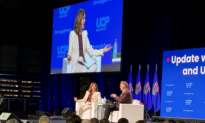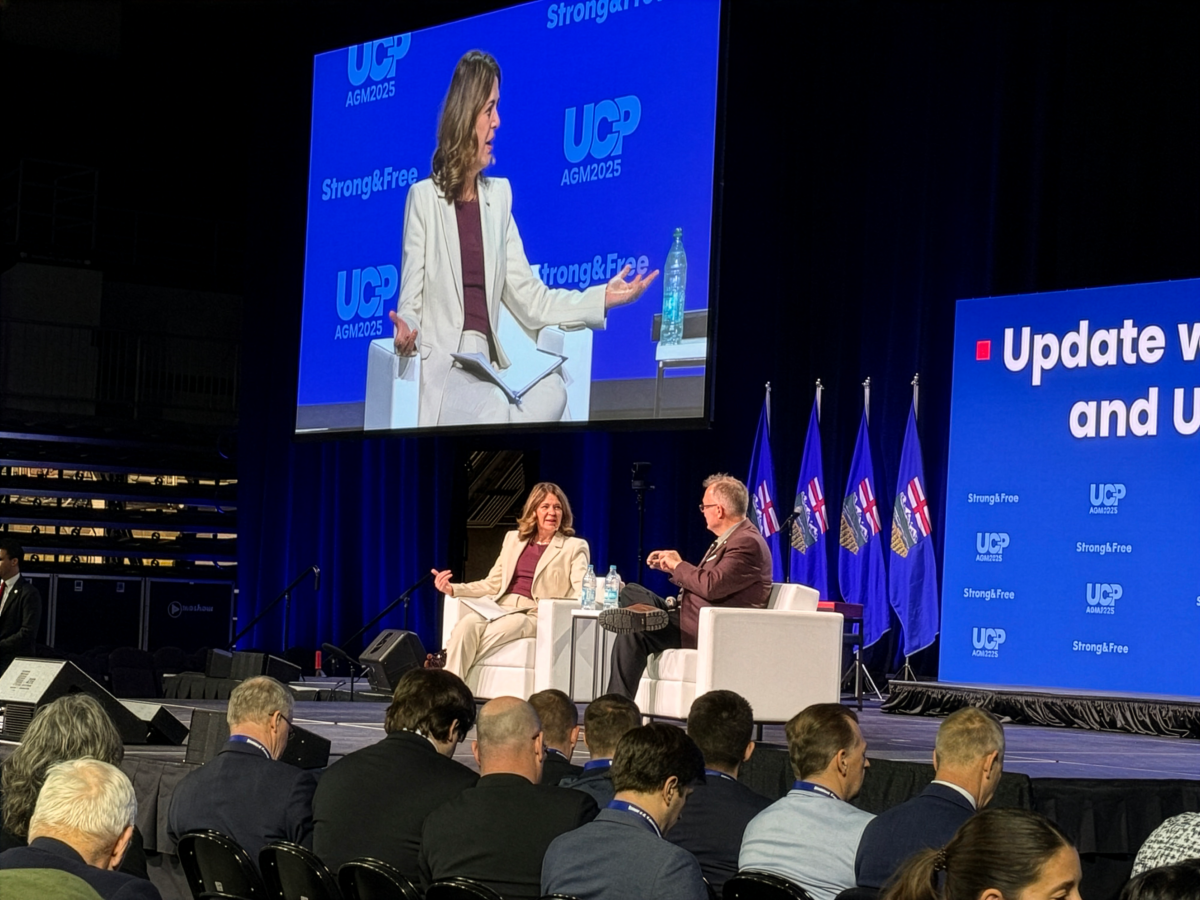

Alberta Premier Danielle Smith said at the UCP convention’s opening night on Nov. 28 that her recently signed pipeline agreement with Ottawa is a “clear win” for the province, and that her government is taking additional steps to assert provincial autonomy.
According to party estimates, more than 4,200 members registered for this year’s annual general meeting (AGM) in Edmonton, where delegates will debate governance and policy resolutions, elect a new UCP board, and engage with government representatives.
Smith’s remarks on the deal with Ottawa came in response to an attendee’s question about whether Alberta was being short-changed in the deal, given that the province must raise its industrial carbon tax and adopt a major carbon capture project before a pipeline to British Columbia’s northwest coast could be a possibility.
Smith and Prime Minister Mark Carney signed a memorandum of understanding (MOU) on Nov. 27 outlining commitments to advance a pipeline to the B.C. coast if a private proponent comes forward, and roll back certain Trudeau-era energy policies in return for emission-reduction measures from the province.
The MOU requires Alberta to raise its industrial carbon price to at least $130 per tonne as part of a new pricing framework it must finalize with Ottawa by April 1, 2026, and reduce methane emissions by 75 percent compared to 2014 values by 2035.
Smith said one way the deal benefits Alberta is by keeping carbon pricing under provincial oversight, which was a key demand she has been pressing the federal government on since the start of the year.
“We just feel like if we were to give that up, that the federal government would step in, and then we would really end up having a potential harm come to our large businesses,” Smith said.
She added that in terms of what the province gained from the MOU, the most significant achievement was the repeal or overhaul of seven of what she calls the “nine bad laws.”
The MOU addresses those federal laws and policies through measures such as removing the oil and gas emissions cap; returning oversight of the industrial carbon tax to the province; scrapping clean electricity regulations; permitting a carve-out to the tanker ban off B.C.’s coast; lifting federal restrictions on energy companies’ advertising of their environmental initiatives; committing to negotiations toward a “cooperation agreement” on the Impact Assessment Act, and guaranteeing no restrictions to Alberta’s export of oil and gas.
Smith said the other two laws, related to the national plastics ban and the electric vehicle mandate, will be dealt with later.
“I think seven out of nine isn’t bad, plus the commitment to work with us to get a bitumen pipeline” she said. “I think it’s a clear win.”
Relations With Ottawa
During her address, Smith reiterated her position that she supports “a strong and sovereign Alberta within a united Canada,” and said she hopes the newly signed deal with Ottawa reassures members that the province can still function within the Confederation.
The comments come amid the rise of an independence movement in Alberta following the federal Liberals’ re-election this year, with the separatist movement having gained support among a significant portion of UCP members.
“I hope people today feel a lot more confident that Canada works than they did a couple of days ago,” Smith said.
Her remarks were met with boos from the audience, and because the next item on the schedule was due to begin, the exchange with the premier ended on that note. However, Smith said the topic could be revisited the next day during an accountability session with her scheduled for the morning.
While addressing industry representatives following the signing of the MOU on Nov. 27, Smith said she told Carney in their first conversations that his predecessor, former Prime Minister Justin Trudeau, had sparked Alberta’s independence movement and that Carney could “take the wind out of it” by reversing policies the province views as harmful to its economy.
“I would say that good policy and genuinely addressing the concerns of Albertans is always a pathway to have a good and solid relationship,” Smith said. “I think the prime minister understands that, certainly, based on this agreement, it shows he does, and so I am hopeful.”
Mitch Sylvestre, CEO of sovereignty advocacy group Alberta Prosperity Project, said the MOU cannot repair the relationship between Ottawa and the province.
“This MOU is a useless piece of paper with no binding commitments, no guaranteed pipeline, and no surrender of federal authority over Alberta’s energy sector,” he said in a Nov. 28 statement.
“This is the ultimate evidence that Confederation is rigged against us—and it is handing our movement the momentum we have been building for years.”
For his part, Carney said the agreement with Alberta is an example of “cooperative federalism.”
“We’ve agreed in partnership and in a spirt of trust,” Carney said on Nov. 27. “We look at this as the start of a process. We’ve created some of the necessary conditions for this to happen, but there’s a lot more work to do.”
Provincial Sovereignty
During the Nov. 28 AGM session, Smith also shared key takeaways from the Alberta Next Panel, a series of in-person and online engagements between government representatives and Albertans aimed at gathering input and developing proposals to strengthen provincial sovereignty within Canada.
Proposals discussed at the town halls included possible reforms to equalization, establishing a provincial pension plan, and increasing provincial control over immigration. The panel is set to release recommendations for potential referendum questions for a province-wide vote in 2026.
Smith said some of the proposals, such as a provincial pension plan and a provincial police force, received “very mixed” reactions, making it difficult to gauge public sentiment on these issues. Meanwhile, proposals like increasing provincial control over immigration drew more decisive responses.
“I think there’s a very strong consensus about going down the Quebec pathway and taking more control over our own immigration system,” she said.
 Friends Read Free
Copy
Facebook
Tweet
Friends Read Free
Copy
Facebook
Tweet