Germany and Croatia are the latest European countries to restore a form of military service, and experts say Russia’s aggressive posture is likely to lead more nations to bring back some sort of conscription.
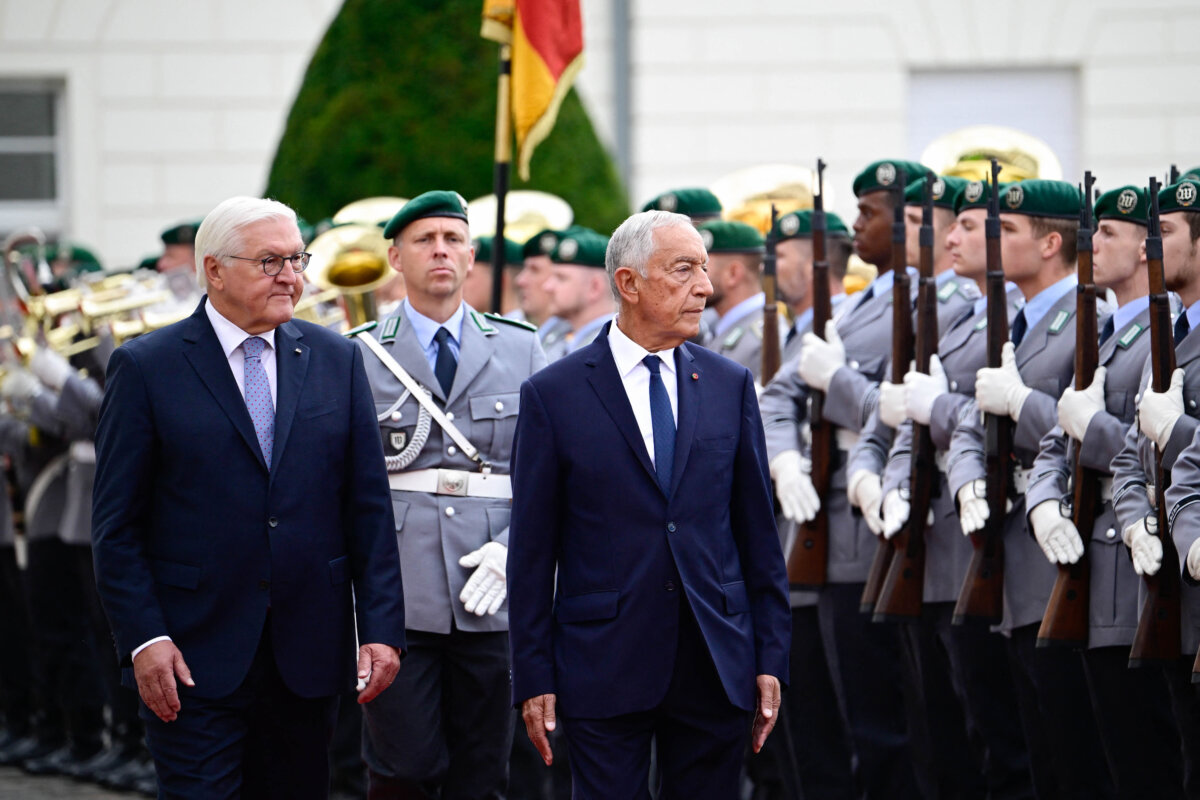
The German Cabinet approved plans on Aug. 27 for a new voluntary military service system, in an attempt to boost numbers in the armed forces, as it attempts to meet NATO targets.
Seven NATO member states currently have conscription for men: Greece, Norway, Denmark, Finland, Estonia, Latvia, and Croatia, which is reintroducing it 17 years after it was suspended.
Sweden has what is known as “total defense duty,” and two non-NATO European countries, Austria and Cyprus, also have a form of national service, the latter as a reflection of the fact that it was invaded and partially occupied by Turkey in 1974.
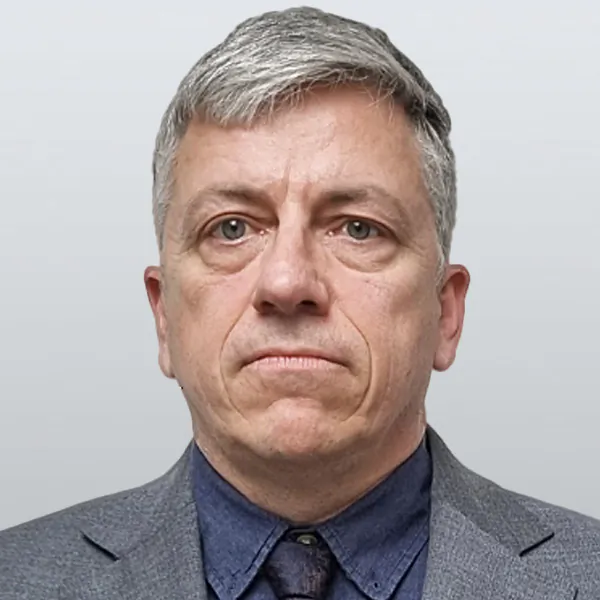
Torsten Schmidt, a German defense consultant, told The Epoch Times that he believed it would only be a matter of time before Germany reintroduced mandatory military service, and he said it would probably be followed by France, Britain, and several other European nations.
He said the Russian threat showed no sign of diminishing. However, he said the demographics were not on the side of European governments. The average number of live births per woman in the European Union is 1.38, and that number is as low as 1.12 in Spain.
Speaking at the DSEI defense industry exhibition in London on Sept. 10, Schmidt said, “If you look at the figures, the number of men in the 18-to-35 age group—which is the optimal age for recruitment—is expected to fall in most European countries in the next 20 years, largely due to the falling rates of fertility.”
“So the smaller the group of people you have to choose from, the harder it makes it to attract people, because they have so many choices of more lucrative and less risky careers,” he said.
Fertility rates have fallen drastically in EU countries—down to 1.43 in 2023 from 3.12 in 1960 in the Netherlands, and to 1.21 from 2.4 over the same period in Italy.
But as rates have fallen, the perceived threat from Russia, and to a lesser degree China, has gone up.
Some of the countries that have reintroduced national service have done it after abolishing it years earlier—Latvia scrapped it in 2007 but brought it back in 2023.
‘Russian Threat Looms Large’
Tim Ripley, a defense analyst and the author of “Little Green Men: The Inside Story of Russia’s New Military Power,“ told The Epoch Times that Moscow’s increased belligerence was to blame for the U-turn.
“The Russian threat looms large [over] all things military in Europe,” Ripley said.
In May 2024—two months before losing the general election—British Prime Minister Rishi Sunak proposed reintroducing military service, saying it would help unite society in an “increasingly uncertain world” and give young people a “shared sense of purpose.”
There has also been debate recently in Italy, France, Poland, and Portugal about reintroducing military service.
Ripley said he did not think any European country was envisaging going back to a time, during the early Cold War, when every 18-year-old was called up and the army of West Germany, the Bundeswehr, was 800,000-strong.
He said Germany’s population is 85 million, “so the age group that is potentially able to be conscripted is enormous, but they’re not going to actually call up hundreds of thousands of people.”
Ripley said, “The crucial question for the Germans is how many people they actually want.”
Berlin needs to determine “how many bodies” are needed, according to Ripley.
The draft bill—which first has to be passed by the Bundestag—would introduce a new form of voluntary military service, but the government of Chancellor Friedrich Merz said that if it fails to meet recruitment targets, conscription could be reintroduced.
European countries are not alone in struggling to hit recruitment targets in recent years, as Canada and Australia are also failing, and even the United States has issued warnings.
Times have changed a great deal over the past 60 years, and the armed forces are increasingly being seen as a less popular option in many countries.
Ripley said that across Western Europe, the demographics are leaning toward an aging population.
“There’s also a competitive job market,” he said. “If you’re in lots of West European countries, serving in the army as a private is not a well-paid job, and it has a lot of negative connotations. Military careers are not considered very prestigious.”
“In the old days of, in the 1950s and ’60s, it was the whole cohort that was called up,” he said. “It was a mass civil mobilization, and every 18-year-old was called up. So it’s a fundamentally different beast.”
The German government said it had “agreed to introduce a new, attractive military service model based on the Swedish military service model and initially based on voluntary participation.”
Ripley said the voluntary military service model in Sweden, and several other Scandinavian countries, was so popular that they have more people who want to do the military service than they have spaces for, “so they use it as a sort of a filter for people who want to join the regular armed forces.”
Under their total defense duty policy, both male and female Swedes are “part of Sweden’s total defense and required to serve in the event of war or the threat of war” from the time they are 16 until the end of the year they turn 70.
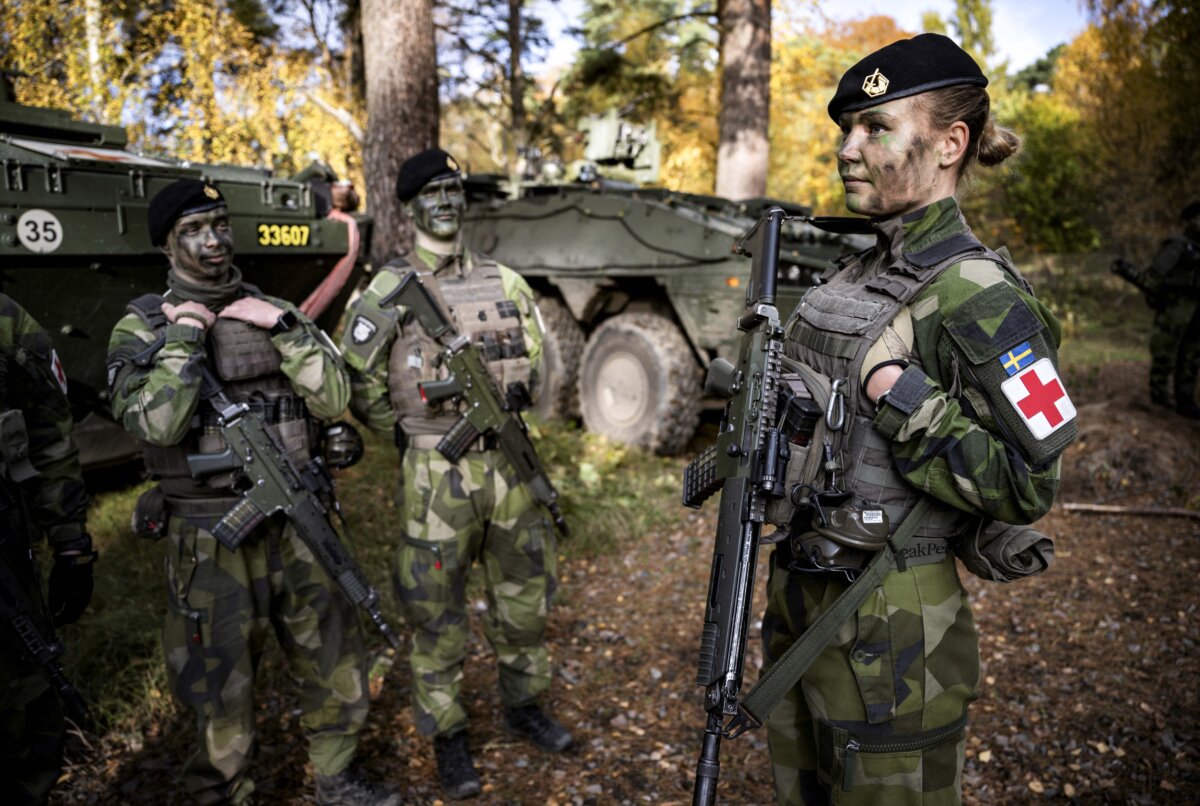
But military service is only one option.
People can opt for civilian service—which could be as a volunteer firefighter, or working in health care, or working in a kindergarten—or participating in “activities that must also function in the event of danger of war.”
The latter option often involves gaining a skill, such as cooking, building, or driving a truck or van, that could be useful in the event of a war.
“In Scandinavian countries, military service is very prestigious,” Ripley said. “It opens the door to lots of very prestigious careers and elite networks, and contact with government … which makes it quite desirable to get it on your CV.”
But he said it will take a lot to convince many young people in other European countries that being in the armed forces “is not just marching around doing pointless activity.”
“It’s something interesting, and you get a skill like flying a drone, or cyber warfare, that is beneficial to your future career,” he said.
Schmidt said, “Russia is of course suffering this problem too, and in the next few years it will struggle to find the numbers to replace those lost in the Ukraine conflict, even with mandatory national service and indeed the recruitment of convicted prisoners.”

He said that although reintroducing mandatory national service will not be popular among young people, the politicians also have demographics on their side, because older people are far more significant in the electorate.
“The opinion polls, in France, Germany and elsewhere, suggest that older people are in favor of reintroducing national service, so it will actually be a vote-winner,” Schmidt said, adding that it “might seem unfair as those older voters are obviously too old to be considered for national service.”
A survey conducted in France by IPSOS for Le Parisien newspaper in March this year found that 86 percent of respondents supported the return of national service, but only 56 percent were in favor of it being on a compulsory basis.
The same survey showed that 63 percent of those older than 60 were in favor of compulsory military service, compared with 41 percent of those younger than 35.

But Schmidt said he believes national service will not actually be as onerous as some young people may think.
“The future of warfare is going to involve drones, satellites, and [artificial intelligence]-enabled autonomous vehicles, so younger people will be in their element,” he said.
“It will essentially be a very similar skillset to gaming. Most of them won’t be fighting in the trenches. They will be using remote controls in nice warm computer suites miles from the battlefield.”
 Friends Read Free
Copy
Facebook
Tweet
Friends Read Free
Copy
Facebook
Tweet