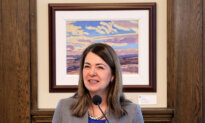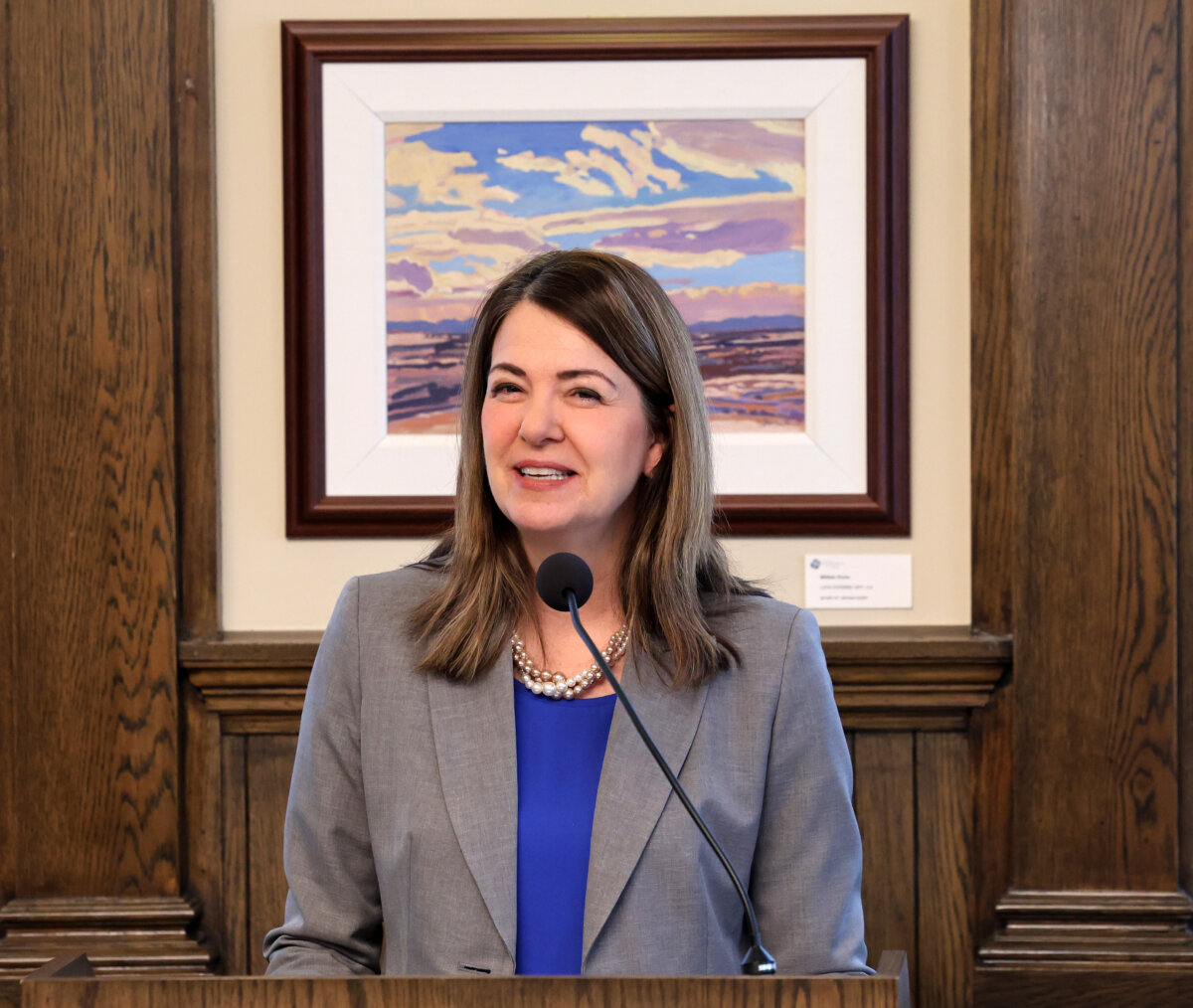

Alberta Premier Danielle Smith says she doesn’t think supporters of the Alberta independence movement want their province to join the United States. Her comments came a day after U.S. Treasury Secretary Scott Bessent weighed in on the separatism movement during a Jan. 23 interview on the American network Real America’s Voice.
Smith said Albertans have been “frustrated” with the federal government but have not indicated to her that they want the province to join their southern neighbour.
“I would say, when I talk to people who are frustrated with the way we’ve been treated [by Ottawa] for the past 10 years, they don’t say, ‘therefore, I want to be an American state.’ That is not what I am hearing,” Smith said during her weekend morning radio show, “Your Province. Your Premier.” on Jan. 24.
The premier was responding to a question asked by the host about Bessent’s comment that Alberta is a “natural partner” for the United States as well as his reference to a potential referendum on whether the province should remain in Canada.
“[Albertans] want a new relationship with Canada, and that’s what I’m doing,” Smith told host Wayne Nelson.

During his interview on Real America’s Voice, Bessent said the Canadian government has not allowed Alberta to build an oil pipeline to the Pacific coast, and he suggested that “we should let them come down into the U.S.”
“People [in Alberta] are talking. People want sovereignty. They want what the U.S. has got,” he added.
A May 2025 Leger survey indicated that 29 percent of Albertans support their province becoming a country independent of Canada, while 5 percent were undecided and the remaining 67 percent were opposed. A Pollara poll released on Jan. 9 this year indicated that 19 percent of Albertans would vote for separation from Canada, while 75 percent would vote to remain.
Elections Alberta on Jan. 2 approved a petition question on Alberta independence. Proponents have until May 2 to collect 177,732 signatures in support of the petition question before it can qualify as a referendum.
The question, submitted by the Alberta Prosperity Project (APP), a sovereignty advocacy group, asks, “Do you agree that the province of Alberta should cease to be a part of Canada to become an independent state?”
APP CEO Mitch Sylvestre told The Canadian Press on Jan. 23 that he doesn’t think anyone in his movement wants to join the United States.
“People want sovereignty, and that’s what people in the U.S. have, but we want sovereignty independent of the U.S,” he said.
‘Pressure Release Valve’
For Smith’s part, she has consistently said she doesn’t support separation herself but has also said her government would allow a vote on separation if a citizen-led petition meets the requirements to qualify as a referendum question.
Alberta NDP Leader Naheed Nenshi, who has been critical of the separatists’ movement, uploaded a video to YouTube on Jan. 24 with a caption saying “Smith needs to unequivocally denounce separatism and stand united with Team Canada.”
The video was an interview he had with CBC’s Power & Politics a day earlier, in which he accused the premier of having “been pandering to the separatists.”
Asked during the Jan. 24 radio show to respond to legal action launched by a northern Alberta First Nation to block the petition—arguing a referendum could violate treaty rights—Smith said the citizen-led petition offers an outlet for Albertans to voice their concerns.
“You need to have a pressure release valve on issues that people care about, and this is something that clearly a motivated group of people care about,” she said.
‘A Great Partner’
Weighing on current trade disputes Ottawa has with Washington, the premier said Canada has been and will continue to be “a great partner” for the United States “on all fronts.” She added that it would be mutually beneficial for both countries to focus on the upcoming renegotiation of the Canada-United States-Mexico Agreement on free trade starting in July this year.
“That’s the position I take when I speak with U.S. officials. It’s the position I take when I talk with the U.S. ambassador, it’s, ‘Let’s maintain the Canada-U.S.-Mexico trade agreement as it is, and then let’s work on getting resolution on the areas where there’s dispute,’” Smith said.
“When you look at Alberta, 97 percent of our goods cross the border tariff-free,” she added. “The areas where there’s problems—aluminum, steel, autos, softwood lumber, pharmaceuticals, digital—let’s get to the table and start negotiating on those particular issues, as opposed to thinking there’s something wrong with the deal as a whole.”
Smith also expressed optimism with regard to Alberta’s relationship with Ottawa since she and Prime Minister Mark Carney signed a memorandum of understanding (MOU) on Nov. 27, 2025, which proposes to build one or more pipelines to carry Alberta crude oil to the B.C. coast if a private proponent comes forward.
“I’m forging a new relationship with Canada. We’ve got a new leader, a new prime minister, we’ve got a new MOU and we seem to have common cause on trying to get a new pipeline built and open new markets. So that’s what I’m going to keep focused on,” she said.
The MOU will see the lifting or adjustment of a number of existing and proposed Trudeau-era energy regulations. In return, Alberta has committed to increasing the industrial carbon tax, lowering methane emissions, and pairing the proposed pipeline with an elaborate carbon capture project.
Federal Finance Minister François-Philippe Champagne was also asked about Bessent’s comments later in the day on Jan. 23, to which he replied, “We will do our own things, and we will be able to develop our resources with Albertans, with Canadians. And that’s something I will remind him of the next time I see him.”
Paul Rowan Brian and The Canadian Press contributed to this report.
 Friends Read Free
Copy
Facebook
Tweet
Friends Read Free
Copy
Facebook
Tweet