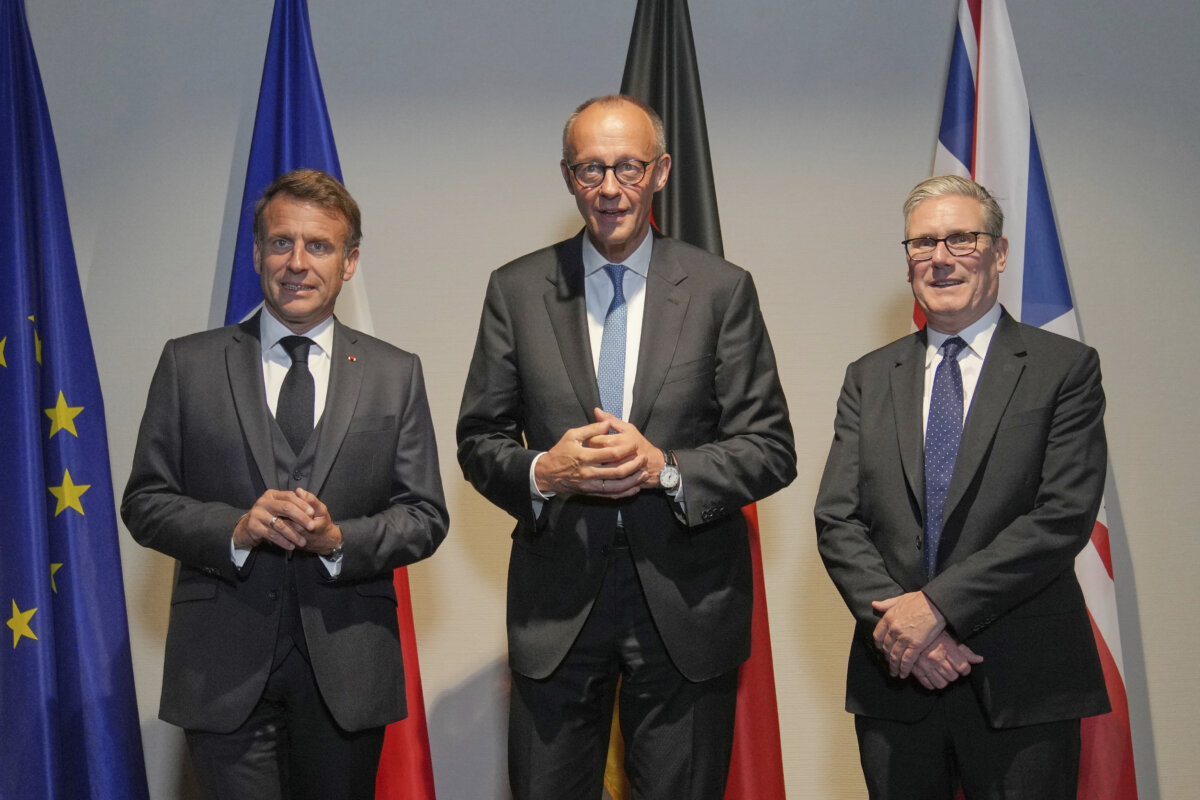

The UK and Germany will sign a defense cooperation treaty, as German Chancellor Friedrich Merz arrives in London on his first official visit to the UK since taking office in May.
The new treaty builds on last year’s agreement between the two nations to boost defense exports, including the UK’s Boxer armored vehicles and Typhoon jets. British Prime Minister Keir Starmer and his German counterpart are also set to commit to developing in the next decade a long-range, advanced missile system with a range of more than 1,200 miles.
Europe has accelerated defense investment and cooperation since U.S. President Donald Trump’s return to the White House in January renewed pressure on NATO allies to shoulder more of the responsibility in defending Europe.
In June, the UK, Germany, France, and the rest of NATO committed to raising defense spending to 5 percent of GDP by 2035.
In a statement on July 16, the UK government said the development of the new Deep Precision Strike capability will “safeguard the British public and reinforce NATO deterrence, while boosting the UK and European defence sectors through significant industrial investment.”
The announcement follows last week’s agreement between the UK and France to coordinate their independent nuclear deterrents if needed to defend Europe.
Defense and Commercial Ties
Merz’s visit to the UK will build on the previous agreement between Germany and the UK to deepen cooperation in defense procurement, research, and technological innovation, in light of escalating security concerns, exacerbated by the war in Ukraine.
Alongside the treaty, the UK announced new German investments, including a manufacturing site by defense tech firm Stark in Swindon, southwest England. This marks Stark’s first production expansion outside of Germany.
Mike Armstrong, managing director of Stark UK, said the new site will develop AI-powered, unmanned systems to help defend Europe and NATO.
Beyond defense, the treaty also establishes a new UK–Germany Business Forum to strengthen the countries’ commercial ties. Bilateral trade currently stands at 146.4 billion pounds (about $196.2 billion), with Germany being the UK’s second-largest trading partner after the United States.
Ahead of his visit, Merz said on X: “We want closer cooperation with the United Kingdom—on security and defense, trade, and business. It’s good that the UK is moving closer to Europe once again.”
Illegal Immigration
Alongside the treaty, Germany is expected to commit to changing its laws to make it a crime to facilitate illegal immigration to the UK.
The move targets small-boat crossings via the English Channel. According to Europol, Germany has been one of the key countries in Europe where smuggling gangs operate, supplying cheap rubber boats and engines for these crossings.
By the end of the year, Berlin plans to close legal loopholes that have made it difficult to prosecute people involved in storing and supplying boats for smuggling.
The change will give law enforcement the tools that they need to investigate and take action against warehouses and storage facilities used by human traffickers to conceal dangerous small boats intended for illegal crossings to the UK, the British government said.
“Chancellor Merz’s commitment to make necessary changes to German law to disrupt the supply lines of the dangerous vessels which carry illegal migrants across the Channel is hugely welcome,” Starmer said.
The step is part of a wider joint plan that the UK and Germany agreed to in 2024. The UK’s National Crime Agency has already seized more than 600 boats and engines in the past 18 months with help from European partners.
The announcement comes after the UK and France struck a new returns deal on July 10. Under the plan, the UK will send about 50 illegal immigrants back to France each week. In exchange, the UK will take in the same number of asylum-seekers from France through a legal route.
More than 21,000 illegal immigrants have arrived in the UK in small boats so far this year.
 Friends Read Free
Copy
Facebook
Tweet
Friends Read Free
Copy
Facebook
Tweet