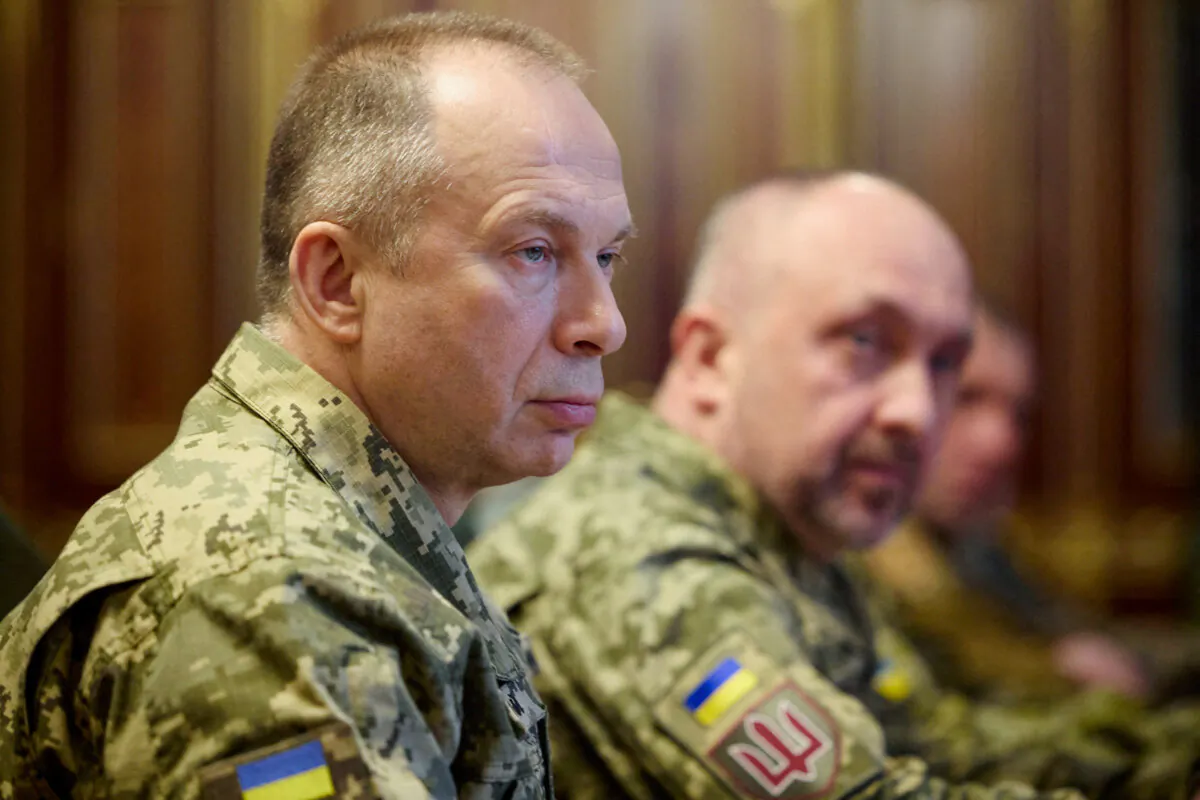

Ukraine has recaptured 280 square miles of territory so far this year, Gen. Oleksandr Syrskyi said on July 22, as he confirmed his exit from the role of top general.
“The army, which two years ago was conducting a difficult defense, is advancing today,” said the outgoing commander-in-chief in a Telegram post.
Ukrainian President Volodymyr Zelenskyy announced on July 21 that Syrskyi was being replaced with Mykhailo Drapatyi as commander-in-chief amid a wider shake-up of the government.
Syrskyi said he was handing over to his successor “an army that is not only holding the defense, but is also in a state of offensive—with initiative, with structure, with people who know how to beat the enemy.”
“I sincerely hope that this offensive will be continued. Everything is there for this,” he said.
In June, Syrskyi said that by the end of May of this year, Kyiv had retaken some 230 square miles of Ukrainian territory.
Russia controls about 20 percent of Ukraine, which includes Crimea and parts of the Donbas that Russia had seized before the full-scale invasion on Feb. 24, 2022.
In the initial months after Russia’s invasion, Kyiv recaptured land in a series of counterstrikes. But a major Ukrainian counteroffensive failed in 2023, and Russia had since been making gains.
However, researchers have reported that Russia’s total advances have slowed in recent months.
The Institute for the Study of War said in a July 1 assessment that Moscow’s offensive this spring and summer has failed to achieve significant gains and that the rate of Russian military advance last month “is a fraction” of the gain achieved in June 2025.
Ukraine Intensifies Drone Attacks
Ukraine has been intensifying its long-range drone attacks on Russian military and energy infrastructure—including recent strikes against two major oil facilities in Russia hundreds of miles from the front line—in a bid to slow the Russian army’s advances.
Likewise, Moscow has been targeting Ukrainian military manufacturing facilities in an attempt to choke off Kyiv’s ability to strike oil sites with drones.
The Institute for the Study of War said in a July 6 report that Ukraine’s intermediate- and long-range drone campaigns into Russian-occupied Ukrainian territory and Russia “are causing significant effects on the Russian economy and impact Russia’s ability to sustain its frontline military efforts in Ukraine.”
It noted that Ukraine has recently intensified these campaigns, causing gasoline shortages in Russia and occupied Ukraine and affecting frontline logistics. Moscow has lost petrochemical export revenue that could have funded the war effort.
“Ukrainian forces will likely be able to continue—if not escalate—their long-range strike campaign until Russia is able to find a solution to its air defense insufficiencies,” the report’s authors said.
“Ukraine’s strike campaigns against Russian petrochemical infrastructure and logistics will likely continue to degrade Russia’s struggling wartime economy and have growing consequences on Russia’s frontline operations in the future.”
Zelenskyy Replaces Military Chief
Zelenskyy on July 21 announced that he would be replacing Syrskyi with Drapatyi, days after he replaced Defense Minister Mykhailo Fedorov with Yevhenii Khmara as acting defense minister.
Fedorov had been credited with reshaping the Ukrainian army into a more effective fighting force and had championed the use of drones.
The announcement to replace Fedorov sparked rare wartime public protests and revealed tensions between the former defense minister and Syrskyi, the now-former commander-in-chief of the armed forces. Fedorov accused Syrskyi of deliberately undermining him.
Zelenskyy said in a July 22 post on X that the decisions to change the armed forces’ leadership would be finalized, and he named Major Gen. Ihor Skybiuk as the new chief of the general staff of the Armed Forces of Ukraine.
The Ukrainian president said that the military leaders had discussed defense objectives, including strengthening air defenses and developing cyberforces.
 Friends Read Free
Copy
Facebook
Tweet
Friends Read Free
Copy
Facebook
Tweet