
A U.S. lawmaker says while it’s good news that Canada has now committed to meeting its NATO defence spending target, the country needs to make up for the amount it missed over the past two decades.
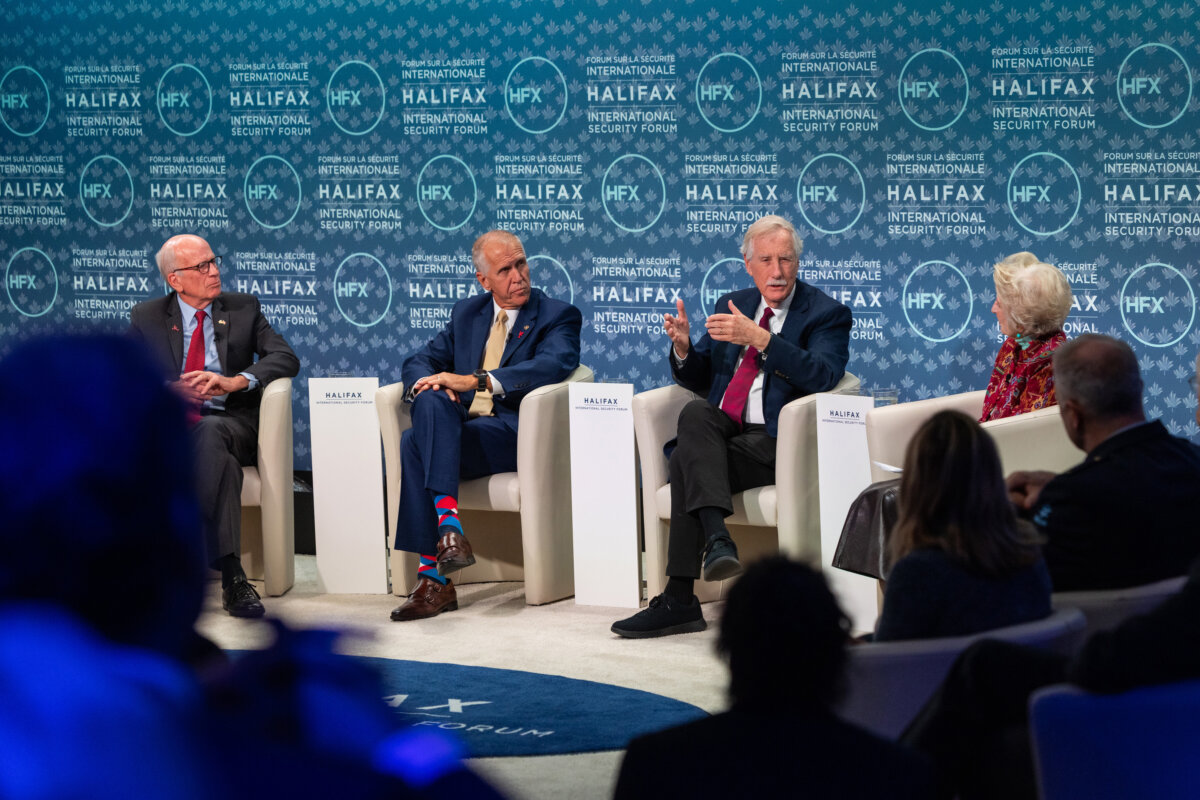
Speaking on a panel at the Halifax International Security Forum (HFX) on Nov. 22, Thom Tillis, a Republican senator from North Carolina, said he has a “serious frustration” with NATO countries that failed to meet the minimum spending goal of 2 percent of their GDP on defence over the last 20 years. The consequence, he said, is a $2 trillion shortfall, with “$300 billion from Canada alone.”
“It’s fine to say you’re about to catch up, but it’s not fun to look past a $300 billion shortfall,” Tillis told a morning panel. “Can we do a makeup payment for the 20 years of shortfalls as well?”
The forum, held in Halifax, Nova Scotia, from Nov. 21 to 23, is an annual summit that gathers international government and military officials, business and academia experts, and media representatives to address pressing global security challenges.
Tillis told co-panellists during the “America and the World, America in the World” session that he considered NATO members as a “family of democratic nations” that needed to engage in “serious discussion” about fulfilling funding obligations to bolster defence among the allies.
“Let’s be open and honest about this family problem that we need to deal with. Otherwise, another 20 years from now, we’ll be having the same discussion,” the U.S. senator said. He added that the shortfall has hindered NATO’s ability to “project more power, to have more democracies, and free more people,” while also referring to Russia’s invasion of Ukraine as a consequence.
“What would $2 trillion of modernization mean to NATO if we’d made the investment at the time that we said we were going to?” he stated.
Commitment
In his comments on the panel, Tillis credited U.S. President Donald Trump for obtaining commitment from NATO member countries to spending 2 percent of their GDP on defence.
Trump has long been critical of NATO countries that fail to meet that minimum spending target. He said during a February 2024 rally that he wouldn’t defend those NATO member countries from Russian attacks.
According to 2024 NATO estimates, 9 out of 31 countries in the defence alliance fell short of reaching the spending goal. These include Canada, Croatia, Portugal, Italy, Belgium, Slovenia, Spain, Luxembourg, and Montenegro. Canada spent just 1.37 percent of its GDP in the 2024–25 fiscal year.
During opening remarks at the HFX forum on Nov. 21, federal Minister of National Defence David McGuinty assured attendees of Canada’s pledge to meet the 2 percent goal by the end of this fiscal year and the alliance’s new 5 percent defence spending commitment by 2035.
In his over 15-minute speech, McGuinty acknowledged that Canada has put security and defence priorities on the “back burner” since the end of the cold war.
“When national budgets were tight, other priorities took precedence,” the minister said. “If I’m being honest, we became complacent. Our defence muscles atrophied, our security muscles atrophied. Call it the peace dividend, or the end of history. We now know this era was short-lived.”
McGuinty added that Canada is “rebuilding, rearming, and reinvesting” its military “on a massive scale and at speed.”
“We’re making generational investments into our security, our sovereignty, and our resilience,” he said, referring to promises Ottawa made in its latest budget to strengthen the Canadian Armed Forces (CAF).
Budget 2025, which was introduced on Nov. 4 and passed its confidence vote in the House of Commons on Nov. 17, sets aside a total of $81.8 billion for the CAF over five years, starting this fiscal year, as the federal government works toward the updated NATO defence spending target of 5 percent of GDP by 2035.
The amount allocated includes $20.4 billion to recruit and retain CAF personnel; $19 billion to repair and modernize military infrastructure; $17.9 billion to expand capabilities with new vehicles, weapons, and ammunition; $10.9 billion to upgrade digital and cyber defence systems; and $6.6 billion to bolster the domestic defence industry.
The budget also allocates $6.2 billion over five years to expand Canada’s defence partnerships, including expanding military assistance to Ukraine in its fight against Russia, as well as $805 million over five years to the Canadian Coast Guard, the Canadian Security Intelligence Service, and Public Services and Procurement Canada for “complementary initiatives to support Canada’s defence capabilities.”
Asked about Tillis’s remarks on Canada paying its back dues, McGuinty reiterated to media that Ottawa will focus on rebuilding its military and said that while he respected the senator’s position, Canada is moving forward with its own plan.
Matthew Horwood and Omid Ghoreishi contributed to this report.
 Friends Read Free
Copy
Facebook
Tweet
Friends Read Free
Copy
Facebook
Tweet