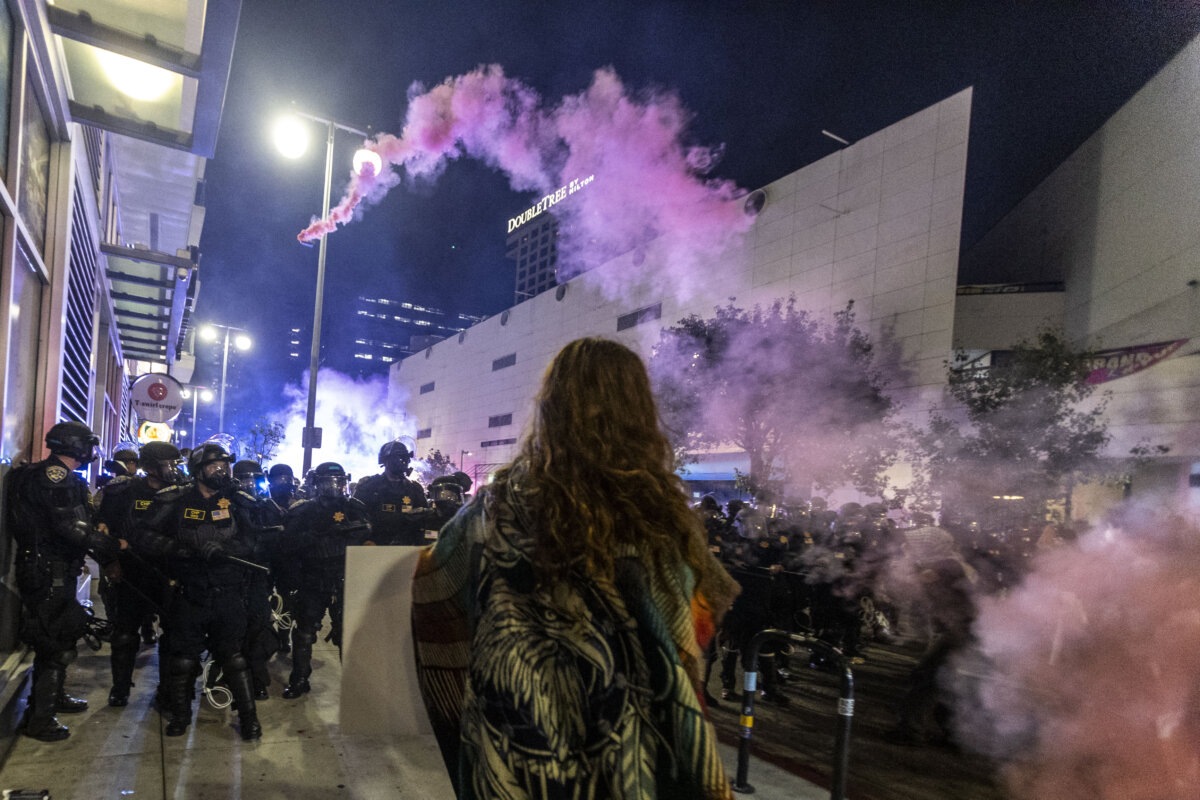

As protests against President Donald Trump’s immigration policies flared across Los Angeles over the weekend, questions have arisen about whether he would—or could—invoke the Insurrection Act of 1807, and send active duty U.S. military to quell the rioting and vandalism.
The law allows the president to deploy the National Guard or other U.S. military personnel to put down an uprising that interferes with the rights of the populace if “the constituted authorities of that state are unable, fail, or refuse” to do so.
Although he has not yet officially invoked the act, on Saturday, Trump announced he has authorized 2,000 National Guard troops for deployment to Los Angeles to quell the riots, despite objections by California Gov. Gavin Newsom.
Newsom responded by calling Trump’s move “a serious breach of state sovereignty — inflaming tensions while pulling resources from where they’re actually needed.”
On Monday, Newsom also announced he was suing the Trump administration over its decision to deploy the National Guard to California.
Here’s what to know.
The Law
The issue has its origin in 1792 legislation that allowed the federal government to call up state militias “to execute the laws of the Union, suppress insurrections and repel invasions.”
The 1807 legislation added additional powers for the president, including the ability to deploy active duty federal troops without the request or support of state government actors.
It provides some of the only exceptions to the Posse Comitatus Act, an 1878 law which generally forbids the use of the military against American citizens.
History
The legislation has been used numerous times across U.S. history.
President George Washington called up state militias under the 1792 law to suppress the Whiskey Rebellion, an uprising against federal excise taxes on liquor.
It was later used by Abraham Lincoln at the outset of the Civil War, and by Ulysses S. Grant against the Ku Klux Klan.
The last use of the legislation came in 1992, when President George H. W. Bush invoked it to send troops to Los Angeles to put down riots when four police officers were acquitted after beating Rodney King.
Following the 2020 death of George Floyd, use of the Insurrection Act to suppress riots was considered, but Trump ultimately declined to use the law.
At the outset of his second term as president, Trump signed an executive order requiring the secretaries of Defense and Homeland Security to submit a report within 90 days on the illegal immigration crisis at the southern border, and if it justified the use of the 1807 Insurrection Act.
Will He, Won’t He?
While Trump has not yet invoked the Insurrection Act, the law gives him broad authority to decide whether it’s necessary.
In the 1827 case Martin v. Mott, the Supreme Court ruled that the authority to decide whether an emergency justifies deploying a militia under the Insurrection Act—in this case, the National Guard—“belongs exclusively to the president,” and “his decision is conclusive upon all other persons.”
On June 9, Trump continued to be ambiguous about his plans regarding the Insurrection Act.
When The Epoch Times asked the president if he intended to invoke the Act, Trump smiled and continued to walk away without answering.
—Stacy Robinson, Joseph Lord, Iris Tao
BOOKMARKS
The Department of Government Efficiency (DOGE) is still working to reduce government spending and announced on June 6 that it had canceled nearly 90,000 more government credit cards since May, bringing the total to more than 610,000. DOGE said on June 8 that government agencies had canceled thousands of unused phone plans in the last month, and they “will continue to work agency by agency to identify wasteful IT spend and report back.”
The U.S. Treasury Department has sanctioned two sons of Joaquín “El Chapo” Guzmán and several members of their network, Los Chapitos, for drug trafficking and money laundering. “Los Chapitos is a powerful, hyperviolent faction of the Sinaloa Cartel at the forefront of fentanyl trafficking into the United States,” Treasury Secretary Scott Bessent said in a statement.
Italy is holding a two-day referendum on a series of issues, including a plan to reduce requirements for gaining permanent residence in that country. Prime Minister Giorgia Meloni opposes the change, which is expected to affect 2.5 million foreign residents living in Italy.
Over 100 National Institutes of Health (NIH) employees are calling on its director, Dr. Jay Bhattacharya, to reinstate fired employees and canceled grants. The group has signed a declaration saying that the recent downsizing of the institute will “undermine the NIH mission, waste public resources, and harm the health of Americans and people across the globe.”
David Huerta, president of the Service Employees International Union (SEIU) of California, will face charges for obstructing an illegal immigration raid in Los Angeles last Friday. Huerta and one other protester allegedly sat down in front of an ICE vehicle that was attempting to enter a business complex and execute search warrants for undocumented workers.
—Stacy Robinson
 Friends Read Free
Copy
Facebook
Tweet
Friends Read Free
Copy
Facebook
Tweet