



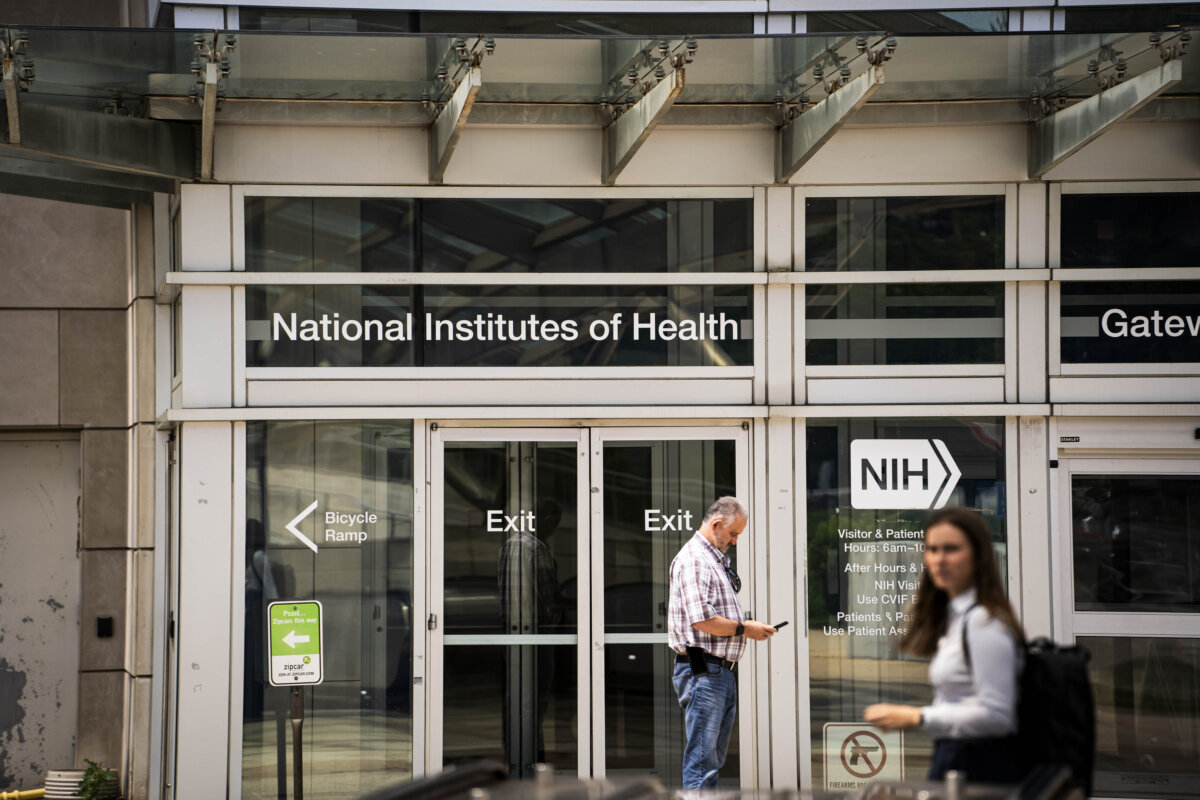
More than 100 National Institutes of Health (NIH) employees on June 9 released a declaration that calls on the agency’s director to roll back terminations of grants and the firings of workers.
Alexander Grinberg, a director at the National Institute of Child Health and Human Development, and dozens of other NIH employees signed the so-called Bethesda Declaration using their real names. Others chose to remain anonymous due to what they described as fear of retaliation.
The employees told Dr. Jay Bhattacharya, the NIH’s director, that they oppose policies that “undermine the NIH mission, waste public resources, and harm the health of Americans and people across the globe.” They said in the declaration that the NIH has improperly targeted universities with such actions as terminating grant submissions; ending funding for research that focuses on diversity, equity, and inclusion; and firing NIH workers “without thought to their purpose or need.”
The employees called on Bhattacharya to restore grants that were “delayed or terminated for political reasons so that life-saving science can continue,” reinstate fired workers, set aside a 15 percent cap on indirect costs for research, allow peer-reviewed research with foreign scientists to continue without interruption, and restore independent peer review.
“We want to work together to maintain NIH’s tradition of excellence,” the employees said.
Other signatories currently employed by the government include Jenna Norton, a program officer at the National Institute of Diabetes and Digestive and Kidney Diseases; Ann-Marie Roy, acting branch chief at the National Institute of Allergy and Infectious Diseases; and Janine Simmons, deputy director at the Division of Program Coordination, Planning, and Strategic Initiatives.
Some individuals who do not work for the government, such as Dr. Joshua Gordon, former director of the National Institute of Mental Health, also signed the document, which is modeled after the Great Barrington Declaration, which Bhattacharya signed in 2020 to promote an alternative path to dealing with the COVID-19 pandemic.
Bhattacharya, who became the NIH’s director in 2025, told The Epoch Times in an emailed statement that the new declaration “has some fundamental misconceptions about the policy directions the NIH has taken in recent months, including the continuing support of the NIH for international collaboration.”
“Nevertheless, respectful dissent in science is productive. We all want the NIH to succeed,” he stated.
A spokesperson for the Department of Health and Human Services, the NIH’s parent agency, told The Epoch Times in an email that there has not been a halt to “legitimate international collaborations” but that officials are focusing on accountability, or making sure money is spent properly.
The spokesperson also said that grants were discontinued if they involved “ideological narratives,” rather than “provable and testable hypotheses.”
With regard to terminations, the spokesperson said that each firing is being reviewed to make sure it was appropriate.
“We’ve already reinstated some individuals,” the spokesperson said. “Still, as NIH priorities evolve, so must our staffing model to ensure alignment with our central mission and being good stewards of taxpayer dollars.”