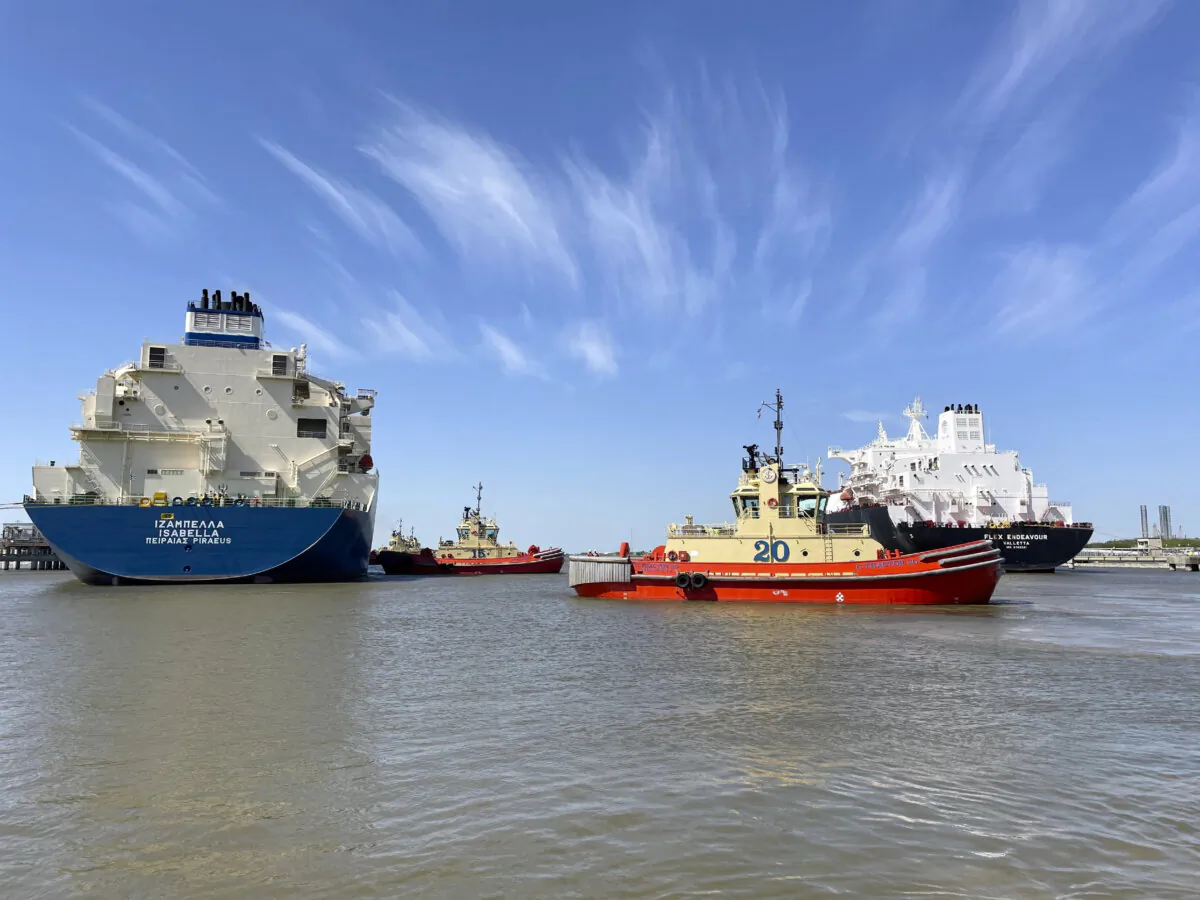

U.S. producers exported a record-high 111 million metric tons of liquefied natural gas (LNG) in 2025, cementing the nation’s status as the world’s largest natural gas supplier with rising demand—especially from Europe—prompting the U.S. Energy Information Administration (EIA) to project that the nation’s LNG exports could double by 2031.
Only a decade ago, the U.S. was a net natural gas importer with only one large-scale liquefaction plant and export terminal at Sabine Pass, Louisiana.
In fact, when the tanker Asia Vision left the port on Feb. 24, 2016, with 3.3 billion cubic feet of LNG, it was the first time since 1959 that U.S. natural gas left its shores, “marking the beginning of a new era in U.S. LNG exports,” EIA analysts write.
There are now eight U.S. LNG export terminals, all on the Gulf and east coasts: four in Louisiana, two in Texas, and one each in Georgia and Maryland. A ninth terminal—ExxonMobil’s Golden Pass on the Texas side of Sabine Pass—began liquifying “dry” natural gas on Feb. 24 and is expected to start shipping next month.
At least two new Texas LNG terminals are planned, and Alaska LNG is expanding and reopening its liquefaction plant and export terminal in Nikiski on the Kenai Peninsula. Shuttered since 2011, the terminal had shipped LNG to Japan for more than 40 years.
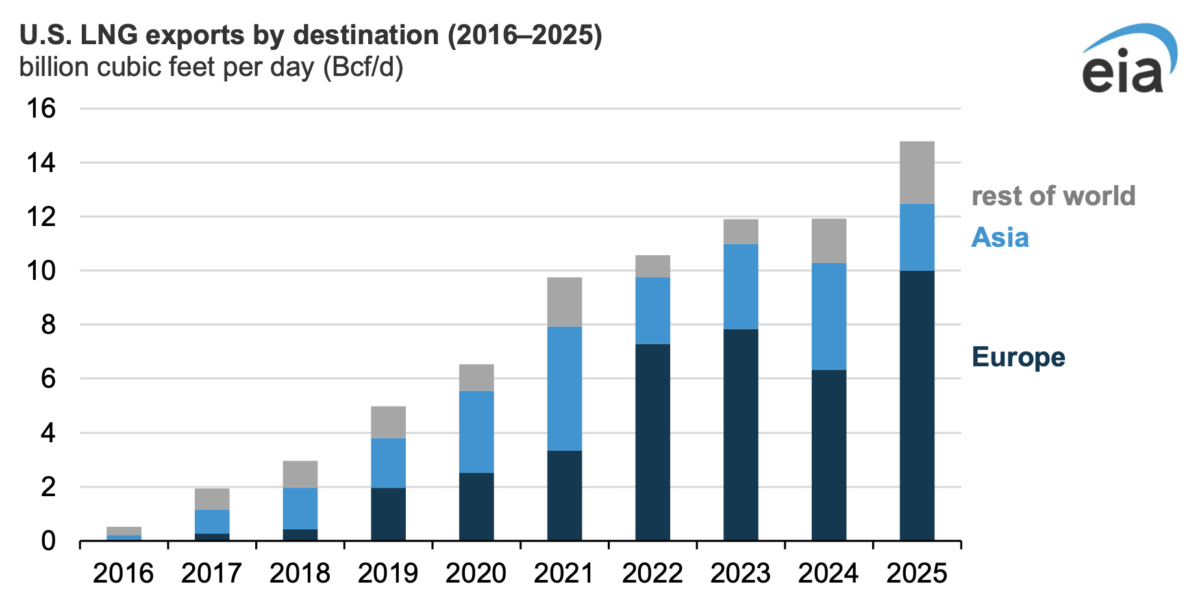
In 2016, according to the EIA, U.S. LNG exports averaged 0.5 billion cubic feet per day. The 111 million metric ton annual 2025 export total breaks down to an average of nearly 15 billion cubic feet a day, a 30-fold increase in less than a decade, the administration calculates.
It projects exports to increase to 16.4 billion cubic feet a day in 2026, top 18.1 billion cubic feet a day in 2027, and continue to grow as the new terminals come online by 2031, nearly doubling the nation’s collective LNG export capacity.
The EIA cites “abundant supply and reserves, flexible LNG export contracts, and relatively low feedgas costs” among reasons why U.S. producers now lead the world in LNG exports, eclipsing Australia and Qatar in 2022.
But the two biggest factors that elevated “dry” natural gas and LNG as a prime source for electricity and heating—it’s used to generate 43 percent of electricity in the United States, and about a quarter of the world’s power—are “Shale Revolution” advances in hydraulic fracturing, or “fracking,” in the 2000s, and a “favorable investment climate” fostered by Russia’s 2022 invasion of Ukraine.
Europe Top Customer
Before the war in Ukraine began in 2022, Asia was the primary market for U.S. LNG. Between 2017 and 2021, the biggest buyers were in South Korea, Japan, and China, consuming nearly half of U.S. natural gas, the administration notes.
Russia had been Europe’s chief energy source, selling nearly $180 billion a year in fossil fuels to buyers on the continent. Russia primarily exports crude oil, although the EIA maintains its producers also provided approximately 45 percent of LNG and “piped” natural gas purchased by Europeans in 2021.
In the wake of the February 2022 invasion of Ukraine, individual European nations and the European Union have imposed a series of sanctions that have dramatically reduced reliance on Russian fossil fuels while significantly increasing imports from the United States.
Despite sanctions and efforts to develop other energy sources, some European nations continue to import Russian oil and LNG. France, Belgium, and Spain continue to import Russian LNG while Hungary and Slovakia still buy Russian crude shipped by pipeline.
But a prospective July trade deal between European Union Commission President Ursula von der Leyen and U.S. President Donald Trump calls for European nations to completely detach from Russia and purchase $750 billion in U.S. energy commodities over the next three years.
That deal, or “framework,” is not binding on the European Union’s 27 members. Citing “tariff turmoil,” the union paused trade negotiations on Feb. 23 after Trump imposed a universal 10 percent tariff—which he may increase to 15 percent—on imports in the wake of the Feb. 20 Supreme Court ruling that invalidated the tariff framework imposed by the president under the International Emergency Economic Powers Act.
The administration issued its projections before the union paused its import pact, but there’s been no revision in those projections from the government or domestic industry trade groups that remain bullish on the long-term stability of the U.S. natural gas industry.
According to the National Association of Manufacturers, the U.S. LNG industry contributed $43.8 billion to the national economy in 2023, supported more than 222,000 direct and indirect jobs, and generated more than $11 billion in federal, state, local tax, and royalty revenues.
The association projects the industry could support up to 900,000 U.S. jobs with $104 billion in wages, generate $47.7 billion in taxes and royalties, and contribute $215.7 billion to the nation’s gross domestic product by 2044.
 Friends Read Free
Copy
Facebook
Tweet
Friends Read Free
Copy
Facebook
Tweet