



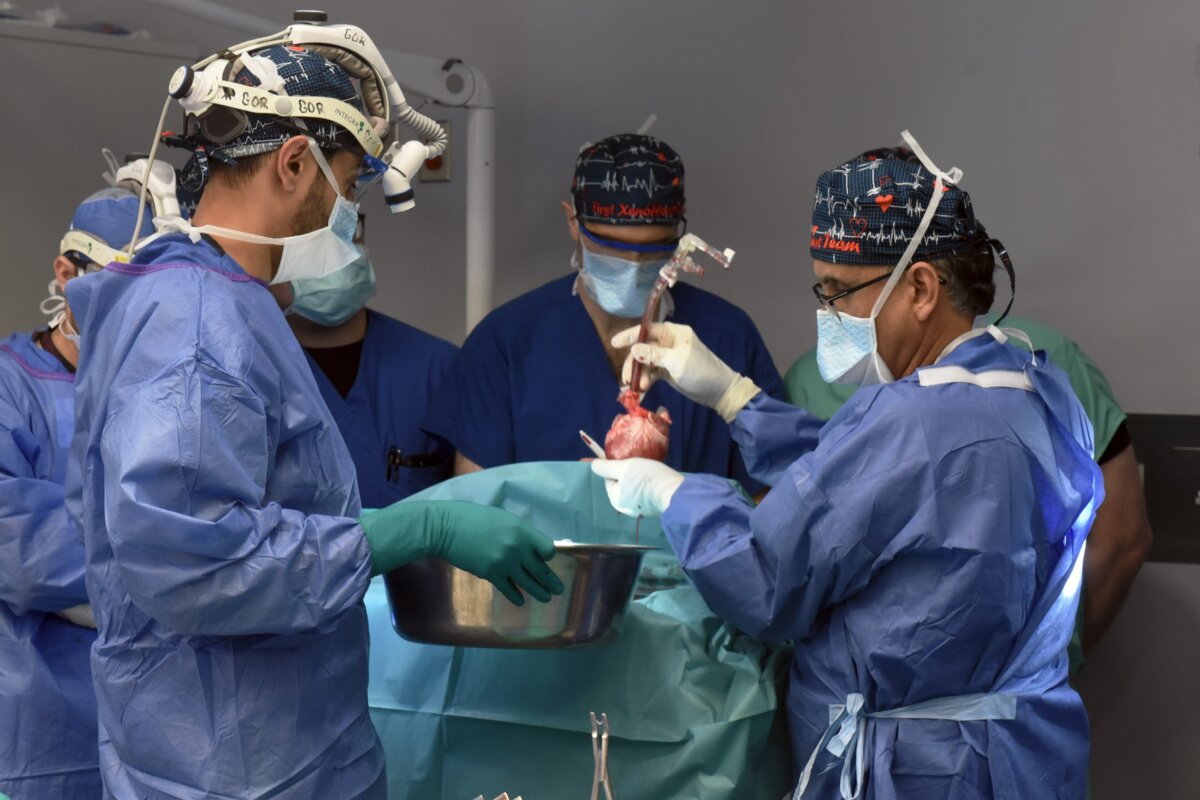
The second recipient of a genetically modified pig heart died on Monday six weeks after he underwent transplant surgery.
“It is with great sadness that we announce the passing of Lawrence Faucette, the 58-year-old patient with terminal heart disease who received the world’s second genetically-modified pig heart transplant,” the University of Maryland School of Medicine (UMSOM), which conducted the transplant, said in an Oct. 31 press release. “Mr. Faucette received the transplant on September 20 and lived for nearly six weeks following the surgery.”
Mr. Faucette first approached UMSOM as a patient on Sept. 14 when he was in end-stage heart failure. He was deemed to be ineligible for a traditional human heart transplant owing to his peripheral vascular disease and complications with internal bleeding.
Facing near-certain death from heart failure, a genetically modified pig heart transplant was determined to be Mr. Faucette’s only option to survive.
On Sept. 15, the U.S. Food and Drug Administration (FDA) gave emergency approval for the surgery under its single patient investigational new drug “compassionate use” pathway.
This approval process is granted for experimental medical products when a patient is faced with a serious or life-threatening medical condition.
“The approval was granted in the hope of saving the patient’s life,” UMSOM said.
After the surgery, the transplanted heart “performed very well” and there was no evidence of rejection in the first month of recovery, the university stated.
Mr. Faucette was engaged in physical therapy and was working to regain his ability to walk. In recent days, his heart started showing signs of rejection. Despite the medical team attempting to ease the situation, Mr. Faucette died on Oct. 30.

The process of transplanting genetically modified pig hearts in human beings has raised concerns about the risks involved in the procedure.
In an American Heart Association post last year, Dr. Clyde Yancy, chief of cardiology at Northwestern University Feinberg School of Medicine in Chicago, said that there is “promise embedded within” the new technology but warned that there is “also peril.”
He pointed out that while pig hearts are similar to human hearts and are good candidates for transplants among people, there are several unforeseen risks. For instance, the procedure could transfer pig viruses to human hosts.
“There are lots of reasons to be celebratory, but we need to pause and consider all of the questions that go along with this discovery … starting with any evidence of harm and a careful review of safety,” he said.
Another question is about the efficacy of the procedure. Transplanting human hearts into human beings is a very successful procedure, with 91 percent of people who received such transplants living for at least one year. On average, such people live for 12 to 13 years. In contrast, the two recipients of genetically modified pig hearts died a few weeks after surgery.
“Will these genetically modified pig hearts meet the now standard thresholds for transplantation? Will they last as long as a human cadaver heart can last? Will they be as functional? Will the patient feel better?” Dr. Yancy asked.
The 1st Transplant
The first person to undergo a genetically modified pig heart transplant died two months following the surgery. The same medical team at UMSOM carried out the surgery on the 57-year-old David Bennett, Sr. The procedure was conducted in January last year, but Mr. Bennett died in March.
The technique used in the transplant involves altering the genetic profile of the donor pig to make the heart compatible with humans. In the case of Mr. Bennett, researchers altered 10 genes in the donor pig.
Six genes were inserted into the pig to ensure that Mr. Bennett’s immune system would accept the pig heart. Three genes in the pig were inactivated as these would cause the human body to reject the pig’s organ. One gene in the donor pig was inactivated to prevent excessive growth of the pig heart’s tissue.
To suppress Mr. Bennett’s immune system and prevent the rejection of the pig heart, the UMSOM team used an experimental drug. A new machine was used to preserve the pig’s heart until the surgery took place.
Transplanting the genetically modified pig heart into Mr. Bennett attracted attention as he had a criminal history and was denied a human heart owing to allegedly failing to follow medical guidance.
The transplant is also suspected to have resulted in Mr. Bennett being exposed to porcine cytomegalovirus, a pig virus.
Risks and Ethical Issues
In an article at Philosophy Now, Laura Purdy, professor of Philosophy at Wells College in Aurora, New York, points out that diseases like Ebola, HIV, bird flu, and hepatitis B originated from animals and then infected human beings.
She points out that pigs were thought to have been the animal vector for the devastating influenza epidemic back in 1918. Pigs also harbor numerous unknown viruses and bacteria and potentially have “dangerous viruses” embedded in their DNA.
The transplant procedures raise ethical questions, including about the commodification of human bodies and also about what it means to be a human being.
A 2018 paper published at the National Library of Medicine points out that “gene editing and stem cell biotechnologies are being applied to create chimeric animals with human organs.”
It raised concerns that human cells transplanted into genetically altered pig embryos will “migrate to the animal’s brain and alter its behavior or cognitive state.”
“There is no consensus on accurately assessing what it means to possess a human‐like cognitive state. There are many attributes to personhood including intelligence, capacity to be autonomous, capacity to communicate, and self‐awareness,” the paper said.
“Should personhood be defined as the percent of human brain cells expressed in a human‐animal chimera or should it be assessed using psychological or cognitive learning evaluations?”