



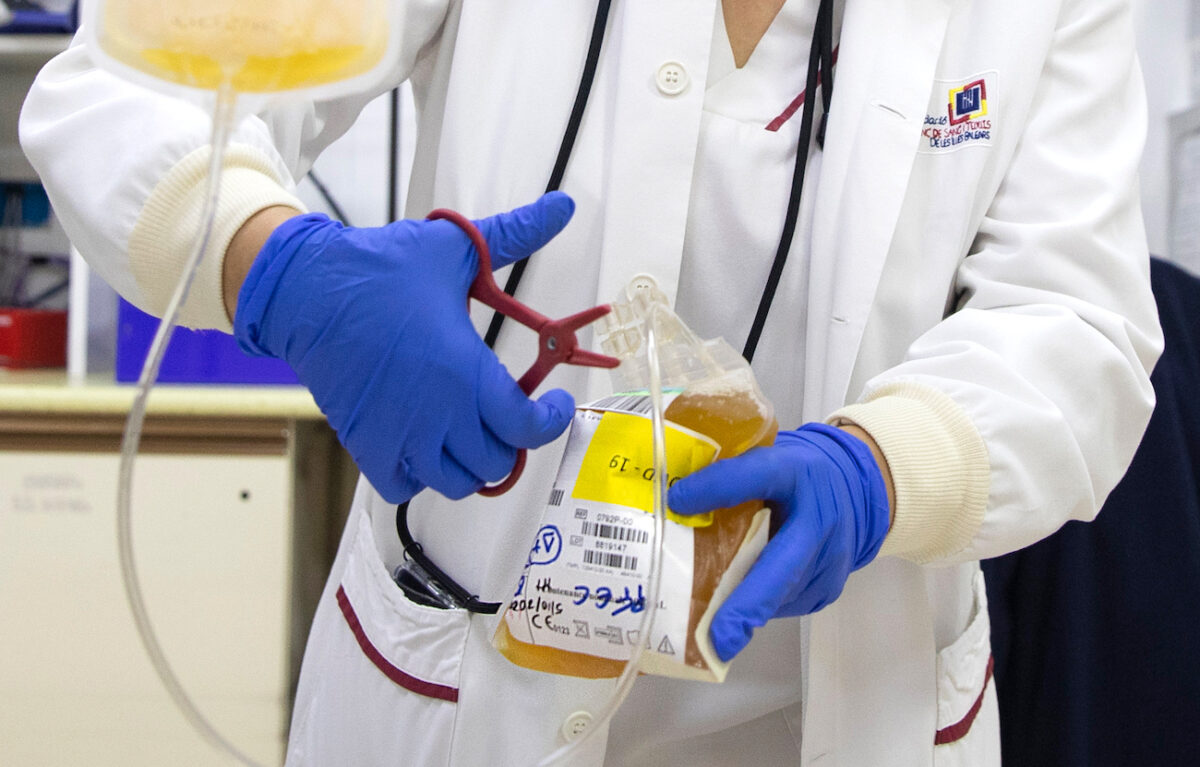
Convalescent plasma, a treatment for COVID-19 that has largely faded into the background since the introduction of vaccines, was able to reduce mortality by 10 percent in mechanically ventilated COVID patients suffering from severe respiratory distress syndrome, a new study suggests.
This effect was found to be more pronounced among those who got the antibody-rich plasma during the first 48 hours after being put on mechanical ventilators, according to the paper published Wednesday in The New England Journal of Medicine.
For their study, researchers at the University Hospital Center of Liège, Belgium, randomly assigned patients with COVID–induced ARDS who had been on ventilators for less than five days to receive either plasma of a recovered patient or standard care alone. A total of 475 patients underwent this open-label trial from September 2020 through March 2022, with 237 patients receiving the plasma and the remaining 238 receiving standard care.
Researchers then looked at the mortalities in each group on the 28th day following the treatment. At day 28, 84 patients (35.4 percent) in the convalescent plasma group died, as compared to 107 deaths (45.0 percent) in the standard care group.
Within the convalescent plasma group, the researchers found that those who received treatment 48 hours or less after ventilation were more likely to survive than those who were treated more than 48 hours after ventilation.
Specifically, 56 of the 171 patients (32.7 percent) who got treated early died, whereas 28 of 66 patients (42.4 percent) died after the relatively delayed plasma treatment.
A total of 711 adverse events occurred in this study, including 209 serious adverse events, of which 184 were fatal. The researchers found that patients from the standard care group were more likely than their convalescent plasma counterparts to experience an adverse event (387 vs. 324), a serious adverse event (116 vs. 93) and a fatal adverse event (106 vs. 78), but noted that none of those could be directly attributed to the study treatment.
Notably, the research team said they used plasma with a neutralizing antibody titer of 1:160 on 17.7 percent of those in the convalescent plasma group because of a plasma donor shortage in Belgium. The remaining patients from this group received plasma with an antibody titer of 1:320.
“We used this lower titer owing to a shortage of donors in the early phase of the pandemic, and we accepted it because it still exceeded the titer that has been recommended,” they wrote.
With that said, the researchers didn’t observe any connection between neutralizing antibody titer and mortality in their trial.
The authors did admit to some limitations, such as that the plasma they used was obtained between April 2020 and May 2021, a period when the ancestral virus and its alpha variant were the dominant versions of COVID in their country.
“Their neutralizing antibodies might have been less active against subsequent variants,” they wrote. “However, a difference in treatment effect was not apparent between the periods when the Delta or Omicron BA.1 variants were predominant in Belgium.”
In their paper, the researchers also explained why they deliberately chose to have an open rather than blinded trial.
“We chose this design intentionally, because the use of a placebo would have added an extra fluid volume of 500 ml, which is against the recommended conservative approach when treating ARDS,” they wrote.
“To reduce the risk of bias due to the lack of blinding, we chose a non-subjective primary outcome, death by day 28, that was not likely to be influenced by the knowledge of the trial-group assignment.”
This is the first study to specifically focus on the effect of convalescent plasma treatment on COVID patients with severely compromised lungs, according to Dr. Benoît Misset, head of the intensive care unit at the University Hospital Center of Liège.
“For the first time, we have demonstrated the therapeutic value of convalescent plasma in improving the very poor vital prognosis of these patients,” Dr. Misset said in a press release. “The reduction in mortality, of the order of 10 percent, is particularly noticeable in patients who were given convalescent plasma rapidly after the start of artificial respiratory ventilation.”
The study adds to a list of literature demonstrating the survival benefits of convalescent plasma for the most severe COVID patients. According to a meta analysis published earlier this year, immune-compromised COVID-19 patients were less likely to die if treated with convalescent plasma.
This systematic review, published in JAMA Network Open, included three randomized clinical trials enrolling 1487 participants and five controlled studies. Most studies reported in the analysis used COVID-19 convalescent plasma from unvaccinated donors.