



Health Viewpoints
What if there were an exercise that could reduce the risk of most breast cancers? Here, I cover a theory of mine (yet to be found in medical literature).
A Brief Overview of Breast Cancer Distribution
Breast cancer affects one in every eight women in the United States. Over 54 percent of nearly 500,000 breast cancer patients in one analysis had tumors diagnosed in the upper-outer quadrant of the breast. [1]
In a hemispherical breast, the UO quadrant comprises only 25 percent of the breast volume. In a pendulous breast, that proportion of UO volume compared to total volume is even less, as the bulk of the breast mass in a pendulous breast is below (“inferior to” in anatomical language) the nipple line.
The predominance of breast tumors in the UO quadrant, therefore, defies a random distribution by over 200 percent (54.3 percent / 25 percent).
UO quadrant breast tumors generally have better outcomes than tumors in other areas of the breast. [2] It is possible that worse outcomes are seen with lower and medial breast tumors due to their being in an area that will less likely drain to axillary lymph and more likely drain to the internal mammary lymph chain. [3]
Lymph is one-third of the bodily fluid. It is a one-way circulatory system that collects debris from all over the body (the residuals from normal cell metabolism) into lymph nodes and transports it along lymph chains. Ultimately, this debris is deposited in the thoracic duct and then is taken out with the stool. The breast is a lymphatic dead end, so to speak, and part of the risk of breast cancer may be that the debris of cellular metabolism has a narrow path outward.
The UO quadrant is most likely of all quadrants to drain to the axillary lymph chains, [4] where the lymph flow is more abundant than elsewhere surrounding the breast, draining about 75 percent of breast lymph. The advantage of this is that debris is cleared more reliably and quickly. Movement of the arms pumps lymph and thereby enhances this lymph flow to and through axillary chains rather than internal mammary chains for a more thorough clearance of metabolic wastes. Areas drained by the internal mammary chain, in contrast, have had more progression to later-stage cancers. [5]
Why Are Most Breast Tumors in the Upper Outer Quadrant?
The breast is composed of about 50 percent to 70 percent fat and 30 percent to 50 percent glandular tissue. [6] That ratio is about 50-50 before menopause, and then after menopause, glandular tissue is gradually replaced by fatty tissue. The predominance of breast cancer in the UO quadrant has been attributed to the high density of glandular tissue in this area, and the glandular tissue develops and proliferates under the influence of hormones secreted by the ovaries, [7] predominantly estrogen, but also prolactin during pregnancy, with somewhat less influence by progesterone. Glandular tissue is where most breast cancers arise.
However, toxic chemical residues enter into and remain in that tissue. This includes carcinogenic compounds in underarm deodorants, antiperspirants, or other cosmetics commonly used in that area, [8] which may be involved in the high incidence of breast cancer.
Parabens have been used in deodorants to suppress the growth of fungi, yeast, and bacteria. [9] Paraben compounds have been found intact in both normal and cancerous breast tissue [10] and have shown estrogenic effects on breast tissue. [11]
Aluminum and its salts are common ingredients in antiperspirant products. These compounds have been shown to alter estrogen action on tissues, as do other metals in the metalloestrogen category. [12]
Where Does Exercise Come In?
The largest surface of breast tissue, the interior (deep) side, overlays and contacts the pectoralis major muscle, which is more than 100 centimeters squared in the adult woman or somewhat larger than the palm of the hand. Pectoralis major and minor muscle tissue is thickest behind (deep to) the UO quadrant of the breast. Breast tissue and pectoral muscle are separated only by a thin 0.3-millimeter layer of pectoral fascia, so there is considerable surface area for interaction, as I will discuss below.
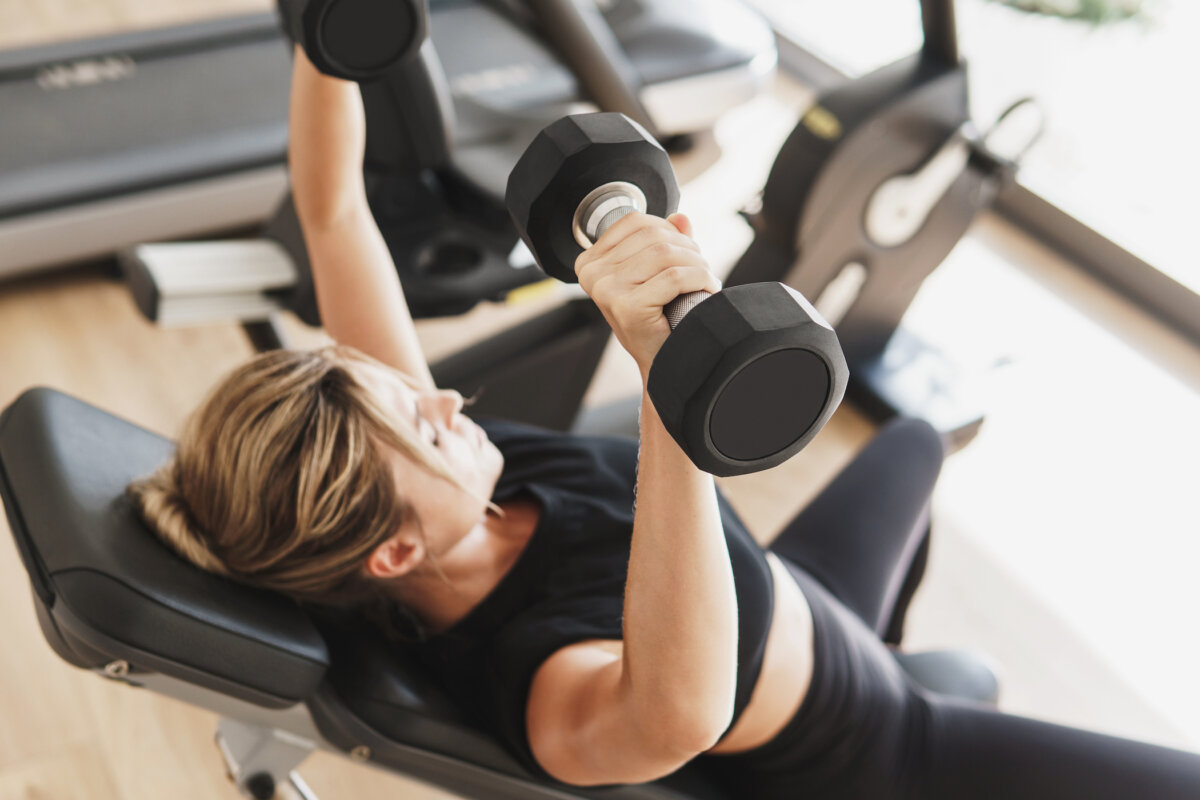
Chest flies, cable chest pulls, and, to a lesser extent, bench presses, and pushups, all work the pectoralis muscles.
Exertion of muscles produces lactic acid. This lactic acid, along with the physical stress of exercise, is followed by a soreness sensation in the muscles used, especially over the next day or two. First, the lactic acid clears, and then the muscles undergo repair, regeneration, and even proliferation, as the muscles become bigger and stronger.
Exercise may reduce the risk of death from breast cancer, especially in women with hormone-receptive tumors. [13] One meta-analysis examined 16 studies that found a significant reduction in early-stage breast cancer from exercise. [14] Any exercise at all has been found to be beneficial against breast cancer, even with as little as an hour per week of walking. Benefits were regardless of type of exercise, intensity, or menopausal status. [15] The effect of exercise against breast cancer was shown in a meta-analysis of 42,602 women to beneficially impact survival whether the exercise was done before or after diagnosis. A linear dose-response was shown, in which the more physical activity events, the more survival. [14] The correlation was so strong across all studies that irrefutable causation was established between exercise and breast cancer survival.
Lactic Acid Benefit Against Cancer
Nobel Prize biochemist Otto Warburg showed that cancerous cells are able to quickly convert an excess amount of sugar into lactate (lactic acid). It has been observed since Warburg’s time that sugar fuels cancer growth and is its primary fuel, and PET imaging makes use of this fact. [16] The conversion of sugar to lactate (lactic acid) is the body’s way of disposing of a sudden and large amount of sugar, such as from a soda or dessert, in a way that helps prevent a hyperglycemic crisis. Senior research scientist Stephanie Seneff of MIT calls this quickly converting a large amount of sugar to lactate the “cancer machine.” Cancer arises as an (undesirable) solution to a more immediately urgent problem of intolerably—even dangerously—high levels of dietary sugar.
Lactate or lactic acid has been observed to seep into nearby tissues. [17]
Stop a Chemical Reaction by Adding End Product
This principle is also well-known in pharmacology. Just as orally dosed estrogen (hormone replacement therapy) has been seen to reduce the body’s own estrogen production, so, too, are the effects of lactic acid production through physical activity expected to inhibit lactic acid production by other means—in this case, by cancerous activity.
This is our goal with the cancer machine: to slow it down to an extent in which continued cancer cell survival is no longer viable or to make it stop altogether.
Breast cancer is by far the most common cancer in women. At my natural cancer clinic of 17 years, it is by far the most common cancer among new patients. In the case of any cancer, the chemical reaction is sugar into lactate. Exercise also produces lactate in the muscle, but without producing cancer. Exercise is known to reduce or inhibit cancer. Pectoral muscle exercises produce lactic acid, which then seeps into nearby tissue, which, in turn, adds an end product to the cancer chemical reaction of sugar to lactate. This then inhibits or stops cancer’s chemical function and thus stops cancer. Therefore, I believe pectoral exercises are a strategy to reduce breast cancer incidence, severity, and risk.
My Theory
Pectoral exercises add lactate adjacent to breast tissue, which, by Le Chatelier’s Principle, places a biochemical obstacle in the cancer machine. This results in depriving cancer of a reason to exist (at least in that area), particularly in the upper outer quadrants but also throughout the deep breast tissue.
Starting Pectoral Exercises
Chest flies are often done starting with 5-pound weights, one in each hand, while lying face up, bringing the hands apart, and then raising them to meet in the middle. The elbows are kept somewhat bent, and the motions are done smoothly and slowly. Anywhere from 10 to 20 repetitions are done at a time. Weight is often increased with time to 10 or 15 pounds in each hand. Rest days are often incorporated, and exercises are usually done once or twice per week. A sore sensation can be expected the following day in these muscles while the lactic acid buildup and microtears of muscle tissue are repaired.
The purpose of these exercises is to add an end product to an unwanted chemical reaction: glucose to pyruvate to lactate (which is the cancer machine), in order to give cancer no more reason to exist, at least not in the breasts.
Reposted from Colleen Huber’s Substack
◇ References
[1] Y Han, J Moore, et al. Do breast quadrants explain racial disparities in breast cancer outcomes? Aug 27 2019. Cancer Causes Control. https://www.ncbi.nlm.nih.gov/pmc/articles/PMC6924513/
[2] D Gaffney, A Tsodikov et al. Diminished survival in patients with inner versus out quadrant breast cancers. Feb 1 2003. J Clin Oncol. 21 (3). 467-72. https://pubmed.ncbi.nlm.nih.gov/12560437/
[3] K Shahar, T Buchholz, et al. Lower and central tumor location correlates with lymphoscintigrphy drainage to the internal mammary chain lymph nodes in breast carcinoma. Feb 22 2005. Cancer. 103 (7). 1323-1329. https://acsjournals.onlinelibrary.wiley.com/doi/10.1002/cncr.20914
[4] S Estourgie, O Nieweg, et al. Lymphatic drainage patters from the breast. Feb 2004. Annals of Surgery. 239 (2). 232-237. https://www.ncbi.nlm.nih.gov/pmc/articles/PMC1356216/
[5] S Estourgie, P Tanis, et al. Should the hunt for internal mammary chain sentinel nodes begin? An evaluation of 150 breast cancer patients. Oct 2003. Ann. Surg. Oncol. 10 (8). 935-941. https://pubmed.ncbi.nlm.nih.gov/14527914/
[6] T Nelson, L Cerviño, et al. Classification of breast computed tomography data. Mar 2008. Med Phys. 35 (3). 1078-1086. https://www.ncbi.nlm.nih.gov/pmc/articles/PMC2706664/
[7] C Briskin, B O’Malley. Hormone action in the mammary gland. Dec 2010. Cold Spring Harb Perspect. Biol. 2 (12). https://www.ncbi.nlm.nih.gov/pmc/articles/PMC2982168/
[8] P Darbre. Underarm cosmetics and breast cancer. J Appl Toxicol. Mar-Apr 2003. 23 (2): 89-95. https://pubmed.ncbi.nlm.nih.gov/12666152/
[9] Penn Medicine. Is deodorant harmful for your health? June 2019. Univ. Penn. https://www.pennmedicine.org/updates/blogs/health-and-wellness/2019/june/deodorant
[10] P Darbre, A Aljarrah, et al. Concentrations of parabens in human breast tumours. Jan Feb 2004. J Appl. Toxicol. 24 (1): 5-13. https://pubmed.ncbi.nlm.nih.gov/14745841/
[11] P Harvey, D Everett. Significance of the detection of esters of p-hydroxybenzoic acid (parabens) in human breast tumours. Jan 8 2004. J Appl Toxicol. 24 (1). 1-4. https://analyticalsciencejournals.onlinelibrary.wiley.com/doi/10.1002/jat.957
[12] P Darbre. Aluminium, antiperspirants and breast cancer. Sept 2005. J Inorg Biochem. 99 (9). 1912-1919. https://www.sciencedirect.com/science/article/abs/pii/S0162013405001613
[13] M Holmes, W Chen, et al. Physical activity and survival after breast cancer diagnosis. 2005. JAMA 293. 2479-2486. https://jamanetwork.com/journals/jama/fullarticle/200955
[14] D Schmid, M Leitzmann. Association between physical activity and mortality among breast cancer and colorectal cancer survivors: a systematic review and meta-analysis 2014. Ann Oncol. 25. 1293-1311. https://www.annalsofoncology.org/article/S0923-7534(19)36684-0/fulltext
[15] F Bianchini, R Kaaks, et al. Weight control and physical activity in cancer prevention. February 21 2022. Obesity Reviews. 3 (1). 5-8. https://onlinelibrary.wiley.com/doi/abs/10.1046/j.1467-789X.2002.00046.x
[16] C Huber. Cancer patients’ use of sweeteners: a 7-year controlled study. 2014. Int J Cancer Res Molec Mech. https://sciforschenonline.org/journals/cancer-research/IJCRMM-2-127.php
[17] G Brooks. The science and translation of lactate shuttle theory. Apr 3 2018. Cell Metabolism. 27 (4). 757-785. https://www.cell.com/cell-metabolism/fulltext/S1550-4131(18)30186-4
Views expressed in this article are the opinions of the author and do not necessarily reflect the views of The Epoch Times. Epoch Health welcomes professional discussion and friendly debate. To submit an opinion piece, please follow these guidelines and submit through our form here.