



A cabal of publishers has turned the world of academic research upside down. Five mammoth companies now control over half the publication of peer-reviewed journal articles, fueling a $1 billion oligopoly astride academia and influencing the science seen by scholars and the public.
This powerful group prioritizes pumping out research quantity over ensuring quality, with scientists having to fork over hefty sums just for the honor of being published, according to a new study by renowned academics in Canada and Germany, published on MIT Press Direct.
Top Publishers Charge Over $2,500 Per Paper
“Since the early 2010s, over half of all peer-reviewed journal articles have been published by a few for-profit companies that control the majority of scholarly publishing and contribute to an oligopolistic market structure,” the author wrote.
Springer Nature, a German–British academic publishing company, generated the highest revenue from open-access publication fees between 2015 and 2018, according to the study.
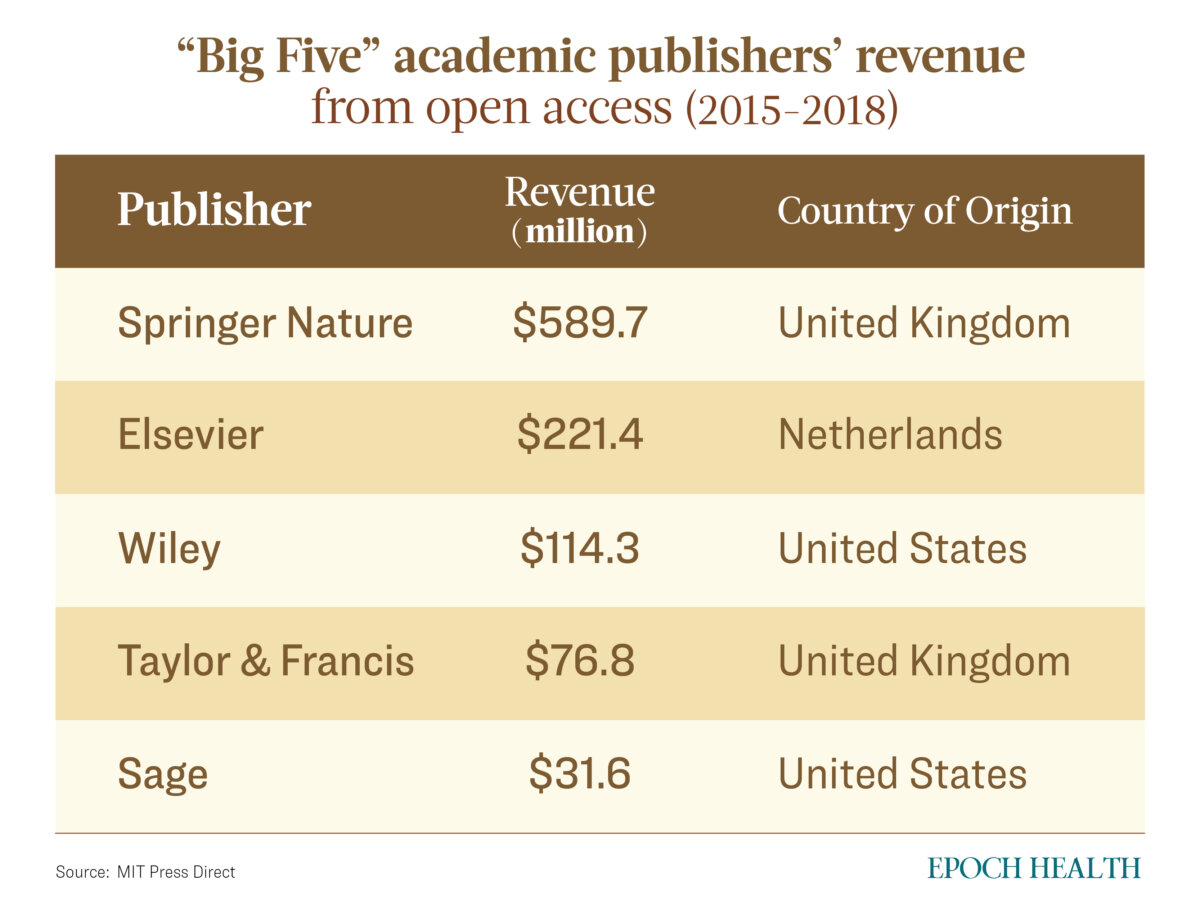
These lucrative fees, officially termed “article processing charges,” can exceed $2,500 per published study. Authors or their institutions shoulder this cost for the privilege of open-access publication.
Two of Springer Nature’s journals—Scientific Reports and Nature Communications—accounted for much of the publisher’s bounty, netting $105.1 million and $71.1 million, respectively.
In total, the study estimates authors globally paid these five prominent publishers over $1 billion in publication fees from 2015 to 2018, demonstrating how a handful of commercial players dominate academic publishing and reap immense profits from author-side charges.
The True Cost of Open Access
The research team sought to analyze the five major for-profit publishers controlling academic publishing to quantify open-access revenue, according to Stefanie Haustein, who has a postdoctoral degree in information science and is a co-author of the study. Open access allows free public access to scholarly articles. The hard data proved eye-opening.
The biggest problem is that “all of these big publishers are shareholder companies purely driven by profit,” Ms. Haustein said. She then quoted a book titled “Data Cartels“: “Even though Elsevier is the largest publisher of academic research, it’s not obligated to focus on publishing the best science for the public good. So it doesn’t. Instead, Elsevier focuses on crunching academic researchers’ data in new ways to make money off the research process.”
Currently, open-access fees merely reflect authors’ ability to pay, not publishing costs, she added. Initially meant to increase accessibility, open access now excludes less-funded researchers.
Ms. Haustein advocates for a not-for-profit “diamond open-access” model, allowing free author publication subsidized by academic institutions and groups. “We need to stop large companies reaping profits of 30 percent and higher,” she said. With recent European backing, such alternative infrastructure could sustain open access without publisher profiteering barring academic contribution.
Destructive Feedback Loop
These five publishers, it appears, have a strong financial incentive to continually publish as much content as possible, even if it lacks quality.
A recent study published in Social Science & Medicine, which is part of Elsevier, demonstrates this pattern. For years, low-quality scientific publications have been a major concern. As Daniel Sarewitz, co-founder and co-director of the Consortium for Science, Policy, and Outcomes, wrote in 2016, poor research, obligations to cite previous work, and pressure to constantly publish fuel a “destructive feedback loop.” Scientists, he added, “must publish less.”
A June article in El País, one of the largest newspapers in Spain, exposed how researchers face immense pressure to frequently publish as career advancements and funding hinge on volume-based performance assessments. This aligns with scientific research showing quality suffering for quantity under unyielding publication demands.
The Root of the Problem
Academics publish with major for-profit publishers because those journals are pivotal in the academic reward system, Ms. Haustein said. “In order to land a job or obtain funding in academia,” she added, “most still value publishing in prestigious high-impact journals, which tend to be the ones that are controlled by the big-five academic publishers.”
While not the first critique of open access, earlier ones, like a 2017 paper from Banaras Hindu University, charted its transition in scholarly publishing—from a domain of universities and academics to one dominated by commercial interests seeking profits.
Similarly, a recent Empire State University analysis identified common criticisms of open access, including exorbitant author fees that exclude less-funded researchers. Additionally, it discussed the rise of predatory open-access journals of dubious quality that tarnish the model’s legitimacy.
Peter Boghossian, a philosophy professor known for his critical stance on academia, has been sounding the alarm on the crisis within the scientific community for many years. The “Big 5” dilemma reflects a larger legitimacy crisis across institutions.
“People no longer trust once venerable institutions because our institutions are no longer discharging their primary mission,” he said. “Instead, they have been co-opted by a morally fashionable ideology.”
In this case, perhaps, the ideology of profit over principle.