



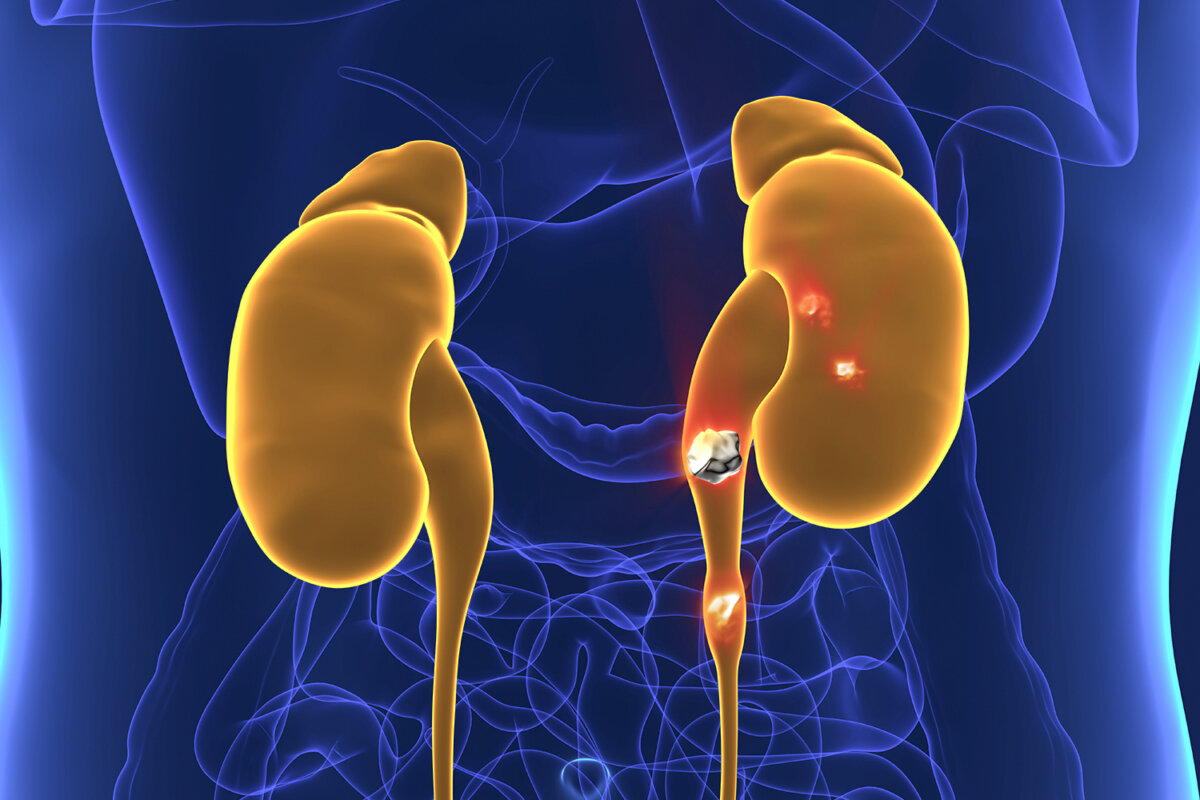
A recent University of California–Los Angeles study has uncovered bacteria hiding inside the most common type of kidney stone.
The unexpected discovery challenges decades of scientific thinking about how these painful stones form.
“This breakthrough challenges the long‑held assumption that these stones develop solely through chemical and physical processes, and instead shows that bacteria can reside inside stones and may actively contribute to their formation,” senior study coauthor Dr. Kymora Scotland, assistant professor of urology at the UCLA David Geffen School of Medicine, said in a statement.
She emphasized that this discovery “opens the door” to new therapeutic strategies that target the microbial environment of kidney stones.
Bacteria an Essential Part of Kidney Stones
The research team found that bacteria aren’t just present in the stones—they’re an integral part of their architecture. Using electron and fluorescence microscopy, Scotland and her colleagues identified live bacteria and bacterial layers, called biofilms, embedded within the crystals.
Kidney stones start forming when urine becomes concentrated, causing crystals to grow in the urine. These crystals become stones when they become large enough that they can’t be washed out with normal urine flow. Previously, only one rare stone type was known to contain bacteria.
Calcium oxalate stones, which make up nearly 80 percent of kidney stone cases, were not thought to contain bacteria until now.
When researchers used a staining method to examine common kidney stones for DNA, they found fluorescent bands of DNA that lit up in regular stripes, marking bacterial layers.
Researchers speculate that bacteria may be helping these stones grow. Instead of kidney stones forming through crystals mineralizing on their own, bacteria may help build up layers of kidney stones.
“We found a new mechanism of stone formation that may help to explain why these stones are so common,” Scotland said in the statement. “These results may also help to explain the connections between recurrent urinary tract infections and recurrent kidney stone formation, and provides insights on potential future treatment for these conditions.”
Between 7 percent and 28 percent of people with kidney stone disease have a concurrent urinary tract infection.
The clinical implications are not fully understood, but the discovery supports a novel prevention strategy to reduce stone formation and growth, Dr. Michael Zell, a board-certified urologist at University Hospitals and associate clinical professor of urology at Case Western Reserve University, who was not involved in the study, told The Epoch Times.
“Most stones have been thought to form due to what is known as the supersaturation model, leading to crystallization and aggregation,” he said. “This study suggests some stones contain a previously unrecognized bacterial component that may be a nidus [focus of infection] for stone formation.”
The discovery suggests that there may be a role for targeting the kidney’s local microbiome to reduce stone formation and growth, according to Zell.
How to Reduce Your Risk
The occurrence of kidney stones has increased worldwide, with the most recent data showing that one in 11 people will develop a kidney stone in their lifetime.
Risk factors include family history, metabolic syndrome—including prediabetes—and low fluid intake.
There are five main types of kidney stones, according to Dr. George Ellis, a urologic surgeon in Orlando who was not involved in the study:
- Calcium oxalate stones, which are the most common
- Calcium phosphate stones
- Struvite stones, which are associated with infection
- Uric acid stones, which form in acidic urine
- Cystine stones, which are rare
“Multiple stone types can develop either simultaneously or during a lifetime,” Ellis told The Epoch Times. “Treatment of these stones varies based on their chemical composition. Some can be treated with medication, or may require surgery.”
Current preventive measures also exist, including drinking more water, taking antibiotics (for struvite stones), or using medications that target the underlying cause of stone formation, Ellis said. Citrate is commonly used to treat calcium oxalate stones by preventing calcium from binding to oxalate in the urine.
However, he said, the recent findings suggest a possible additional treatment option: antibiotics similar to those used to treat struvite stones.
Scotland and her team plan to conduct further studies to better understand how bacteria interact with calcium-based stones and why some patients are more prone to recurring stones.
“Our multi-institutional team is currently performing studies to determine how bacteria and calcium-based kidney stones interact,” Scotland said in the statement. “We want to understand exactly what makes some patients particularly susceptible to recurrent stone formation, and what it is about these particular species of bacteria that allows them to [initiate the formation of] these stones.”