



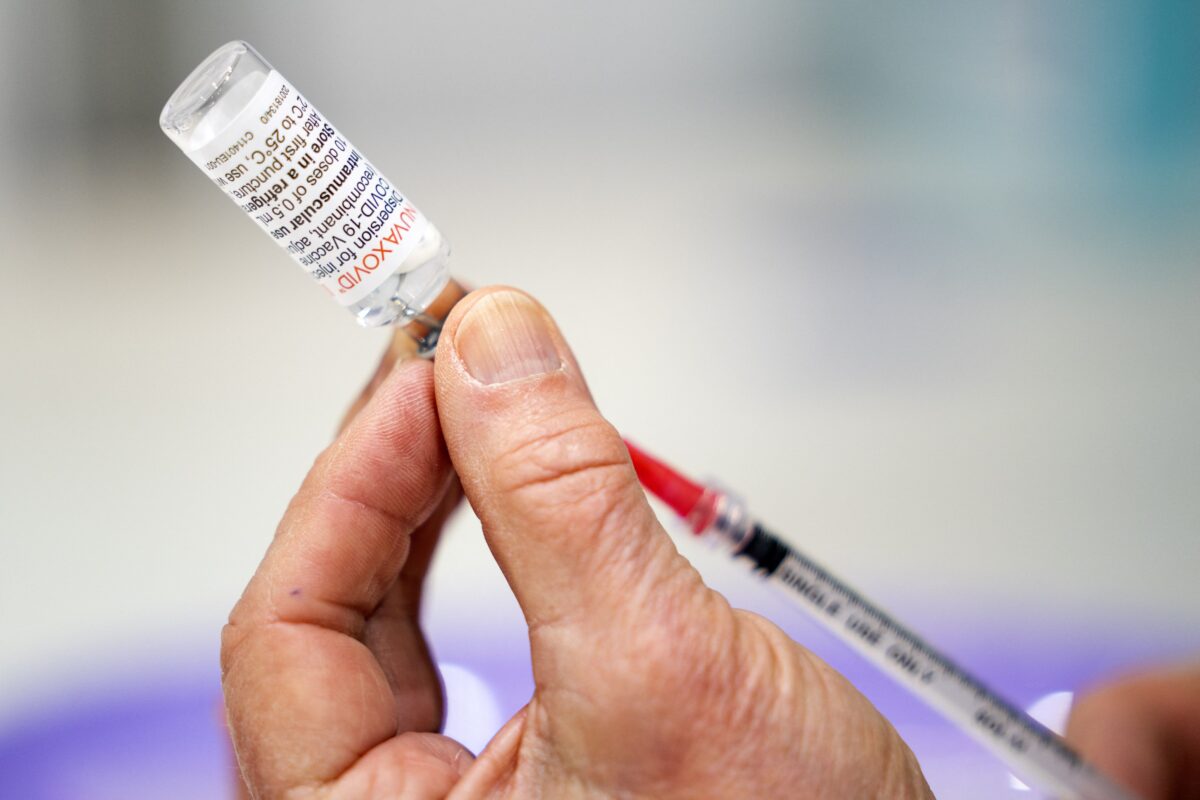
Novavax’s vaccine provided little protection against COVID-19 infection, according to a new study.
Two weeks after the second dose of the two-dose primary series, the effectiveness against infection was just 31 percent, researchers in Italy estimated.
The estimated effectiveness waned over time, fitting the pattern seen with many COVID-19 vaccines.
When factoring in the time since vaccination, people started from zero to 29 days after a second dose with 41 percent protection against infection. That protection dipped to 39 percent between 30 and 59 days after vaccination, and to 21 percent from 60 to 89 days. It was pegged at 28 percent beyond 89 days. No estimates were provided for protection beyond 120 days.
Protection against symptomatic infection was estimated to be higher.
That shielding was estimated to start from zero to 29 days after a second dose at 48 percent. It dipped at one point to 44 percent before settling at 55 percent beyond 89 days after vaccination.
The study was published by the American Medical Association.
Researchers used a reference group of vaccinated people instead of unvaccinated people, who are typically used.
The baseline effectiveness estimates were drawn from people who were vaccinated three to 10 days prior with one dose.
Researchers said they “assum[ed] that the risk of infection in the first 14 days after first-dose administration was similar to that of unvaccinated individuals, according to information from the trial that led to the authorization of NVX-CoV2373 and using a methodological approach previously reported in other studies.”
But Dr. Harvey Risch, professor emeritus of epidemiology at the Yale School of Public Health, said that the method was flawed because studies have found the risk of infection is actually higher in the days following vaccination with the Pfizer or Moderna mRNA vaccines. Novavax’s vaccine is a protein-based shot.
“Studies of the mRNA vaccines provide evidence that risk of SARS-CoV-2 infection is elevated in the 10-14 days after each vaccine dose. Such elevation in the present study would artifactually increase the calculated (but still admittedly low) efficacy of the vaccine,” Dr. Risch, who was not involved in the research, told The Epoch Times via email.
“The authors would need to demonstrate that the infection rates during these post-vaccination intervals were empirically similar to infection rates in unvaccinated people of similar ages in the geographic areas of the study over the study follow-up period in order for the vaccine efficacy estimates shown here to be taken seriously,” Dr. Risch added.
Dr. Alberto Mateo-Urdiales, with the Department of Infectious Diseases at Istituto Superiore di Sanità in Rome and one of the authors, did not respond to a request for comment. Neither did Novavax.
Researchers said in the study that using a vaccinated reference group “helps to avoid biases arising from unknown or unmeasured differences in risk behavior between the vaccinated and the unvaccinated.”
Limitations of the paper include the lack of estimates beyond 120 days and an inability to estimate protection against hospitalization or death due to low numbers of such events among the study population.
Researchers did not report any conflicts of interest. The study was supported by funding from the European Union.
More on Research
A single dose of Novavax’s vaccine, the researchers estimated, provided even worse protection.
They estimated protection against infection at 23 percent and against symptomatic infection at 31 percent.
The researchers also looked at estimates using a baseline drawn from people who had a first dose zero to 14 days prior.
Those estimates were lower for the fully vaccinated than when using the baseline of three to 10 days, or those who completed a primary series.
Against infections, the estimates started at 29 percent before dipping as low as 5 percent.
Against symptomatic infections, the estimates started at 34 percent before dropping as low as 28 percent.
Overall, using the other baseline, the protection against infection was estimated at 17 percent, and the protection against symptomatic infection was estimated at 35 percent.
Researchers analyzed vaccination data from the Italian National Vaccination Registry and testing data from a national surveillance system. They linked the data to end up with a vaccinated population of 20,903 people who received two doses of Novavax’s vaccine between Feb. 28, 2022, and Sept. 4, 2022. The median age was 52. People were followed until Sept. 25, 2022.
Exclusions included people with a past COVID-19 infection and people who received one or more shots of another vaccine.
The research came after the U.S. Food and Drug Administration authorized an updated formulation for Novavax’s vaccine.
U.S. regulators relied on data from previous versions of the company’s shot. Those trials found effectiveness against symptomatic infection as high as 90 percent.
That data indicates the vaccine will be effective against new variants, the agency said. Novavax’s first shot targeted older variants, while the updated shot targets XBB.1.5, an Omicron subvariant that has largely been displaced in the United States.
“Novavax’s authorization today means people will now have the choice of a protein-based non-MRNA option to help protect themselves against COVID-19,” John Jacobs, president and CEO of Novavax, said in a statement.