



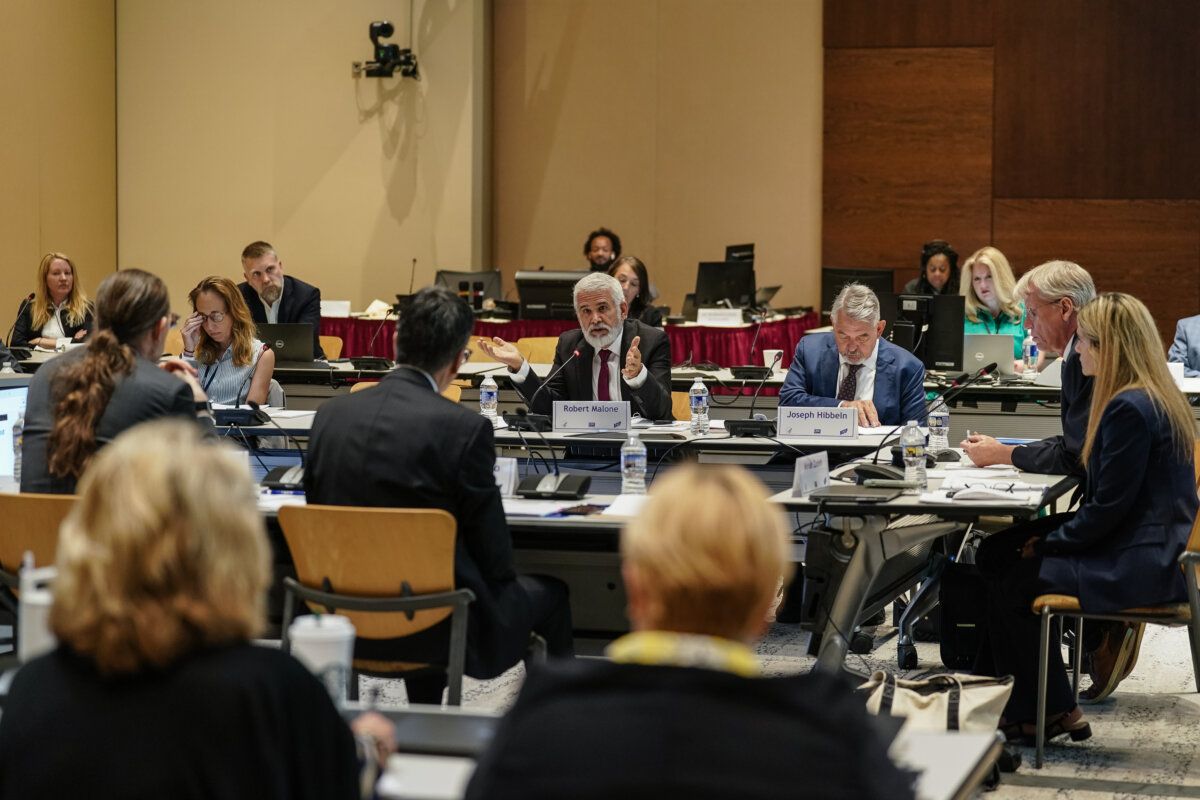
A government advisory panel in a split vote on June 26 advised the Centers for Disease Control and Prevention to recommend an antibody against respiratory syncytial virus (RSV) for many infants younger than 8 months of age.
In the first vote from the Advisory Committee on Immunization Practices (ACIP) since it was remade by Health Secretary Robert F. Kennedy Jr., a majority of members said they favor making an antibody made by Merck called clesrovimab available to all infants, regardless of underlying health.
Martin Kulldorff and Drs. Joseph Hibbeln, Robert Malone, Cody Meissner, and James Pagano voted yes.
The vote means that, if the advice is adopted, the CDC will recommend receipt of an antibody to infants younger than 8 months of age whose mothers did not receive an RSV vaccination while pregnant.
Retsef Levi and Vicky Pebsworth voted no.
Levi expressed concerns about safety data, including an interim analysis from an ongoing phase 4 clinical trial that reported eight deaths among infants who received the antibody, versus four deaths among infants who received another product.
Levi said that he is a father of six and was trying to imagine himself as a young parent.
If he had a baby with underlying issues, he said, he would likely take it to get an antibody against RSV, given the harm the virus can cause.
On the other hand, he said, “I think most parents that have a healthy baby would be concerned to use a new product against a disease that has turned out in the past to be quite tricky against immunization and vaccination.”
Monoclonal antibodies have been referred to as passive immunization.
Meissner, who worked with the ACIP workgroup studying the product, responded to Levi.
“If I were your pediatrician, I would strongly recommend that either your wife receive the RSV vaccine, or a monoclonal antibody at birth” for the infant, he said.
A representative from Merck told members ahead of the vote that all deaths among infants in the trial were deemed by investigators as unrelated to clesrovimab.
ACIP in April, in a 14–0 vote, with one member abstaining, recommended that the CDC expand the availability of RSV vaccines to adults aged 50 to 59 with at least one risk factor. Kennedy in June dismissed all the members and named eight replacements.
The Food and Drug Administration approved clesrovimab earlier this year. The CDC decides which populations should receive approved products.
Another antibody, known as Beyfortus and made by Sanofi, was recommended in 2023 by the CDC for infants. Shortages of the antibody subsequently developed.
Pebsworth asked before the vote about the safety of administering clesrovimab at the same time as vaccines, given the childhood immunization schedule calls for multiple shots in a baby’s first months of life. Dr. Matthew Daley, with Kaiser Permanente Colorado, said that data from the CDC’s Vaccine Safety Datalink system with Beyfortus indicated concomitant administration is safe.
Advisers in a second vote unanimously advised the CDC to add clesrovimab to the Vaccines for Children Program, which covers the cost of vaccines for children from poorer families, or about half of all children in the United States.
Meissner said the second vote was “very important to ensure equity in our country so that all children have access to these monoclonal antibodies.”
RSV typically causes mild, cold-like symptoms, but can cause severe problems, primarily in infants and older individuals.
RSV vaccination is currently recommended for all adults aged 75 and older, as well as adults aged 60 to 74 who have a condition such as chronic lung disease that the CDC says places them at increased risk of severe illness if they contract RSV.
The CDC also recommends RSV vaccination for pregnant women.
Approximately 57 percent of infants were protected through maternal vaccination or receipt of a monoclonal antibody through March, according to a CDC presentation.
Maternal vaccine effectiveness against RSV-associated hospitalization among infants was pegged at 79 percent in one CDC system and 70 percent in another, CDC officials said this week. Antibody effectiveness was estimated to be about 80 percent in the initial months after receipt.
Patterns of RSV-related infant hospitalization went down in the fall of 2024 into early 2025, compared to previous virus seasons during which no products were available, Adam MacNeil with the CDC said during the meeting, suggesting that vaccination and Beyfortus “had an impact on protecting the infant group at the population level.”
Sylvia Xu contributed to this report.