



Health Viewpoints
Cancer patients have come into our clinic after trying fenbendazole to shrink tumors, with disappointment that it had not worked and upheaval in their liver labs.
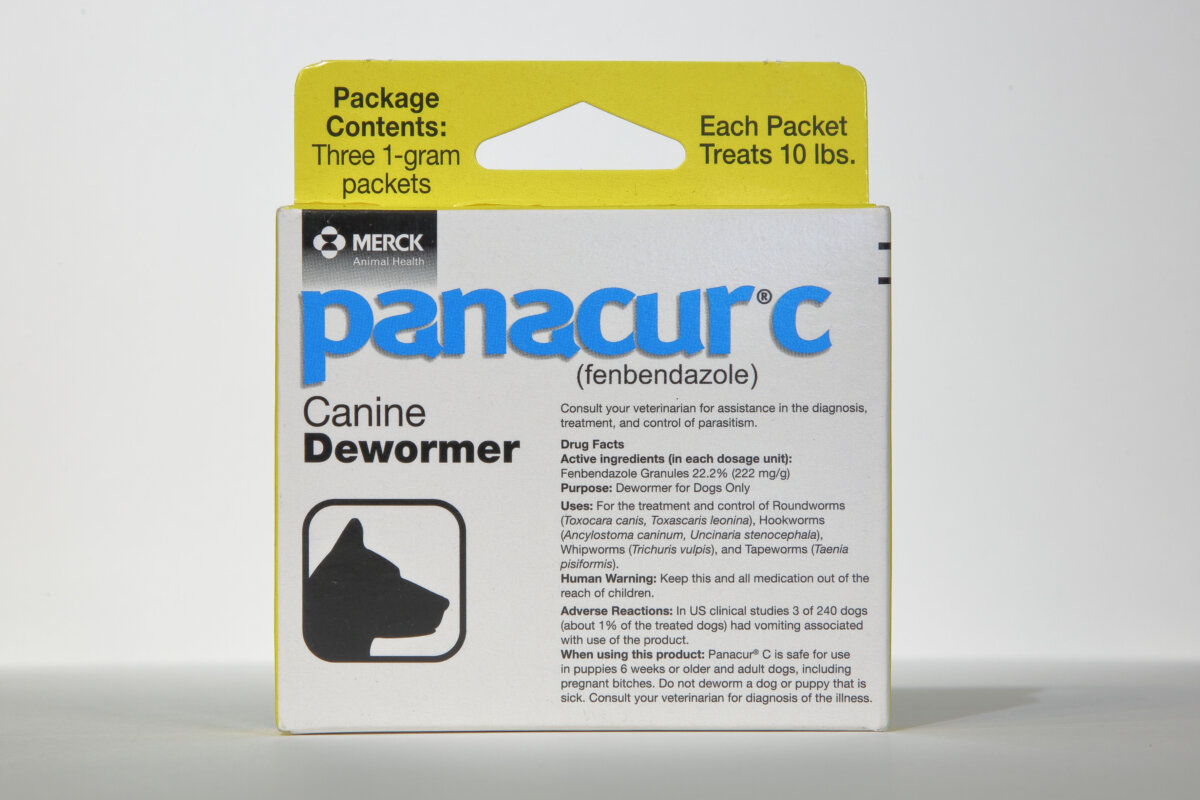
Fenbendazole, known on the street as “dog de-wormer for cancer,” has been very effectively advertised for its anti-cancer effects. Social media has let this urban legend loose to the point where it gained high hopes and very high-profile attention. Even Joe Rogan, the world’s biggest broadcaster by far, recently touted it on a podcast for shrinking tumors.
But there are some misconceptions that Mr. Rogan missed, not having worked at a natural cancer clinic as I have for the past 17 years.
First, fenbendazole is an OTC veterinary medicine and is, therefore, subject to much looser quality control than human pharmaceuticals. Because this is being sold by third-party vendors on the internet, that are fenbendazole’s biggest cheerleaders, it is your guess as to what exactly is in the capsules you receive, and at what concentration, after exactly what kind of quality control.
What has been missing from the public conversation is that fenbendazole’s mechanism against cancer is in the context of a weak chemotherapy drug. Like vinblastine and vincristine, it disrupts microtubule formation and microtubule activity. [1] The drug’s target is the molecule tubulin, which helps provide the skeletal foundation of microtubules necessary in cell replication—for both normal and cancer cells. Cancers reproduce faster than normal tissue, so a long-standing chemotherapy strategy has been to create damage to cellular replication, which injures cancer cells earlier than it injures normal cells, but it does injure all kinds of cells.
At first, fenbendazole’s effect on disrupting the cell cycle looked effective in the lab mice. [2] But then, sacrificing mice to examine tumors is not quite the same as taking responsibility for human cancer patients to get well, to survive their cancers, and to stay in remission long-term.
The two big problems we have seen at my clinic with previous fenbendazole use are the following:
- For a cancer patient to rely on anything—especially one monomolecular approach—that does not work effectively against cancer wastes valuable time. Doing that attacks cancer only strongly enough to make it mutate. Just like giving too little antibiotic to bacteria, giving a mild chemotherapy like fenbendazole to a cancer patient buys time for the tumor to become resilient to this gentle nudge. The net result usually strengthens existing cancer. It is one of the worst strategies against cancer, from what I have seen over the years.
- The other problem is that fenbendazole has not had positive effects on the liver. There are reports in the medical literature of people damaging their livers with this drug, driving the liver enzymes alanine transaminase (ALT) and aspartate aminotransferase (AST) into the several-hundred range but then reversing the alarming liver blood labs on discontinuation of the drug. [3] ALT and AST are each supposed to be less than 40, and around the teens or 20s would be nice. This new liver toxicity may even have the potential to promote new cancer in the liver. [4] The liver toxicity of another hepatotoxicant, acetaminophen, is increased when fenbendazole is added. [5] Besides liver damage, this study of fenbendazole use with pigeons showed multiple organ damage. [6]
At my clinic, people have arrived after trying a number of different conventional and/or natural, including dietary, approaches to cancer.
Here is a summary of liver blood labs in a patient who had chosen to take fenbendazole after a recent public discussion of using it to attempt to fight cancer.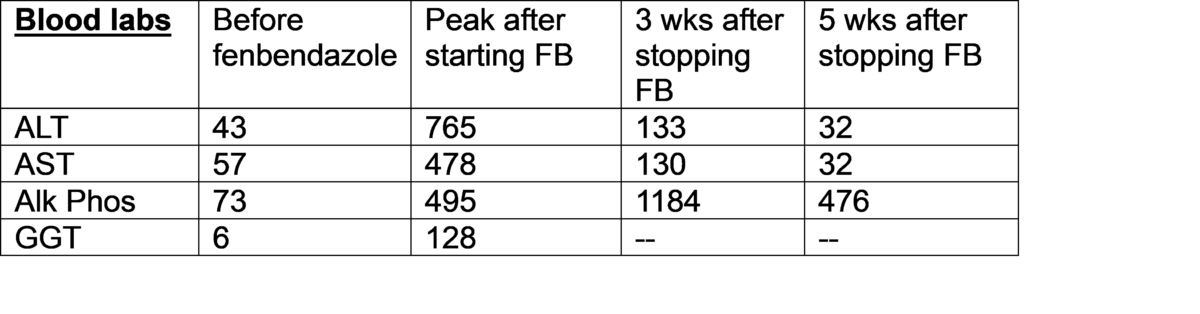
It should come as no surprise that fenbendazole and its metabolites mildly poison the liver. The related drugs mebendazole and albendazole are already known to have metabolites that are toxic to human livers [7] by means of cholestatic liver injury [8] and in dose-dependent effects. [9] This is why the usual course of mebendazole treatment in humans is only two days.
There are many effective substances against cancer and various routes to defeat it. Here are over 700 peer-reviewed studies on natural substances with effect against each of the major cancers.
Why not consider those treatments primarily that do not have a toxic profile before considering ones with little confirmed effect and are known to have a concerning toxic profile?
Joe Rogan did get ivermectin for COVID exactly right [10] and has likely thereby saved countless lives due to his enormous reach. But I must disagree with him regarding the use of fenbendazole for cancer on the basis of its unimpressive track record and, primarily, the tenet of “first do no harm.”
Reposted from Colleen Huber’s Substack
◇ References
[1] N Dogra, A Kumar, et al. Fenbendazole acts as a moderate microtubule estabilizing agent ad causes cancer cell death by modulating multiple cellular pathways. May 2018. Nature. https://www.nature.com/articles/s41598-018-30158-6
[2] W Wang, D Kong, et al. New Benzimidazole-2-urea derivates as tubulin inhibitors. Feb 2014. Bioorg Med Chem Letters. 24(17). https://www.sciencedirect.com/science/article/abs/pii/S0960894X14007598?via%3Dihub
[3] T Yamaguchi, J Shimizu, et al. Drug-induced liver injury in a patient with non-small cell lung cancer after the self-administration of fenbendazole based on social media information. Jun 2021. Case Rep Oncol. https://www.ncbi.nlm.nih.gov/pmc/articles/PMC8255718/
[4] T Shoda, H Onodera, et al. Liver tumor promoting effects of fenbendazole in rats. Sep 1999. Toxicol. Pathol. 27 (5). https://pubmed.ncbi.nlm.nih.gov/10528635/
[5] C Gardner, V Mishin, et al. Exacerbation of acetaminophen hepatotoxicity by the antihelminbthic drug fenbendazole. Feb 2012. Toxicol. Sci. 125(2). https://pubmed.ncbi.nlm.nih.gov/22048645/
[6] A Gonzalo, R Schwiebert, et al. Mortality associated with fenbendazole administration in pigeons (Columba livia) Nov 2006. J Am Assoc Lab Anim Sci. 45(6). https://pubmed.ncbi.nlm.nih.gov/17089995/
[7] G Choi, H Yang, et al. Acture drug-induced hepatitis caused by albendazole. Oct 2008. J Korean Med Sci. 23 (5). https://www.ncbi.nlm.nih.gov/pmc/articles/PMC2580005/
[8] Anthelmintic agents, in Liver Tox: Clinical and research information on drug-induced liver injury. 2012. National Inst Diabetes, Dig and Kidney Dis. https://www.ncbi.nlm.nih.gov/books/NBK548602/
[9] F Higa, K Kitsukawa, et al. Cytotoxicity of mebendazole against established cell lines from the human, rat and mouse liver. 1992. Arch. Toxicol. 66 (3). https://pubmed.ncbi.nlm.nih.gov/1497489/
[10] COVID-19 Treatment Research. Ivermectin for COVID-19: 230 ivermectin COVID-19 studies, 177 peer-reviewed, 99 comparing treatment and control groups. https://c19ivm.org/
Views expressed in this article are the opinions of the author and do not necessarily reflect the views of The Epoch Times. Epoch Health welcomes professional discussion and friendly debate. To submit an opinion piece, please follow these guidelines and submit through our form here.